The Only Money Plan You Should Follow For The Next 3 Months
In a Nutshell
Follow this exact sequence for 90 days: track spending for one week, build a $1,000 emergency fund, get any 401k match, pay off credit card debt at 20%+ interest, then reach 3-6 months of essential expenses in savings. Only after these steps should you invest in low-cost index funds like VTI. Simultaneously work on income increases through raises or side work, since cutting expenses alone has limits.
These notes were generated by AI and may contain inaccuracies.
If starting over financially tomorrow with no savings or investments, the approach focuses on five specific priorities over the next 90 days rather than immediately buying stocks, seeking the next Bitcoin or Nvidia, or purchasing rental property with borrowed money.
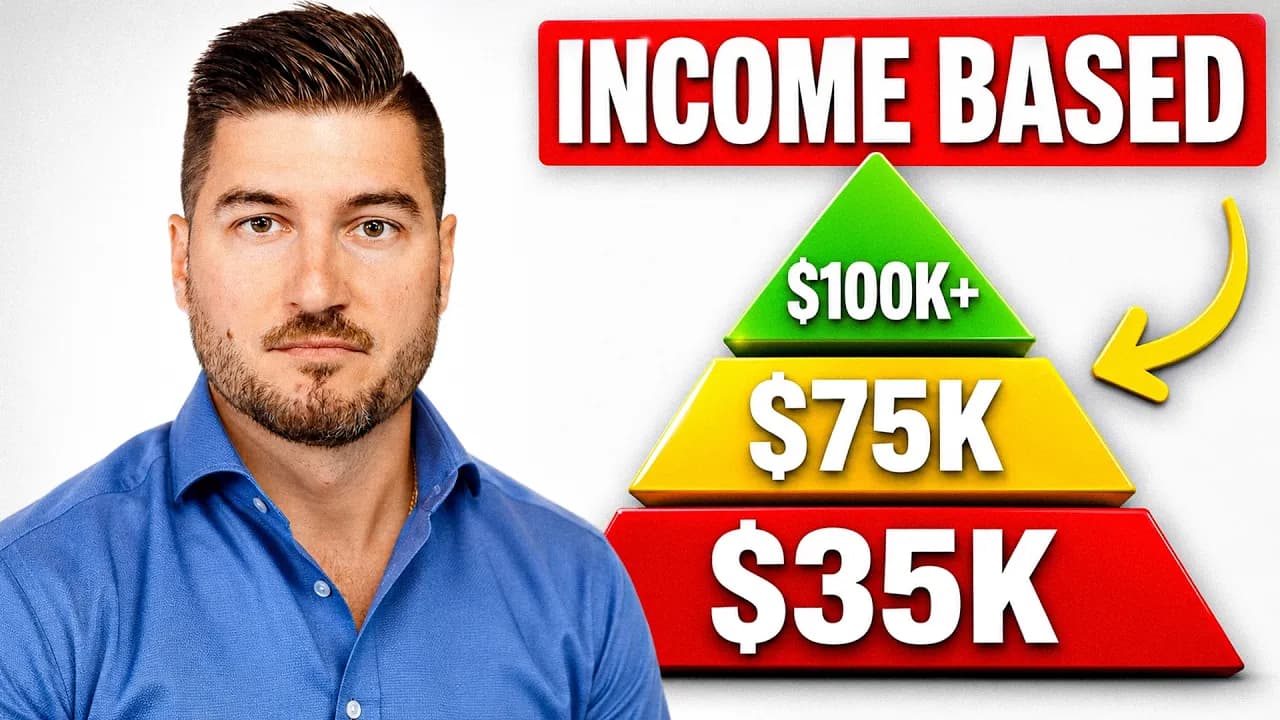
One of the biggest mistakes people make with money is doing the right things but in the wrong order. This includes investing while paying 25% interest on credit cards, buying houses and cars barely affordable, or making $100,000 a year yet having nothing left over.
Using a person making $75,000 a year as an example, the breakdown shows: after taxes, health insurance, and other deductions, they bring home roughly $4,700 per month. Their monthly spending includes $1,600 on housing, $700 on transportation, $600 on food, $400 on fun, $400 on debt, and $600 on miscellaneous items, totaling $4,300 in expenses and leaving $400 remaining.
The first priority is figuring out exactly where money stands financially by pulling up the last three months of bank statements and credit card statements. This can be done using Excel, Google Sheets, an app, or AI. Expenses that don't happen every month must be accounted for, such as car insurance at $1,200 every six months, which averages to $200 per month.
The goal by the end of the first week is knowing exactly how much is brought home, how much is spent, and how much is actually kept. This process is similar to counting calories, where tracking for a month provides enough understanding to estimate without daily detailed tracking.
The next step is determining financial runway, which is how long survival would be possible if income stopped tomorrow. Essential spending (housing, groceries, insurance, transportation, and minimum debt payments) must be distinguished from total spending.
For the example person spending $4,300 per month with $3,500 in essential expenses: $2,000 in savings covers less than one month, $10,000 provides roughly three months, and $21,000 provides six months. Having cash provides options and breathing room for unexpected expenses like furnace repairs, avoiding credit card debt.
If starting with nothing, the goal is getting at least $1,000 into an emergency fund, then moving toward three to six months of essential expenses in an FDIC insured high yield savings account or short-term Treasury ETF like ESG.
An important exception exists for expensive debt. Someone with $5,000 in credit card debt at 24% interest who invests $500 monthly in the S&P 500 is paying roughly $100 in interest during the first month alone while hoping to earn 7-8% annually on investments with no guarantee. Paying off credit card debt provides a guaranteed 24% rate of return.
However, a 401k match is different. A 50% or 100% guaranteed match of free 401k money beats even 24% credit card payoff. The recommended order is: pay bills, build small emergency fund, get the match, pay off high interest rate debt, reach 3-6 months target emergency fund, then invest.
If not enough money remains after tracking to accomplish these priorities, expenses must be examined. The $3 coffee won't make or break net worth, but major expenses like housing, transportation, and food matter most.
Choosing a $1,600 apartment versus $1,900 costs $300 more monthly, which equals $3,600 annually or $18,000 over five years. For someone making $75,000 with a $900 car payment, transportation consumes 28% of take-home pay, exceeding $15,000 annually including insurance and maintenance.
Simple changes can free up money without lifestyle changes: shopping around for car insurance might save $50 monthly ($600 yearly), eating out can be reduced by $150 monthly, unnecessary spending can be cut by $100, and phone plans can potentially save $100 monthly. These adjustments could free up $400 monthly, creating $800 total available when combined with the original $400 surplus.
Once extra money is freed up, automation ensures consistent action. With $800 remaining monthly while paying off credit card debt and building an emergency fund, $600 might go toward credit card debt and $200 toward savings. If paid twice monthly, that's $300 toward debt and $100 toward savings from each paycheck.
Once credit card debt is paid off, the $600 should be redirected toward building the emergency fund, then eventually toward investing.
For investing, focus on low-cost diversified index funds like VTI for broad US stock market exposure or S&P 500 ETFs. International stocks or bonds might be appropriate depending on age, risk tolerance, and time horizon, but 27 different ETFs and 15 individual stocks aren't needed to get started.
Investing $400 per month for 30 years at an assumed 7% annual return compounded monthly yields roughly $488,000, with $144,000 from contributions and $344,000 from investment growth. Most net worth should be in VTI, keeping expense ratios low and investing consistently through dollar cost averaging.
The final 90-day focus is increasing income because expense cutting has limits. A $5,000 annual raise provides roughly $300 monthly net after taxes, which won't significantly move the needle. Larger raises need justification through documented value added, shown in a brag book containing accomplishments from start date to present.
Job hopping may be necessary, using the same brag book during interviews. Freelancing opportunities include digital work, baking sourdough for farmers markets, growing garlic, selling eggs, or selling flowers. Building income streams on nights and weekends is essential.
The 90-day reset focuses on common sense actions in the right order, similar to going to the gym where knowing what to do prevents wasted effort. The sequence is: track spending, build emergency fund, get employer match, pay high-interest debt, reach 3-6 months expenses in savings, then invest, while simultaneously working to increase income.
Keep Marko - WhiteBoard Finance in your library
Save the videos and channels worth coming back to, and find them again in one place.