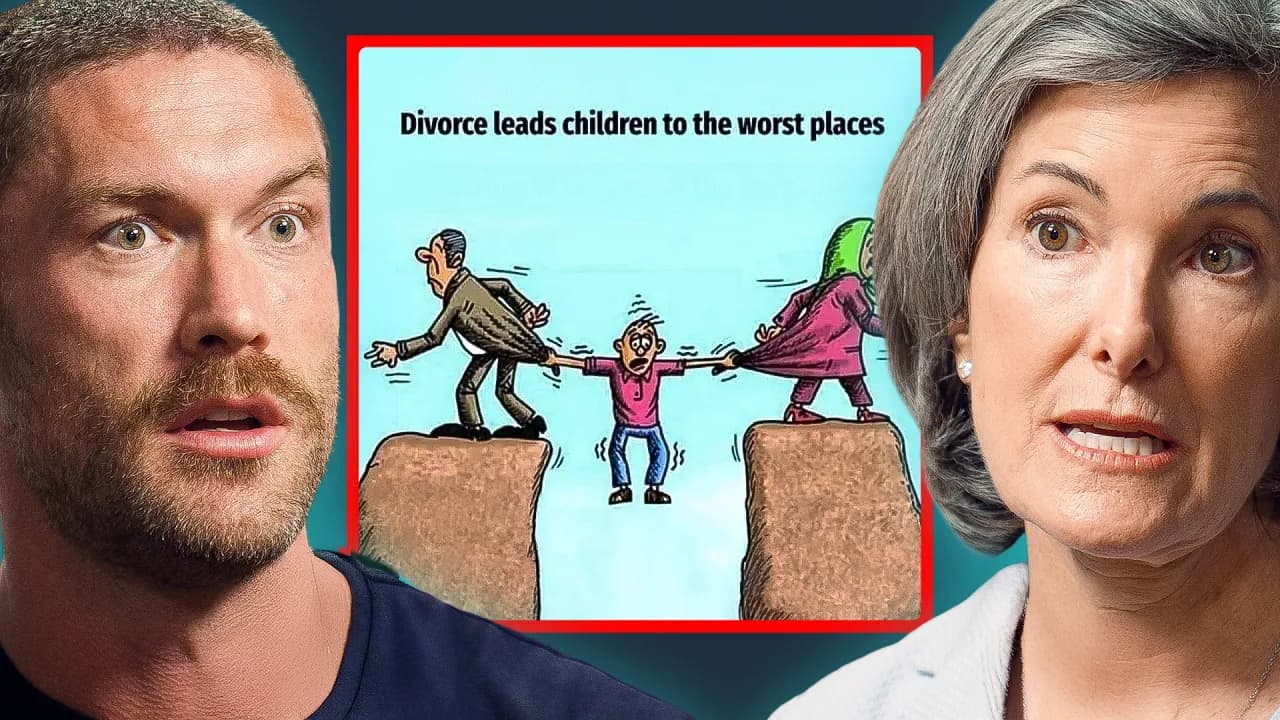
The Permanent Impact of Divorce on Children - Erica Komisar
In a Nutshell
Divorce permanently damages children's emotional security, trust in relationships, and brain development—especially under age 3 (when 85% of the right brain forms and stress overactivates the amygdala, leading to lifelong anxiety, depression, and poor regulation) or during adolescence (9-25, a pruning period of instability)—with boys hit harder due to cortisol sensitivity. Prioritize child-centric approaches: delay divorce until after 3 or in stable windows like 6-11; avoid 50/50 custody splits that traumatize attachment (favor primary mother first 3 years, fathers sacrificing overnights); reject chronic conflict (worse than good divorce), alienation, oversharing, and instability like 2-3-2 schedules—opt for nesting, proximity, daily access, and therapy to process grief (Kubler-Ross stages). Secure attachment demands physical/emotional presence of a primary figure (mother via oxytocin nurturing, skin-to-skin) over daycare's cortisol spikes; societal feminism and work pressures exacerbate mental health crises by ignoring trade-offs, urging sacrifice now for resilient kids later.
These notes were generated by AI and may contain inaccuracies.
Erica Komisar's work is controversial due to inconvenient truths. Her first book emphasized attachment security in the first three years and a mother's presence, misinterpreted as anti-feminist (women shouldn't work). The actual message: importance of a mother or primary attachment figure's physical and emotional presence as much as possible in the first three years. This clashes with societal pressure that everyone should work and no one should raise their own children. Her most recent book on divorce argues against treating children like possessions in 50/50 custody splits.
Divorce universally tests children's emotional security, sense of permanence, and trust in relationships. Judith Wallerstein's book decades ago claimed all divorce is terrible for children, implying stay in unhappy marriages for kids' sake. Recent research shows divorce is not good but can be mitigated; chronic intractable conflict between parents is worse for children's psyches than a good divorce. Ideal: two parents who love, respect, and are affectionate with each other. A good divorce is better than a terrible marriage.
Divorce is not costless: tests security, permanence, resilience. Controversial advice: do not divorce until children are at least 3 years old (unless physical or sexual abuse). First 3 years: greatest brain growth, 85% of right brain grown by age 3. Hold together if possible for stability, security, minimal conflict/stress.
Stress harms children's brains (also adults', but worse for kids). Brain architecture forms in first three years; stress changes it. Amygdala (almond-shaped, primitive brain part) triggers survival mode (fight/flight), releases cortisol. Little stress protects; chronic stress children can't handle alters development, impairing future stress/adversity handling.
Columbia University researcher: stress-regulating part of brain offline first year—mothers wearing/carrying babies buffers stress. Next two years: keep close, introduce stress incrementally. Overexposure before 3 years: overactive amygdala, sets baby in survival mode; that part shrinks/shrivels, ceases functioning for future stress handling.
Adulthood outcomes: person who can't deal with stress, anxious, depressed, poor emotional regulation. Modern epidemic: adults/young adults unable to regulate emotions. Anxiety, depression, attentional issues (ADHD as symptom, not condition) from overexposure to stress—hypervigilant amygdala, chronic fight/flight. Distractibility = fleeing from threat.
Much modern youth mental health problems from dysfunctional upbringings. Little mental illness genetically connected (schizophrenia, bipolar have precursors; none for depression, anxiety, ADHD).
Sensitivity gene: short allele on serotonin receptor (regulates good feelings, excitement). Some babies neurologically sensitive, easily triggered to fight/flight. Signs: cry easily, hard to soothe, clingy, poor sleep, eczema/rashes, sensitive to clothing/smells/sounds.
Sensitive empathic nurturing + consistent physically/emotionally present primary attachment figure (first 1-3 years) neutralizes sensitivity gene—those babies as healthy as non-sensitive ones. Overexposure to stress (separation from primary figure, daycare, disregarding attachment) exacerbates it.
HSPs (highly sensitive people) term concocted but connects to discovered gene. Babies born neurologically fragile, not resilient/tough/stress-handling. Have fourth trimester: 9 months post-birth like marsupials—should be on bodies (pouch analogy).
Even amicable divorce problematic due to 50/50 fairness/gender equality demands. Fathers important differently than mothers. Mothers (birth, breastfeeding, nurturing) usually primary attachment figures. Courts (lacking psychological awareness) split baby 50/50 like King Solomon, traumatizing baby—loses center of universe/security for 'fairness'.
Baby needs mother (primary) more than father first 3 years (doesn't negate father's need). Best outcomes: fathers respect attachment security, prioritize child's needs over own fairness/possession view. King Solomon story: true mother selfless, yields baby.
Divorcing parents in pain, focus on own needs over child's developmental needs. Courts push 50/50 due to 'men/women exactly same' societal movement. But nurturing differs: women produce oxytocin (love hormone)—makes sensitive/empathic nurturers, attuned to baby's distress, moment-to-moment soothing (internalized ~3 years via skin-to-skin).
Fathers' oxytocin: playful/tactile stimulation (tickle, throw up, roughhouse)—builds resilience/separation (but attachment first, then separation; sequencing matters). Fathers' vasopressin: protective-aggressive hormone. Study (England): mother wakes to baby cries, father sleeps; father wakes to rustling leaves (predatorial threat), mother sleeps.
Fathers can be single fathers but must be taught—doesn't come naturally. Instincts ingrained evolutionarily.
Best outcomes: fathers sacrifice overnights/long separations first 3 years—lots of access but no overnights until older. Good for fathers long-term (happy kids = happy parents). Later (school/adolescence), kids (esp. boys) need fathers more—mothers sacrifice then.
Child-centric divorce: parents sacrifice self-orientation, put kids first—kids do better. Complicated custody schedules destabilizing for all.
Alienation: obstacle (physical/emotional) to child loving other parent. Happens in contentious/hostile divorces (rarely amicable; usually one pushes). Pain/hostility → vengeance → alienation: badmouthing, blocking calls/visitation, shutting door if late. Exists with mothers and/or fathers.
Parental alienation is more rare than assumed. Parents need education: children do not ask for divorce, so parents must be selfless if they want children to be well.
Periods of developmental instability include 0-3 years (high brain plasticity, rapid growth, needs security) and adolescence (9-25 years, starts earlier/ends later, up to 27 in young men; period of great pruning). Analogy: 0-3 is growing a garden; adolescence is pruning to produce vegetables. Both are critical periods of plasticity and vulnerability. Worst times to divorce: 0-3 and 9-25, especially 11-14 (middle school: physical development, puberty, social drama, rejection, exclusion, teasing, bullying—most challenging transitional period). More stable periods: 6-11 (ideal window if divorcing) or after 14 (late adolescence). Adolescence divided into early, mid, and late.
Never a good time to divorce, but if you have to, 6-11 or after 14 are better windows.
Developmentally, children are more sensitive at certain times—no one discusses better/worse times to divorce. Myths: better while baby is little (tears attachment security); better when they go to college (fragile transition needing secure tether for individuation—wait until launched at 23+ with friends/job). No good time, but better times exist for children.
11-14 already unstable; divorce destabilizes when stability is needed for security, emotion regulation, attachment (not just 0-3, but throughout childhood, especially separations). Provides unstable base for independence. Can delay development, keep kids regressed/stuck in traumatized state—requires stability to progress.
Divorce is a trauma; book helps reduce/mitigate it, make it least traumatic.
Boys more neurologically sensitive than girls (from utero: more sensitive to cortisol; prone to fight/flight, behavioral/attentional issues, autism—cortisol may trigger autism gene). Girls susceptible in adolescence (hypervigilant to criticism, self-consciousness; social media worst 11-14). Boys affected more overall, but girls very susceptible in adolescence.
Avoid mother stress in pregnancy—cortisol transmitted to baby, affects developing brain (research ongoing). Same for career stress up to birth (work pressures, not wanting to seem fragile/diva). Even low-stress jobs have daily insults (traffic, conflicts, new boss).
US has no federal paid maternity leave; Family Leave Act: unpaid 3 months (can't be fired). State-by-state (e.g., NY: 3 months at minimum wage). Employer-discretionary. Called barbaric/uncivilized—US pays lip service to mental health/families but no 12-18 months paid leave.
Erica more influential in Australia/UK policy than US (Democrats see anti-feminist; Republicans too expensive). Mental health starts from conception (last trimester most susceptible to cortisol). Wish: 18 months paid leave starting pre-birth to lower cortisol, prepare psychologically/emotionally. Women now wound up/guilty/overwhelmed, crash into postpartum depression, on 'shot clock' timer back to work—cortisol affects breast milk (prolactin/estrogen). Phenomenon: mothers not producing enough milk.
Two parents better (different functions; 'heir and spare'—lose one, have another). Nuclear family provides illusion of safe nest/stability for emotional security/healthy development. Divorce disillusioned children before ready, shatters needed illusion of permanence (no true permanence, but healthy defenses/resilience like shock absorbers cope with adversity/optimism).
Children need sense of parents' omnipotence/protectiveness (story: husband's father seemed to know every road). Divorce reveals parents' imperfections/humanity too soon, impermanence of relationships, erodes trust (trouble trusting marriage/connections later—not all).
Book helps: talk right way, treat ex well, collaborate/cooperate/communicate, put children first over fairness/desires—dictates if child sees relationships trustworthy.
Crazy that fairness to parents must be sidelined for child's good.
Children blame themselves via magical thinking (normal in young kids: believe center of universe for security/stability; outgrown later). Example: TV commercial—boy in Darth Vader outfit 'turns off' family car with lightsaber (thinks he did it). If bad thing happens after angry wishes/fantasies (e.g., parent dies after child wished it), child feels responsible.
Common in divorce: children think they caused it, fear parents can leave them too (destroys permanence/trust). Book advises how to talk to disavow illusions, reassure always loved/not responsible.
Similar to attachment wounds replayed in adult relationships or 'work harder to be loved' loop—if caused it, can fix it.
Parents need support (therapy for transitions/traumas) to not 'leak' pain onto children (oversharing loneliness, pain, sex lives; using child as therapist/container). Parents raise kids without burdening.
Children need therapy (safe space beyond parents for feelings)—addresses conflicts/traumas early, prevents carryover to adulthood.
Same as any mourning (Kubler-Ross): disbelief, sadness, anger, acceptance. Divorce = death/grief. Problem if child/parent gets stuck (e.g., decade in anger/sadness/despair; doesn't reach acceptance). Like scratch on LP record.
Jewish tradition: 1 year mourning, then unveil stone/move on—but people hold on, stuck in depression/disbelief/anger.
Children aren't getting to the acceptance stage of grief; they're stuck in one stage or another.
How Parents Should Tell Kids About Divorce
Parents should tell kids together in an emotionally balanced, regulated way. Agree on what to say beforehand. Avoid times of high stress like before major exams, big games, concerts, or holidays (e.g., Christmas, Hanukkah) because those will forever be associated with the divorce. Don't do it on birthdays. Consider doing it on vacation with a week to process, go for walks, and talk, avoiding tethering it to a geographical location like the living room seat where they sat.
Analogy: If neutering a dog, take them to a vet they'll never return to, or a crap holiday destination they'll never want to revisit, and spend a week processing.
Be wise and sensitive; how and where parents tell them will always be remembered.
Never say "I never loved your mother/father," "I wish I'd never married them," or "I wish I'd never met them." This implies the family unit was never secure, the child's perception of attachment was wrong, and they should never have been born—downstream from "I didn't love them" is "we shouldn't have had you."
Even two years later during co-parenting breakdowns, avoid such statements. Children want to know they were born out of love and wanted.
For one-night stands: Say "you were young and it was the illusion of love; you thought you loved the person."
Adopting children is a mitzvah (great blessing), but hard because the child must overcome the trauma that biological parents didn't want them. Adopted children like James (business partner, secure attachment, high self-esteem, great relationships with parents) still need to deal with underlying feelings of "did my parents want me?"
Same for divorce: Children wonder if they're the cause, if parents conceived them out of love, if parents ever loved each other.
Most parents conceive children with love or the perception/illusion of love. Tell children: "We loved each other very much, you were conceived in love and brought into the world in love. Adults sometimes fall out of love, but never fall out of love with their children."
Children have BS meters and detect lies. Don't lie blatantly, but be sensitive and discriminating in truths. Avoid lying or making unkeepable promises out of guilt, as it breaches trust.
Example: If child asks about holidays like Christmas, don't promise "we're still a family" or that nothing changes—divorced families usually don't spend holidays together long-term. Keep as much the same as possible (living situation, school), especially first year, but don't promise the impossible.
Betrayal leading to depression, hostility, belligerence between parents. Treating children as possessions (like splitting a Porsche 50/50). Lying to children, oversharing, alienating from one parent, poor communication/cooperation, focusing on own pain over child's good. Announcing at Christmas.
Cooperation, communication, respect. Dig deep to find respect, admiration, love once shared with ex for the children's sake, even if no longer in love or angry/disappointed.
See children developmentally/age-appropriately. Can't do everything at once (careers, children, divorce). Avoid competition overwhelming child's needs.
Work collaboratively, open communication, respect for co-parent, live close together so children go easily back and forth without flights.
Avoid 2-3-2 custody (two days one parent, three another, etc.)—children hate it, feel like a sack of potatoes, thrown back and forth; drives them crazy. Need stability, especially during school week, primary residence to lay head on same pillow.
First year: Nesting—child stays in home, parents come and go (parents have separate apartment). After, primary residence (controversial, vs. fairness). Old arrangements better: live with one parent (mother/father) weekdays for school/homework stability, weekends with other.
Non-custodial parent can still see child daily: dinners, mock sleepovers, pick up from school, soccer. Maintain routines (e.g., Tuesday pizza night—dad takes out then returns child home).
Children resent instability most (consciously, tell parents). Travel feels destabilizing like being in a band.
Parents should see children every day if possible. Live close (not same building), continue routines like walking to school, soccer. Avoid 2-3-2's all-or-nothing.
Avoid moving out of state—shouldn't be allowed; other parent goes too, or mover gives up custody/comes weekends. Sad cases: taking breastfeeding baby away weekly to another state for caregiver/daycare/grandmother to "possess" child.
If one stay-at-home primary parent (e.g., mother part-time, father full-time/10-hour days/traveling), don't take child from them for daycare/babysitter out of selfishness.
For primary school age (6-8 year old) attached to non-primary parent, grandmother/aunt/babysitter in house fine. But for young babies developing attachment security (foundation of mental health), prioritize baby's needs over parents'—period shouldn't be disrupted. Judges/mediators/attorneys/psychologists often prioritize fairness/parental rights over attachment.
When in pain, people lash out (e.g., stub toe, scream at nearest person) to get support—infantile yelp, regress to infant state. Around children, pull together as adult; child needs you to be the adult.
Parents going through divorce need to improve emotional regulation to be better co-parents. Divorce is an 18- to 23-year contract to prepare the child for the real world. It's a trauma laboratory requiring a support system. Get therapy during divorce to deposit feelings, process conflict, and mourn with someone who understands. Family and close friends can support if supportive, but they often have perspectives and agendas. Therapists provide a safe container without sharing personal views, helping process grief and loss. Avoid offloading feelings on children or making terrible decisions with long-term consequences for their mental health.
Attachment security is both emotional and physical. Infants need skin-to-skin contact to regulate emotions, biological processes, breath, heartbeat, and keep cortisol low. Babies in the Western world cry more because they're separated from mothers, unlike in other cultures where babies are worn on fronts or backs, keeping distress low. Western idea that babies are independent and self-sufficient is perverse.
Growth of narcissism prioritizes individual over relationships and connection. Roots in Industrial Revolution separating families, second wave feminism devaluing mothering, and Me Movement in the 1960s promoting individualism. First wave feminism was pro-maternal. Not Sheryl Sandberg, but Gloria Steinem and later figures. Social movements shifted from family to individualistic, narcissistic approach, contributing to family dissolution. 50% of couples divorce, rifting families and traumatizing children, a key factor in mental health crisis. Society avoids discussing divorce to prevent adult guilt, ignoring children's needs. Adults are fragile, can't discuss staying home early years, giving up career ambitions, or avoiding divorce in first three years.
A little bit of guilt is a healthy thing because it means your ego is functioning.
Guilt signals internal conflict, like pain warns of harm. We're mammals with evolutionary instincts, nurturing hormones, and guilt. Excessive guilt is pathological, but some is needed to examine behavior toward self and others.
Study claiming women did as much or more big game hunting was flawed due to p-value manipulation. Reveals soft bigotry of low expectations for women and implicit valuing of male activities over female ones like gathering and nurturing. Second wave feminists identified with the aggressor: rather than value women's work (caregiving, child-rearing, nursing, teaching), they pursued men's work for power and money. Women's professions are right-brained, irreplaceable in AI age.
In Australia, proposals for 18 months paid leave, family stipends instead of daycare, and income splitting for pensions to recognize caregiving.
Daycare separates babies from primary attachment figures, places in institutional settings with 5:1 to 8:1 ratios, spiking salivary cortisol. Loud, overstimulating, with transient caregivers. Worst caregiving: babies cry uncontrollably; one caregiver can't soothe 5-8 distressed babies. Parents with attachment disorders shut down empathy.
Better alternatives:
- Primary attachment figure (mother or father).
- Kinship bonds (family/extended family).
- Single surrogate caregiver/nanny/babysitter in home.
- Shared caregiver (e.g., California: split cost for 2-3 children in home, with agency, cameras).
John Bowlby, father of attachment theory. Stranger Situation studies since 1960s: mother-baby play, stranger enters, mother leaves, reunion. Measures reactions, interactions. Longitudinal research: insecure attachment at 12 months means 72% insecure at adulthood, linked to depression, anxiety, borderline personality disorder. Supported by neuroscience and epigenetics.
Not genetic inheritance but generational expression or inheritance of acquired characteristics. Genetic sensitivity inherited, but environment from parent's attachment style shapes child's: anxious mother produces anxious baby, avoidant produces avoidant, disorganized/borderline produces same. Predisposition, not predetermination. Early years (0-3) are preconcious, shaping personality like "the room where it happens."
Babies born dysregulated and aggressive, like sailing in a Pacific storm. Primary attachment figure provides skin-to-skin, calm soothing tone, responding to every distress to achieve homeostasis—not flatlining.
Ideal emotional state for babies is like sailing in the Caribbean on a sunny day: manageable waves, pleasant. Cannot achieve this if baby is thrown into daycare, primary caregiver disappears 10 hours a day for work. Babies not learning regulation from the one person meant to teach them. Children enter primary school and adolescence completely dysregulated, leading to mental health crisis.
Aggression is constitutional, something babies are born with. In old days, maternity wards separated babies from mothers for rest: nurses babies didn't recognize smell or voice, couldn't find mother's eyes. John Bowlby got rid of them, studied cultures worldwide, wrote Attachment and Separation. Attachment security critical for baby's emotional regulation.
Even ill babies supposed to lie in with mothers. In maternity wards, 20 babies: some quiet, staring at light; others screaming "pick me the fuck up." Babies born with varying amounts of aggression and energy (constitution: genetic markers, passed down, e.g., extraversion, openness, agreeableness).
Constitution small part of personality; important to embrace child's individual constitution (reticent vs. extroverted, aggression levels). Little boys need to get aggression out physically or through sports; others prefer reading/art. Rest is environmental.
If primary attachment figure not sufficiently available first few years, children develop pathological coping mechanisms: attachment disorders as defenses.
- Avoidant attachment disorder: "Learned helplessness," turn away from care; correlates with depression, difficulty trusting in relationships.
- Anxious attachment disorder: Cling desperately on reunion (anticipation of loss); correlates with anxiety, PTSD.
- Disorganized attachment disorder: Cycle through mechanisms (turn away, cling, slap in rage); associated with borderline personality disorder, emotional volatility.
Kids with strategies survive better, but long-term consequences remain.
Mental health issues stem from attachment disorders, but avoid discussing "the room where it happens" (early caregiving). Questions system valuing careerism, materialism, work over family; pushes women back to workforce, deems stay-home mothers invisible, meaningless.
Modern parents must sacrifice (not forever, but when children need most). Penelope Leach: "If you don't want to care for your children, don't have them."
Caring means being present moment-to-moment to regulate emotions, physically/emotionally throughout childhood (0-3 critical brain development period). Parents are children's emotional digestive system, metabolizing feelings/experiences. Children cannot do this alone.
School is children's "work" (play-based learning). Parents work when children at school. One parent works to provide roof; primary caregiver works during child's school hours.
Advice to new mothers: Sleep when baby sleeps (not dishes, emails, Peloton). Use mother's helper, family; avoid isolation (historically multigenerational living).
Mark Friedeman (controversial): Lost extended family living disastrous; originated from real estate developers creating nursing homes/assisted living ("adolescent living for older people," halls of residence for elderly). Adam Lane Smith: Moving from generational housing scam by mortgage companies to keep poor/alone.
1 in 6 US adults have flattening of occipital lobe (back of head reshaped from lying on floor too much first year; babies meant to be on mother's body). Some kids need helmets.
Take your ambitions and leave them at the door when you have children. For a while.
Value caring for children as most valuable work; doesn't diminish career/skills (no amnesia). Women terrorized into believing they lose everything taking time off.
Metaphor: Driving different routes home (sister Karen in London) – taking time with baby transformative, may lead to different fulfilling work later.
Hidden metrics (sleep quality, peace, relationships, baby connection) traded for observable (car, postcode, salary, job title, social media, bank account). Corporate work illusion of agency/control/flexibility (Stockholm syndrome).
Best: Be own boss or cooperatives (service fields: massage therapists, psychotherapists, speech therapists, attorneys not in big firms, nurses/doctors not in corporate hospitals, tutors teaching on own terms). Control hours, fees; adapt if child sick.
Corporate ruse. Example: Harvard-trained pediatrician back at work after 3 weeks (body not healed).
Parents' advice: Be own boss (or husband's). Not elitist – global examples: baking/artist cooperatives, family businesses (India fruit stand: mom with kids, aunt substitutes).
Divorce high; women afraid to depend on men (told not to depend/trust). Leads to no marriage/children. Secure attachment needed to trust, form teams.
Self-perpetuating: Poor attachment → poor partner choices → neurotic repetition (Freud term; modern: repeating unhealthy behavior patterns).
Personal example: Husband worked hard starting practice/nonprofit; she took time off with each kid, worked minimally (paid mother's helper for 3 kids). Now busier than ever.
He's spending more time skiing, hiking, seeing friends, doing the relationship building that he couldn't do when he was young while building relationships with other mothers. You can do everything in life. You just can't do it all at once.
What do you do if you're scared that the person is going to leave you? If you're always waiting for the penny to drop? We've told women not to trust men. As a result, maybe men have become less trustworthy. It's a vicious cycle. We've told young people not to trust each other. We've told them it's a tentative connection that can break at any time.
Less is being expected of everybody all at the same time. Increasingly, we're seeing female breadwinners as the primary financial contributor.
If a woman is the primary breadwinner, can't the father be the primary caregiver and the mom go to work? Yes, and it's happening more and more. But we have to look at the problems associated with it. We can't just switch it like red for blue and blue for red.
Fathers need to be trained to be sensitive, empathic nurturers. Not all get it quickly, but playful tactile stimulation is important, while sensitive empathic nurturing is more important in the early years. The father who wears the baby skin-to-skin, feeds the baby as if breastfeeding, makes eye contact, left-side cradles, and looks at the baby when feeding with a bottle.
Left-side cradling is right brain to right brain connection. One way to diagnose postpartum depression is handing someone a baby: securely attached mothers grab the baby on the left side. An emotionally healthy mother has a larger left breast when breastfeeding because she feeds primarily on the left side for connection to the baby's right brain.
It's the same research as looking at the other person's left eye in NLP—right brain to right brain connection, flipped because we cross over. Hand a baby to a friend; cradling on the right side indicates more disconnection.
Teach fathers: cradle on the left side, look at the baby, don't look at your phone if crying. Reflect emotions: "Oh, sweetheart, I see you're crying." Do what mothers do. Be a mother, not a father, in those early years.
When mothers give up that role, they don't give up the longing for it, causing competitiveness and envy. If a mother comes home and the baby reaches for the father, it triggers gender switching issues, which are evolutionary. Fathers often feel the same when babies reach for mothers.
Most full-time working mothers still say they are the primary attachment figure, unlike John Bowlby's view that it's the person with the baby majority of the day, soothing from moment to moment in distress.
Bottom two quintiles of male earners and top quintile of female earners are mating: bottom 40% of men and top 20% of women in female-primary-breadwinner dynamics. This predicts future increases.
Is it emasculating to men? There's an inverse relationship between oxytocin and testosterone: higher testosterone lowers oxytocin, higher oxytocin lowers testosterone. Higher nurturing investment lowers mating investment—a mammalian concept.
A father nurturing all day may lack desire when mother comes home. Men have to perform; women don't. This impacts sexual performance and desire.
One issue: she had a baby and doesn't want sex because nurturing and mating behaviors don't happen simultaneously. Female lions nurturing cubs reject mating males to protect cubs.
We're mammals; instincts relate to mammalian behavior. In couples where husband lost interest: wife comes home with high testosterone from work, wants to mate, but he's nurturing-focused and uninterested.
Suzanne Venker (Phyllis Schlafly's niece) writes books on how gender reversal affects marital relationships.
People throw shade at men for not wanting to give up privilege or being intimidated by successful women. But do women want a partner in a papoose bottle-feeding all day? > There are no solutions, only trade-offs. (Thomas Sowell)
Unless socioeconomic reversal repedestrializes family-building and motherhood as aspirational with financial safeguards, this will increase. Denial of trade-offs is the issue. Are we willing to talk about them?
Fred Rogers: When feelings are mentionable, they're manageable.
Sweeping under the carpet because it's not politically correct makes issues hide deeply, causing divorce or mental health problems. We must discuss trade-offs.
Children need both physical and emotional presence. Quality time is a ruse to justify parental absence. Children need consistent presence from their primary trusted person to process emotions—you are their digestive system.
You can be physically present but emotionally checked out (depressed, distracted, resentful). But it's not possible to be emotionally present without physical presence. Magical thinking that quality time compensates is baloney.
Children can't be put on a shelf like a vase until you return.
Children can tell the difference between a mother who is there but doesn't want to be, and one who wants to be. They sense a mother who has to work but shares her pain authentically.
A single factory-working mother of three who comes home at 6 PM and stays, telling kids "I wanted to be with you today, not at work," conveys authenticity. Children know when parents don't want to be with them.
Women preparing for motherhood feel nervous about losing status, prestige, independence. Post-kids, they feel second-class while others progress. Mothers envy those who had kids during COVID, feeling no FOMO.
Motherhood—the transcendent experience—is tarnished by shame, guilt, necessity. Even with flexibility, mothers accelerate back to work fearing falling behind, unable to enjoy it. Kids notice.
Life has become a race. Where are we racing? Value of life is lost if success means career, money, status. Higher purpose: to love and be loved.
Teach children to love and be loved as life's meaning. On deathbed (Aristotle's question), no regrets about fame, money, beach houses—it's about loved ones and legacy of love. > May their memory be a blessing. (Judaism)
ericakomisar.com
- Being There (zero to three)
- Chicken Little: The Sky Isn't Falling (raising resilient adolescents)
- A Parent's Guide to Divorce (raising emotionally resilient children through separation)
Keep Chris Williamson in your library
Save the videos and channels worth coming back to, and find them again in one place.