The Shocking Truth About Citrulline: New Evidence
In a Nutshell
Citrulline lowers systolic blood pressure by about 4 points on average and improves arterial function, but lacks evidence for preventing heart attacks or strokes. A 2020 crossover trial in type 2 diabetics found 6 g daily reduced fasting glucose 14 points, A1C 0.3 points, and post-challenge glucose 32 points at 60 minutes versus placebo. The core message is that citrulline offers modest metabolic and vascular benefits as a supplement, but it cannot replace lifestyle changes or proven medical care, and soft plaque—not calcium scores—drives actual heart attack risk.
These notes were generated by AI and may contain inaccuracies.
Citrulline is discussed in relation to blood pressure, type 2 diabetes, weightlifting, and erectile dysfunction. The core question posed is what citrulline actually does based on evidence, making the decision of whether to take it easier to answer.
Citrulline appears in pre-workout supplements, men's vitality products, and heart health supplements marketed as a natural form of Viagra and nitric oxide booster. A retracted paper claiming citrulline drops systolic blood pressure by 7.5 points remains cited on supplement websites despite the 2019 retraction.
Citrulline is an amino acid found primarily in the lining of the small intestine. The name derives from the Latin word for watermelon, where it was first discovered. The kidneys convert citrulline into arginine, which the arterial lining uses to produce nitric oxide. Nitric oxide relaxes artery walls and prevents the lining from becoming sticky, an early function lost in arterial plaque development.
Oral arginine undergoes significant breakdown by the gut and liver before reaching useful destinations, and large doses cause stomach upset. Citrulline bypasses this breakdown and gets converted to arginine in the kidney, making it more effective as a supplement.
A 2023 review of 12 randomized trials involving 360 postmenopausal women found blood pressure decreased in some trials and arterial lining function improved in some trials. Blood sugar and insulin showed no movement. Most participants lacked diagnosed diabetes, though metabolic disease was likely underdiagnosed since fasting glucose was the only metabolic measure used.
Fifteen pooled trials in middle-aged and older adults showed citrulline lowers systolic pressure by approximately four points. This reduction is comparable to taurine effects and less than first-line blood pressure medications.
No human trials have tested citrulline against heart attacks, strokes, or deaths. No studies have imaged plaque before and after citrulline use. Citrulline acts upstream of plaque on blood pressure and arterial lining function but lacks proof of preventing heart attacks.
A November 2020 study published in people with diagnosed type 2 diabetes, average age 62, administered six grams of citrulline daily versus placebo for one month. After an eight-week washout period, participants crossed over to the alternate treatment.
The trial measured flow-mediated dilation, femoral ankle pulse wave velocity, aortic systolic pressure, fasting glucose, and A1C. Flow-mediated dilation improved compared to placebo. Fasting glucose decreased 14 points and A1C fell 0.3 points.
Participants received a 75-gram glucose challenge. In the citrulline group, blood sugar rose initially but dropped 32 points at 60 minutes. The placebo group showed blood sugar rising 22 points at one hour after the glucose challenge.
A 75-year-old caller diagnosed with type 2 diabetes in 1980 (46 years duration) has maintained control through keto diet for six years. The caller reports no diabetes symptoms despite daily gym attendance and calcium score of 1003. Discussion emphasizes that discovering diabetes in one's 30s represents early detection, and strict carbohydrate avoidance prevents arterial damage from elevated blood sugar and insulin.
Calcium scores reflect calcified plaque, which is stable and carries minimal additional risk compared to no plaque. Soft plaque, which poses greater danger, does not appear on calcium scoring. For a 75-year-old with long-standing diabetes managed through keto diet and exercise, soft plaque levels are likely minimal.
For stage 1, 2, and 3 kidney disease, citrulline protein intake does not require the strict limitations needed in stage 4 and 5 kidney failure. No specific studies compare citrulline effects on kidney function, though theoretically citrulline's arterial dilation effects might improve kidney blood flow if arterial tightness contributes to kidney dysfunction.
Preventive medicine is not popular in healthcare because big food, big pharma, big medical care, and hospitals are motivated by money. When organizations or individuals follow the money, they tend to do what generates revenue rather than focus on prevention.
There are not enough preventive medicine doctors because most doctors choose specialties like thoracic surgery and learn prevention on the side. Internal medicine doctors are supposed to do a lot of the groundwork in preventive medicine because they have one-on-one relationships with patients, but they are overloaded with bureaucratic processes and end up prescribing pills instead of looking at the bigger picture and educating the public.
The speaker's transition to prevention began 40 years ago while working in the emergency department at Crestview Community Hospital, a small community hospital in western Florida. After seeing another 50-something-year-old man with a heart attack, the realization came that too much damage had already been done. The decision was made that if making money was the goal, it was the wrong reason to practice medicine. The speaker also noted that running codes in the ER is exciting, but if excitement is the motivation, that is not the right approach. Patients need information, and this was the first epiphany about going into prevention.
Over 20 to 30 years later, when YouTube became available and the algorithm could find people interested in topics like staying healthy, the channel was created. The algorithm knows how to find people interested in health topics even when most people consider the subject boring.
Carl from Georgia called in to share his experience. After listening to a previous video about citrulline, he decided to try it. Within a week, his calf muscle pain improved significantly. He had not initially realized the supplement could lower blood pressure, but his blood pressure did drop. His doctor had to reduce his captopril dosage from 20 mg to 10 mg. He experienced low blood pressure for three to four days and was staggering around the house.
Carl had open heart bypass surgery in 2003. After the surgery, he was put on pre-diabetic medicine including Metformin and other medications. He has been on those medications since 2003. In the last five years, he developed neuropathy in his feet. His doctor told him there is no cure. He has tried everything recommended by doctors on YouTube but has not found anything that helps his neuropathy. He is 76 years old and continues his activities despite the pain.
The caller raised two major themes: neuropathy and whether it can be reversed, and citrulline improving symptoms of poor blood flow in the legs. The ankle brachial index (ABI) test is mentioned as a way to determine if plaque in the legs or pelvis is causing circulation problems.
Carl's story of improved leg symptoms from citrulline is acknowledged. While studies have not shown this magnitude of effect reliably, individual variation means some people experience pronounced benefits. The fact that his blood pressure dropped 10 points adds credibility to his account. One study showed a 7.5-point drop, while multiple studies show an average drop of 4 points. Studies report averages, but individuals experience different results. Some participants have changes of 1 point, others 8 or 10 points.
The channel has been one of the bigger channels discussing plaque reversal early on. The claim that plaque in arteries cannot be reversed is stated to be untrue. The speaker has two patients who have had reversal of neuropathy. Both had major turnarounds. One patient was obese with significant diabetes, made major lifestyle changes, and lost over 100 pounds. Four years later, he has significantly less pain in his feet. The neuropathy did not reverse entirely or immediately, but improvement occurred.
To support health and address the underlying cause of neuropathy:
- Test, do not guess. The most common reason for neuropathy is metabolic disease and diabetes. Get the right testing.
- Cut glycemic carbs.
- Add intensity to exercise if not already exercising intensely.
- Remove roadblocks including proper sleep, proper stress management, and good social connections.
- Supplements and medications come after the above steps.
Free access to Dr. Brewer AI is offered for six months to Carl. The AI answers health questions regarding heart health, arterial plaque, cholesterol, blood sugar, and heart attack risk. For those seeking medical advice for specific situations, PrepMed Health can be contacted at 859-721-1141. Dr. Brewer is licensed in all 50 states and is the only preventive medicine doctor known to be licensed across all states. Patients can also work with practitioners trained by Dr. Brewer or health coaches for lifestyle guidance.
Thomas from New York called in. He had a calcium score test showing 570 in one artery. He has been taking raw garlic for about a month for a blood clot in his right lower leg. His regular doctor put him on medication for about a month. His cardiologist suggested a stress test, which he passed. He asked about foods to avoid and next steps for preventive medicine.
The assumption that passing a stress test means plaque is stable is dangerous. Tim Russert had a stress test and died of a heart attack a few weeks later. The speaker wrote a book called Prevention Myths explaining why stress tests cannot predict heart attacks and what actually does predict them. Patients often come with positive calcium scores, some over 1,000, 2,000, 3,000, or even 4,000.
A calcium score is a better test than a stress test. Stress tests are better at showing stamina than predicting heart attacks. Tim Russert ran three to four miles several times a week but was overweight. His autopsy showed the lining of his coronary arteries looked like a teenager's face with acne, covered in little bumps. These bumps contained soft white material. Soft plaque can rupture like a pimple, and when it touches blood, it can cause a clot. A large clot in the heart causes a heart attack. A large clot in the brain causes a stroke. Tiny clots over time can cause tissue damage resembling Swiss cheese, leading to heart failure or declining brain function.
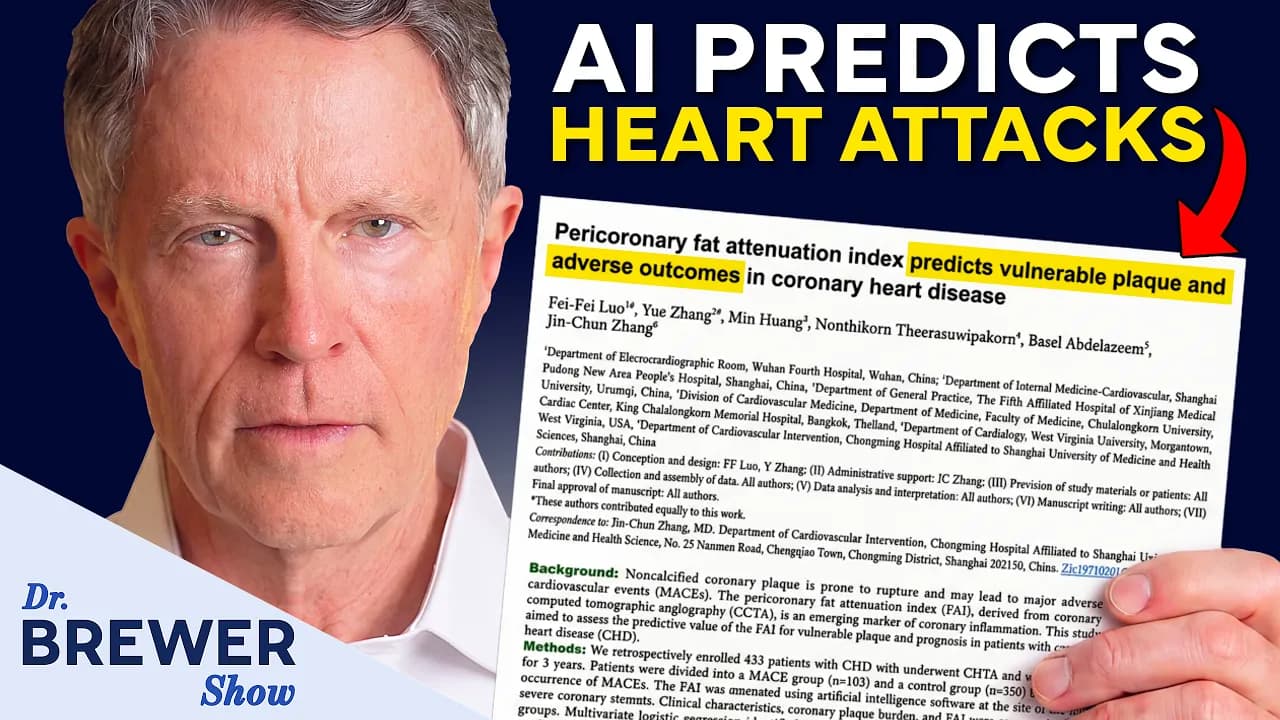
Soft plaque is the real cause of heart attacks. Two tests can identify soft plaque: CIMT (carotid intima media thickness) test and CTA with AI plaque analysis. CTA with AI plaque analysis is the gold standard for finding soft plaque.
The vast majority of soft plaque and constant irritation and inflammation of the artery wall lining is caused by undiagnosed prediabetes and diabetes. The Kraft insulin survey is one of the most important tests. It measures both glucose and insulin after a challenge. The American Diabetes Association admits that blood sugar testing and A1C testing, the standard tests used by most doctors, miss over 50% of this problem.
Thomas asked for a CIMT test and CTA with AI analysis after learning about his calcium score. His cardiologist said a stress test would be better since he passed it. Thomas was told to be insistent on getting the proper tests. Doctors get paid more for stress tests than for CIMT or CTA with AI, and more for stress tests than for proper lab workup. Insurance companies drive this payment structure. These tests can be obtained through PrepMed Health or ordered directly in most states through direct-to-patient laboratory testing services.
GLP-1 medications have changed two major areas of medicine: obesity management and type 2 diabetes treatment. They are the best drug class for both obesity and diabetes because the conditions are connected. GLP-1s help with insulin resistance. They also help with cardiovascular disease and some cancers.
A CT (computerized tomography) is a specific type of X-ray with analytics. A calcium score of the heart is a CT that is timed to avoid blurring from heartbeats. A CT angiogram involves injecting dye into the veins, which travels back to the heart and into the coronary arteries, allowing visualization of the arteries. This technology has existed for over a decade. It was not widely used because it did not differentiate soft plaque from stable plaque. The human eye cannot differentiate soft plaque from stable plaque regardless of radiologist training. AI can make this differentiation.
AI plaque analysis became available about three years ago. It analyzes the images and identifies what is soft plaque and what is not. A CTA with AI analysis involves getting the CT, injecting dye to get the angiogram of the coronary arteries, and then having AI analyze the results for soft plaque. The typical use for CT analytics is to look at the plumbing, called FFR (forward flow reserve).
A calcium score alone does not reveal the amount of soft plaque present in arteries. It only measures stable, calcified plaque. A calcium score of 1,000 at age 65 does not necessarily indicate high risk if lifestyle improvements have led to calcification of previously soft plaque. Many individuals with scores over 1,000 show very little risk when soft plaque has been replaced by stable plaque.
Two preferred methods for assessing soft plaque are a good CIMT scan or a CTA with AI analysis. Calcium scores should never be used in isolation for risk assessment. They provide some additional risk information beyond a stress test but lack the critical soft plaque data needed for accurate risk evaluation.
Daniel Trevor authored The Unholy Trinity, a book that covers heart attack recovery and prevention strategies. Dr. Brewer contributed to the book's development. The book emphasizes the principle of testing rather than guessing when assessing cardiovascular health.
A new comprehensive book is nearing completion, aimed at individuals aged 40-60 who are new to cardiovascular health information, particularly those with positive calcium scores or family history of heart attacks. The book balances accessibility for beginners with technical depth suitable for more advanced readers. It functions as a how-to guide that can be read in a single weekend or used as an ongoing reference.
A recent study on postmenopausal women found citrulline supplementation reduced blood pressure without significantly impacting blood sugar levels. A November study showed potential blood sugar lowering effects. L-citrulline dosage ranges from 1-4 grams daily, while citrulline malate requires 6-8 grams. L-citrulline is preferred for blood flow and mild erectile dysfunction cases, while citrulline malate may offer advantages for pre-workout applications.
Watermelon contains the highest natural citrulline content, but achieving therapeutic doses of 1-6 grams would require consuming several pounds. Citrulline supplements provide metabolic benefits but cannot replace healthy lifestyle practices. Individual responses vary, and supplements work best alongside established lifestyle interventions.
Live call-in number: 859-721-1414. Medicare and Medicaid Advantage are not accepted due to administrative challenges with government programs. Dr. Brewer AI offers a 14-day free trial for immediate question answering without the delays of scheduled programming.
"Growing old is not for sissies. I'm 69 years old. I ought to know. It's a lot better, though, when you got healthy arteries."
The Saturday show airs at 11 a.m. Eastern Time and focuses on artery plaque topics with new practical advice for viewers.
Keep Dr. Ford Brewer MD MPH in your library
Save the videos and channels worth coming back to, and find them again in one place.