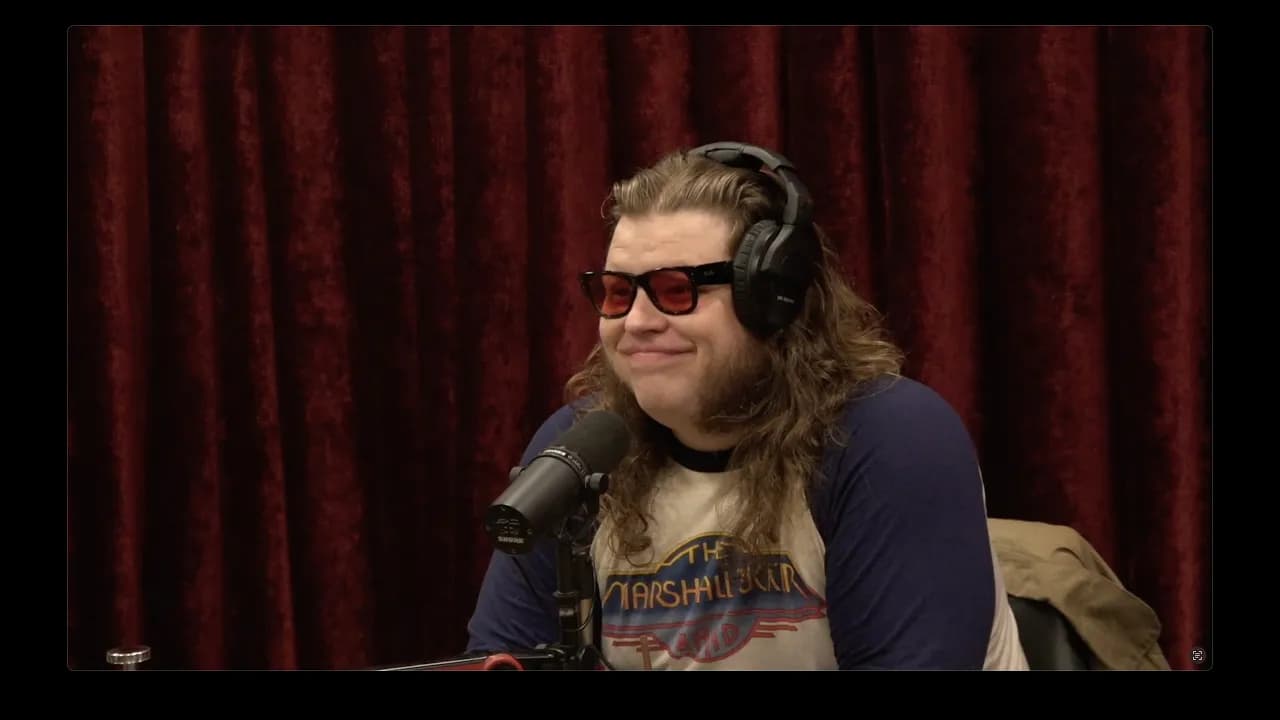
The Strange Freedom To Be Disliked - James Blunt (4K)
In a Nutshell
James Blunt built his career on emotionally honest songwriting but faced brutal UK media backlash after his first album's massive success, forcing him into exile in Ibiza where he wrote his best album from loneliness. The criticism devastated him because Britain punishes success and demands shame about ambition, while Americans celebrate it—leading him to develop a sarcastic online persona as self-protection. After two decades, he's returned to writing from genuine vulnerability without caring about commercial outcomes, treating everything after his early success as "an addition" and a bonus.
These notes were generated by AI and may contain inaccuracies.
The new Modern Wisdom product store is open for six days only. Designs will never be printed again. The favorite metal music design features a rustic farmhouse design with a horseshoe in the front. The snake design represents the Wisdom Nation World Tour. All items are available at mwmerch.com and will not be reprinted.
James Blunt built his career on being very honest with emotionally sensitive songs, then became famous online for being sarcastic and humble. Both personas are correct. He uses music as an emotional outlet rather than going to a therapist, writing songs about what's going on inside him while acting like a fool the rest of the time. These two aspects coexist perfectly happily.
James Blunt went to boarding school at age seven. His parents drove him to school in Berkshire, England in September without telling him he was going to boarding school. They gave him a Donkey Kong Nintendo toy and watch, which was unusual since it wasn't his birthday or Christmas. Three days later, he asked the supervisor when he would see his parents again, who were living in Germany. The supervisor said they would return at Christmas. This experience caused emotional trauma. He deals with the concept of painful feelings on a daily basis.
Boarding school makes students incredibly independent because there are no parents present. Students are directed by other students and work for them. In his final year, Blunt had to work for someone he only called "God" - he didn't know the person's real name. His duties included waking him up in the morning, bringing tea or coffee, opening curtains, arranging sheets, and washing clothes. On weekends, this person would bring him alcohol and cigarettes and protect him from potential trouble with students from other years. Blunt describes boarding school as being more like an educational prison.
Because his father was in the army, the family moved every two years. Blunt has memories of living in Cyprus, Germany, Hong Kong, and Yorkshire. To make friends, his mother would send him to army housing where they lived. He would wander around knocking on doors asking if there were children his age or his sister's age. If someone answered yes, they would become his friend for two years before he moved on. This pattern of having a close friend every two years and then moving on continued throughout his life.
Military service changed Blunt significantly. He was very lazy at university in Newcastle and Bristol, studying aerospace manufacturing engineering and sociology. He describes the university period as being "unemployed" - a wonderful experience where he watched Neighbours and Home and Away twice a day. When he joined the army, he was trained to eliminate this laziness. He now works hard, walks quickly, works long hours, and is very organized. His tour bus is a very tidy place, and he describes his home as being run like a military operation.
Blunt was deployed to the Kosovo War in 1999. The Serbs were committing massacres against the Kosovo Albanians, who had formed the Kosovo Liberation Army. Both peoples were fighting each other. He believes it was a purely humanitarian operation as part of NATO peacekeeping forces, where peace had to be enforced. It was the right war because two peoples were killing each other, and NATO intervened saying enough was enough.
Blunt's first major public foray into music achieved tremendous vertical growth rather than gradual growth. He sees few problems with early success. His first idea will probably be his best idea. He had dreamed of becoming a professional musician since age 14 and achieved success at age 30. His first album "Back to Bedlam" sold millions of copies, with the hit song "You Are Beautiful."
After the massive success of his first album, there was significant media backlash led by the British media, followed by the public. This was extremely disappointing and completely devastated him. The media attack was vicious, making him almost a national pariah. He felt he had to leave and live in exile in Ibiza, which prompted him to write his second album "All the Lost Souls," full of loneliness. He considers this his best album musically.
The music industry is superficial and focused on what's trending. Blunt was never going to be trending. His song and album spread everywhere, and he became an easy target with his little guitar and sharp voice singing a sensitive, hypersensitive song. For him, this was the essence of music - it should carry feelings, not just be paint on a wall. The attack also touched on a small part of his background. Britain is a nation that loves to destroy successes and does not celebrate them, suffering from "Tall Person Syndrome."
The criticism surprised and disappointed Blunt. He felt it was just a song and music - if people didn't like it, they could listen to someone else's song. He didn't understand the reason for the anger, as people saying they hated James Blunt seemed exaggerated since they hadn't met him. It became personal because the name of his band is James Blunt, unlike bands like Coldplay. This affected him deeply because he had dreamed of this his whole life, and it ruined the dream.
At that point, Blunt was living two different lives. He went to Ibiza, stayed up late in nightclubs, and had a great time. He was on tour performing in front of tens of thousands of people every night, living the dream and enjoying himself. The strange thing was that whenever he was asked questions in interviews, they told him how unlovable he was. He learned about perspective - he can search the internet and find a single negative comment, but he has to look in the mirror and say he's a fool for ignoring more than a hundred positive things. The person who wrote the negative comment doesn't know him, didn't spend money on a ticket, didn't travel, and didn't invest anything in the comment.
Blunt doesn't think the same reaction would have happened in America. Americans celebrate success and encourage others. In America, you are allowed to say you are proud of what you have done. Americans set up clubs to say "I am starting a club, who wants to join?" while the British set up clubs to be unique and exclusive. Britain allows success, but only if you feel extremely ashamed of it happening. In Britain, you are forced to apologize for your ambition or for your life going the way you want.
Blunt doesn't think Britain hates the upper class in general, or just the successful upper class. He doesn't think class discrimination exists at the street level. He believes the media, especially social media, exaggerates this issue. In the army, all members were experts in their fields from all over the country, working together as one team. As long as they look each other in the eye, respect each other, and know what each individual adds to the team, they deal with each other as equals.
Songwriting talent developed during military service through having a lot of downtime. In the army, you always have to wait. When going into operations, soldiers have to take something with them - playing cards, a soccer ball, or in Blunt's case, a guitar. He saw things that were inspiring for songwriting. Many wars have produced great poets and wonderful poetry. Those experiences were also a source of inspiration for his songs.
After returning from Kosovo in 1999, Blunt started performing in London in 2000. He joined the London Royal Guard, the Mounted Guard. He spent four months learning to ride horses on rejected army horses that would kick, bite, and knock you to the ground. During the day, he qualified as an official bodyguard for the Queen, walking down The Mall next to Her Majesty amidst huge crowds, wearing armor and connected to police microphones. He had a sword but wasn't going to use it against anyone, especially not against the Queen. At night, he would go and play at small parties and different places, forming a musical group that is pretty much his current group to this day.
Blunt knew he could sing and express feelings. He knew he could express himself and be persuasive. He could convince soldiers to follow him, which requires genuine conviction to motivate them to get up and follow toward a machine gun firing in their direction. If he could convey that feeling through music, it meant he had something. What he lacked was an understanding of the music industry - he was very naive about it.
While performing at concerts and contacting music production companies asking for a contract, one person came up to him and said he was doing it all wrong and needed a business manager. So Blunt gave two parties and invited some business managers. One of them was Todd Interland, who called him in 2002 after hearing his album and wanting to meet him. This manager is still his manager to this day. This gave Blunt the opportunity to do what he does, which is music, with guidance through the perilous world of the music industry.
With his manager's guidance, Blunt went to music publishing companies and got a publishing contract for one of his songs. This gave him a small advance, which allowed time to write more songs without worrying about urgent bills. The publishers introduced him to other people in the music industry who helped him write and record more songs, especially much better demo versions. Having a business manager and publisher supporting him increased his chances of getting a recording contract because companies felt more confident having a supportive team and funders.
James Blunt contacted all production companies after leaving the army, but results were poor. His voice was damaged from military service, his accent came across as that of a naive aristocratic boy who didn't belong in music, and his messy hair and baggy jeans made him stand out as an outsider. It was clear there were songs with potential, but finding a place in the British music scene proved very difficult.
Virgin Records, headed by Frenchman Philippe Ascoli who had signed bands like Air and Daft Punk, was the only company to offer a contract. When they called to offer a recording contract, Blunt was excited and arrived with his business manager and first manager. The marketing manager asked if he could speak with another accent, suggesting a Pakistani accent as a test response. His business manager immediately stood up and said they should leave, recognizing the company wasn't suitable.
Blunt traveled to Austin, Texas to play on the twentieth floor of the Ramada Hotel before an audience of no more than twenty people. His manager hadn't told him it might be his last chance, though the two musicians traveling with him likely knew the situation. He believed he was going to the South by Southwest music festival, but his Ramada concert was merely a side event. Despite the modest setting, he performed his songs for the small crowd.
As Blunt finished his song, a woman with thick-soled shoes, a black hat, and a teardrop tattoo pushed through the audience. She introduced herself as Linda Perry, the lead singer of Four Non Blondes. Though her name meant nothing to him initially, she explained she was establishing a new record label called Custard Records and wanted him to be her first signed artist. She offered to provide the money needed to produce his album the following day if he signed immediately.
They went out drinking that night, and Blunt felt he truly owed her for the opportunity. The transition from army life to someone with a top hat and teardrop tattoo was a significant style shock, and her non-British background meant she didn't hold the same petty prejudices common in the UK music industry. She saw someone who wanted to sing from the heart without hiding anything.
By that point, three-quarters of Blunt's first album "Return to Bedlam" had been written, including "You're Beautiful," "Goodbye My Love," "Cry," and "No Bravery." The remaining task was finding the right producer. Tom Rothrock was selected after discovering a low-quality video online of an Englishman singing "You're Beautiful" at South by Southwest. Rothrock had worked with artists including Elliot Smith (Blunt's real inspiration), Badly Drawn Boy, Foo Fighters, and Beck. His genius lay in extracting from artists what they wanted to add to songs rather than imposing his own vision.
Blunt believes luck plays a role but that you have to create your own luck. Being in the right place at the right time doesn't mean everything comes easily - you have to be present everywhere all the time and make opportunities yourself.
Blunt defines seriousness as the courage to take your feelings seriously. The British are particularly sensitive to this, maintaining reserve, irony, and distance in dealing with things. He contrasts this with American culture, citing Armando Iannucci's series "The Thick of It" versus its American adaptation "Veep," noting the American version lacks the same acerbic, reserved style.
At the beginning of his career and now recovered, Blunt's main purpose in composing music was talking to himself - being honest in the mirror about what he was truly afraid of. These included not knowing life's purpose, whether you'd meet the right person, where you'd end up, or where you'd live. The journey to find answers takes a lifetime, involving mistakes and realizing you're not the hero of your own story. Writing songs became a purifying way to express and explain these feelings to himself.
Standing on stage and singing these honest songs initially attracted audiences who heard the authenticity and were moved by it. People felt something within themselves or heard words they wanted to hear from someone else. However, this honesty and painful sensitivity wasn't the British way and could be easily judged. Blunt believes this criticism stems from a need for flexibility and toughness, qualities that gave strength in the past but may now be responsible for public vulnerability.
Blunt references a Sigmund Freud letter to Carl Jung stating "One day, you will look back on the years of struggle as the most beautiful." After revealing himself to the world and leaving the army for music, the lack of hoped-for reaction shook him. Years later, he can view it more positively, hoping people now see him as a real person rather than the ridiculous "pop star" title given in the music world.
Blunt compares himself to Nickelback's Chad Kroeger, noting how media campaigns turned against them after initial success. He acknowledges being underestimated before media appearances, having been serious about music and interviews while learning to make fun of himself during military service. At the Ivor Novello Awards red carpet, when asked how it felt that everyone hated his song, he replied "Oh God, have mercy on me. I am the poor soul who has to sing this song every day," but newspapers reported it as him calling critics "scoundrels."
Twitter saved Blunt from media misrepresentation, allowing him to tell jokes and show his warmer, funnier side without journalists distorting his words. He had composed music expressing human experience profoundly, revealed himself honestly about falling in love and the difficulties of being human, but even attempts at self-deprecation were distorted.
Blunt experienced despair while writing his second album alone in Ibiza, wearing fingerless gloves because someone had stolen his water heater. Despite buying a beautiful house with earnings from his first album, he felt the dream had faded and felt very lonely. He was in a relationship with a fashion model at the time but felt lost, with a recording contract but believing no one in the UK would want his music. This was the hardest period he'd been through.
Despite objective success metrics like filling stadiums, topping charts, radio play, awards, and fame, the emotional experience remained neutral. The feeling of criticism was much stronger than any compensation from numbers. Social media works because people just want to be liked and receive self-affirmation. Not getting appreciation in his home country bothered him, taking a long time to overcome.
Watching documentary footage from twenty years ago, Blunt could see himself riding success waves while having fun, but sadness was visible in his eyes. He went out constantly, living in nightclubs worldwide and having tremendous fun, yet something dark remained about home. His third album wasn't hugely successful, with songs that felt incoherent and lacking faith or passion. He was writing while thinking about audiences and potential negative criticism rather than being honest.
The journey back involved Twitter interaction revealing that he took music seriously but didn't take himself seriously. This transformation from serious musician to "internet clown" took a decade. Only now does he feel he can pull himself out of the music world and say he's back in music again.
Blunt discusses "esprit d'escalier" (staircase intelligence) - thinking of the perfect response only when leaving a party. He describes a unique nostalgia many feel toward experiences marred by personal flaws at the time, despite objective success. This can lead to bitterness, resentment, drugs, and revenge if not handled properly.
After twenty years, Blunt is still touring until next year and performing at venues like London's O2 Arena. The painful experiences brought him back to his senses, and taking blows can be healthy. His second album emerged from that struggle, and he's proud of it despite its origins.
Blunt's first album wasn't primarily about romance - only two songs mentioned a girl, with others about drugs and war, including "No Bravery." Even "You're Beautiful" was about a man under the influence of drugs talking to someone else's girlfriend. His latest album is heavy and bleak, originally wanting to name it "A Reason to Die" - an ironic title the production company rejected. He won't promote it with the same seriousness as his first album, protecting himself by keeping explanations humorous rather than direct.
The seriousness is in the songs themselves. When explaining song meanings, Blunt keeps explanations short and humorous rather than direct, even when meanings are clear from the lyrics. He's grateful for the field he's chosen to work in.
The discussion creates space for dialogue that allows complex seriousness to mature sufficiently so people can understand the full context of what is meant. This approach tells a story that is not limited to a 30-second audio clip, entering discussions with someone who is not an enemy but honest and serious in their position, asking "How did you feel? I want to learn from you about this."
The third album carries a kind of compensation where the understanding of what will happen when composing songs like these affects songwriting and composition. The approach involves protecting oneself by surrounding beautiful songs with layers of protection rather than being completely honest and open when knowing harsh judgment will follow.
Audience takeover describes the process where you start producing something, receive audience feedback on what they like, and then offer the audience what you think they want instead of continuing to do what you want. Criticism appropriation is considered more distorting than audience appropriation, involving preemptive compensation for what you think critics might say.
This includes not taking yourself too seriously, giving advance warnings so any criticism comes from you first, or becoming so rigid and aggressive that you become a scary opponent so people don't dare to criticize. When both audience targeting and criticism targeting combine, the conflict between wanting people to love you and not wanting them to hate you becomes very confusing.
The audience is present in the room during recording and writing. When one person wants something perfectly clear and another wants it perfectly clear, creating a gray area in the middle doesn't work. The journey to get rid of this pattern has been long.
Momentus' "Nightly Sleep" tablets saved from insomnia during a month of sleeping on tour buses and hotel beds. The new triple-action formula combines magnesium bisglycinate, apigenin and theanine to help relax, fall asleep and stay asleep without melatonin and without worry about sleep paralysis. The product is NSF certified for Olympic athletes and tested for banned substances, with a 30-day money-back guarantee and international shipping available. The link is livemomentous.com/modernwisdom with code modernwisdom for 35% off first subscription.
Advice for a young person achieving both sudden success and sudden scrutiny: Elton John called and said "Listen, screw them. It doesn't matter." You are the one riding the wave while critics are watching from the beach. There are two main responses to criticism: anger and sadness, often referred to online as a "breakdown" or "loss of control." Losing your temper is inherently inappropriate, but drawing some of that energy internally can be powerful fuel.
The second album was a reaction to the initial criticism. The most difficult times in life are the most inspiring because it's difficult to write about things when having too much fun. Great comfort doesn't necessarily lead to development or inspiration, but facing great difficulties and troubles leads to learning, growth, and inspiration.
The metaphor compares trying to swim in a river versus drifting in it slowly. When the river flows slowly, everything is at rest and moving at the same pace. When colliding with the river current and pushing hard, things come to you and are felt intensely. Paying close attention during difficult times occurs because a solution needs to be found.
If everything is going well in the music industry and stagnation occurs, that may represent a slow decline. Aspiring to growth is necessary even to maintain the status quo. Playing in gyms across the UK while aspiring to play in stadiums represents worthwhile ambition, even if it may not happen.
The innocence of youth provides a competitive advantage that cannot be obtained once exposed to shocks. Having a naive, blind conviction that leaving the army would lead to a recording contract, living in Beverly Hills, and having an album released worldwide was wonderful. When the first record label Caster Records signed with a major label that went bankrupt and merged with another, getting rid of 77 artists and keeping only seven, the naive belief that things would work out was valuable and cannot be returned to.
Early concerts played in workers' clubs in places like Ipswich are not available for the world to criticize or for seeing how much ego has swelled or shrunk. The incubation period for such things is wonderful, though setbacks can still be faced and learned from. Constant exposure to negativity gradually weakens people.
At age 30, starting a music career involved heading into an unknown world without understanding whether it would be possible to continue. Everything might fall apart, requiring a suitable job search, with uncertainty about whether the army would accept return. Many people have talent to achieve what they aspire to but don't necessarily have the ability to deal with the consequences.
The documentary about Louis Capaldi shows someone with exceptional talent and skill but a personality almost contrary to his dreams. The fear of scrutiny and sensitivity that made his songs rich and appealing is the same thing that exposed him to pressure. His self-deprecation style included describing himself as dressing like a lesbian woman, wearing glasses like a diaper, and taking weird selfies in front of the mirror.
Capaldi protects himself by starting with himself, telling the joke first, and making fun of himself before anyone else. Artists stand on stage and give up everything that protects them, taking off clothes and standing naked in front of their souls, showing everything while everyone points and laughs. The reward for standing on stage and singing from the bottom of the heart about something meaningful, feeling the audience's excitement and watching them cry, is incredible.
Being open to criticism is a kind of bravery that exposes you to criticism but offers great reward. Joko Willink discussed with Sam Harris the impossibility of faked courage as a feeling. Without fear, doing the deed is not courage because nothing is being overcome. Without fear, exposure, and self-disclosure, life becomes like drifting aimlessly.
Not every artist, musician, podcaster, or literary work is supposed to elevate the spirit. Some might be comical or mindless comfort food, but full self-revelation and showing true feelings creates exciting moments. Old videos of "Playing Catch" by "My Lover" show fear in the voice and fragility, with electricity in the place because people watch a man literally reveal his soul.
DJ or big rock band performances might maximize climax through volume and stirring emotions, but the depth of impact represents a completely different kind of energy. Conscious and active minds are maintained while trying to live happy moments without drawing people into moments of sadness all the time.
After dedicating all of oneself to being a recording artist, singer, and songwriter, if personality or work is disliked, appreciation won't follow. Questions about who to meet, where to live, and who would give peace haunted youth. Time heals all wounds, and now young children come saying they love the first album because their parents forced them to listen to it. The circle is complete when those who missed the first wave of public opinion form opinions based on others' opinions.
Young people know nothing but being present on social media. Spotify allows finding music from any era, associating old songs with specific social media personalities. The product running out serves as a good test of how much something is liked. Element has been used for over five years as the first drink every morning, reducing muscle spasms and fatigue while improving brain health and regulating appetite. The product has no sugar, harmful substances, or artificial ingredients, with a no-questions-asked money-back policy and free shipping in the United States.
The "Celebrity Traitors" program is a social experiment where the uninformed majority ultimately loses to the informed minority. The editing processes make it completely different from the actual experience. The game is based on the basics of the "A-B" lie, which is very easy except for Richard E. Grant. If accused of anything whether innocent or guilty, blushing occurs with desire to kill the accuser.
Making it to the final only to be kicked out by Ramesh and Bash after surviving a real war but being nearly defeated by comedians in a Scottish castle represents an interesting contrast. The filming took a little over three weeks. The experience involved being away from family while volunteering to be away from them, probably to promote oneself, when time with family is precious.
Tours involve four shows in four days including Edinburgh to Portsmouth, a 13-14 hour drive. The environment creates a sense of being a voluntary captive, wondering why the volunteering occurred. The castle setting from 10:30 am until 4:00 am with drawn curtains leads to losing sense of time and control, prompting reflection on the decision to participate.
Different personalities behave differently in the game. Some know how to play when quiet and not revealing themselves, while others want to reveal everything and move on. Being an impulsive person leads to accusing people of many things and preferring to get kicked out rather than stay. The goal was to go home to wife and kids with time off from tour and a new album coming out in two weeks.
The only time James Blunt had an overly emotional moment was when he walked into the interview room and there was no envelope for him. When everyone saw the envelope, they said, "Oh my God." He went in but didn't find an envelope, and heard a voice from a small loudspeaker saying: "Good morning, please come in, let's sit down and talk about what's on your mind." For a moment, he wondered, "Where is my envelope?" Those were his recurring questions: Where is my envelope? He was like a mouse in a trap, longing to get out of that phase. It looked like Harry Potter in reverse - you wished you had received a message telling you that you had to leave Hogwarts.
James Blunt explained that the new album took twenty years to prepare. He told his family and those around him that he would no longer pursue the popular songs he used to chase. Because you can listen to the radio, try to imitate what's popular right now, and you'll be nine months behind the times, and your voice will sound like you're imitating what's being said, and that's simply not him. Instead, he wanted to return to music for what he does best, which is to describe the deepest corners of his heart and mind. He told his wife: "Don't be afraid of what you might hear. I am completely happy. But I need to delve into these corners." So he wrote an album of songs that were like a conversation he had with himself while looking in the mirror.
James Blunt found it extremely difficult to write these deeply personal songs and knew he would have to put it down. He didn't want to explain the songs in too much detail because he doesn't feel comfortable doing that. But it was a wonderful moment of catharsis to be free again. His production company released his best songs album a few years ago. One only releases an album of their best songs after their death. So if he dies, this is a new life. There is no need for him to think about anything related to business, and no need to prove himself in any way. All of this is an added bonus. As a result, he goes back to doing it for the sake of the music, not for the job.
James Blunt has been thinking about this all the time since the TV series "Peaky Blinders," where Arthur Shelby and Tommy Shelby were at the Battle of the Somme, and they were supposed to die because they were tunnel diggers, but they didn't die. Fortunately, they managed to survive, and they always repeat a phrase they say to each other: "Everything that happened after that was an addition." Everything that followed was an addition, and it seems almost as if that's all there is to it. He feels that everything after that is just a reward.
James Blunt still feels a bit sad because of the understandable distance he has put between himself and the songs, and trying to analyze those things. There is a parallel world, a breakaway world somewhere from 2000 or 2003 or something like that, that has broken away from him, where he can push and push and do the same thing and pull it, not out of a desire to exploit personal pain, but because he really wants to know his opinion on that thing, on that song, on what worries him at night, on whether his relationship with his phone is bad.
James Blunt goes into the studio with a producer or maybe another songwriter, and writes these songs with someone who may be a friend or a complete stranger. He still writes songs that spring from the deepest recesses of his soul, from its most fragile parts, those parts that he is very careful to protect, because they will be treated harshly or ridiculed. Therefore, being in the studio with someone and exploring those moments is extremely difficult and reveals a lot of emotions. Because he doesn't want to betray his relationships, especially his family, he doesn't want to betray their trust in him in his private life. So this may be difficult in itself, but he will always find solutions for it.
James Blunt went to Nashville to write with someone named Mickey Eko, who also wrote the song "Stay" with Rihanna. He wrote with several other people in Nashville. Production companies send you to write with these people, and you feel like you're part of a factory. The whole thing is meaningless and very difficult to get involved in. But he is a fan of Mickey, and especially loves the song "Stay." So he met him and said, "Mickey, it was a pleasure meeting you. I've been saving this opportunity for you." Mickey said, "Okay. Oh my God! Here we are." James said: "As you know, I don't know what we will write today, but I know it will come from the heart."
James Blunt walked to Mickey's recording studio, crossed the freeway, and as he was looking at the road, cars were coming from this direction and others from that. So he said to Mickey: "What I was thinking as I crossed the road was: if I wanted to jump, would I jump from the side where the cars are approaching or from the side where you can't see the cars? As you know, if you can see the car, you can set the timing well. If you jump from the other side, you won't know. And you can see that he started to think: Okay, we have a problem here?" James said: "Well, actually another idea occurred to me, which is that if you jump from that side, you might land on the car and cause a lot of damage to it, and that would be bad or worse. So I think we won't do that, and if we think about it, we shouldn't do it here. We should do it somewhere, for example at home. But this would be bad because someone's family might find you. I can't tell my family, and I certainly don't want my father to find me."
Mickey looked at James and asked where he got this from. He started to get nervous. Then he sat down and called his manager. James heard him call his manager and say, "I thought I'd write another 'You're Beautiful' song with this guy." Mickey came in, and James said to him, "Thank you. You allowed me to do exactly what I needed to do. This is the song. I'm not looking for a bridge to jump off, I'm just looking for a hand to hold." At that moment, they wrote a song that talks about the pressures and burdens of life that one might feel, the pressures of being a responsible person with a small family, and the conflicts and stresses. But he had to find something to motivate her, something emotional, and he had to take her on a short emotional journey to get to this point. He is a very happy person, but to get to that point, you just have to go to a small dark corner and find it, then write it down on paper.
Mickey supposedly canceled the intervention he thought was imminent, and that was hilarious, because when they finished the song, he took out a bottle of tequila and said, "I just want to ask you a question. Are you okay?" James replied, "Mickey, I'm just trying to write a song. I wonder if I've ever mentioned that I don't need therapy. I have a talent for songwriting that does it for me." He wonders if some artists fear healing because it will drain some of the well from which they draw their ideas.
James Blunt sees this in the business world - that a lot of ambition stems from pain, disagreement, conflict, resentment, doubt, lack of appreciation, need for recognition, and the desire to be liked by those you like. And when people recover and overcome those deep, dark aspects of themselves, often that ambition begins to gradually fade away. It acquires a different flavor. He wonders if there is an equivalent for singers and songwriters, such that a mild drug addiction can be creatively beneficial. He thinks it applies to both sides. He thinks having a lot of self-confidence can be useful at different times.
If you are an athlete, a tennis player for example, to overcome losing a set or two in tennis, it depends a lot on self-confidence. James Blunt believes this applies to many aspects of our lives. Trust breeds more trust and leads to success. But he believes that struggle and pain can be a source of inspiration for a creative person.
James Blunt wishes he could return to the innocence he once possessed. It's sad to say, but he's not going to have a bigger commercial success than he did with "Back to Bedlam" and "You're Beautiful." It's sad to say this, because what he should have done was be American in this matter, and to say that this album will surpass those previous albums by a large margin. He believes this is what was meant by his question about the problem or challenges of achieving such a first success.
James Blunt is a close friend of Mark Manson, who wrote "The Subtle Art of Not Giving a F*ck." Mark knows that no matter what he does, the chances of repeating this phenomenal success are virtually nil. His chances were practically zero. Then comes the chance of it happening, the chance of catching lightning twice. He had to deal with this. There is a kind of surprise, perhaps not from Morgan, but certainly from Mark and from James as well. There is a sparkle in his eyes, a kind of dignity, or perhaps something closer to humility, self-awareness, with a slight smile. He thinks it is part of a feeling of amazement, as if he is saying, "My God, I can't believe this happened. Yes, obviously I am lucky, and obviously it will not happen again in the same way."
When James Blunt realized it didn't matter - if you catch lightning once, you've caught it. He caught it, and everything else is a bonus. He really feels like he's in a good place, as he always says when he describes himself, and he's lucky, and that's a word he uses constantly. He is alive, lucky, and he still enjoys everything. He lived through the best times, they were wonderful times. The situation is completely different now, but it is still just as exciting and fun.
The question that arises is, would you have changed anything? Would James have preferred his first album to be very small, then think that he missed the opportunity, and work on a second album, and now he is talking about his eighth album, and now everything is going well? No, because it would have taken 20 years of struggle. He lived through the best times. Having a large album is sometimes described as a burden, but no, it was a blessing.
There were turning points or instances of mistrust because it was under criticism, and it was clear that objective standards could not be the solution, at least not in the foreseeable future. James Blunt still has problems with some aspects of confidence in music. He still finds things he can never do, like going on stage, singing a new song, or appearing on a TV show where you never know, you're there for three and a half minutes, embarrassing yourself in front of the nation. He feels that completely. He's still wondering how he's going to get over it all the time, and he hasn't quite gotten over it yet. But it will be over in three minutes. They will deal with the repercussions.
As someone who may have a degree of stress in some situations, someone who may take criticism very seriously, with a career spanning two decades, James Blunt finds it to be a quintessential British heroic story. Imagine an American story; it would be more enthusiastic and encouraging, like David Goggins, man, get over it. He is the man who gets angry but does not get sad. But there are not enough dialogues about role models, specifically designed for people who do not have that ability to respond firmly. He thinks that's very reassuring, because many people feel more stressed than they'd like when it comes to what they love.
James Blunt thinks what he's lucky about is that as you get older, you realize that life is full of ups and downs. You enjoy the ascent and you rise from the fall. He still works with the same production company, Antidot Records, his own company. He's had his ups and downs. And during the moments of landing, he asks for forgiveness. His business manager too. And of course, he sometimes looked at them thinking that they had made some mistakes, but they worked as a team. That's life. It has ups and downs. You just need to make sure you learn from the moments of landing and do not let it affect you too much, preventing you from getting up and striving for another rise and enjoying it when it comes.
James Blunt is selling tickets for a tour that starts in February on jamesblunt.com. He has a new album called "Airplane Mode" that will be released on Friday.
Keep Chris Williamson in your library
Save the videos and channels worth coming back to, and find them again in one place.