Bringing Supersonic Flight To The People
In a Nutshell
Boom's supersonic jet company nearly collapsed when Rolls-Royce abandoned their engine partnership in 2022, forcing them to develop their own engine from scratch using former Pratt & Whitney engineers. This self-reliance unexpectedly solved their sonic boom problem and led to a breakthrough: the same supersonic engine technology, when modified into a 42-megawatt turbine, became the perfect product for AI data centers desperate for power generation capacity. By pivoting to sell turbines to companies like OpenAI, Boom secured massive revenue that funds their supersonic aircraft development while building a flexible manufacturing base that could serve defense needs in wartime.
These notes were generated by AI and may contain inaccuracies.
One of the worst decisions made was entrusting the development of a supersonic engine to a large established company. When looking at it clearly, this was extremely stupid. The success of SpaceX would never have worked if Elon Musk had given the engine to a traditional rocket company. When the company was founded, there was no intention to pursue this strategy. The first employee was an engine designer who, just two weeks after joining when the company had only four or five people, said that Rolls-Royce engines are easier to adapt to supersonic speeds than any other engines. This could save the trouble of developing a whole engine if they collaborated with them.
Everyone in the field used to ask "Who makes your engine?" and they were supposed to mention one of the three major companies. Things were going well with Rolls-Royce, which made them believe it was a successful strategy. The matter reached a Rolls-Royce board meeting in early 2022. The details of the agreement were presented to the board for approval. When the phone call came after the meeting, it was hesitant, as if they were saying "We're not sure it will work." It turned out that the CEO was dismissed at the meeting but kept in position until a replacement was appointed for an indefinite period.
There was a verbal agreement with the head of Rolls-Royce in North America to continue the relationship until the end of the year. They announced a transfer and obtained a license from Rolls-Royce. In July at the Farnborough Airshow, they signed contracts with other partners, though these were later cancelled. In August, American Airlines followed United's lead by offering advance booking.
The question was raised about whether it was necessary to tell American Airlines that the Rolls-Royce deal wasn't real. The answer was that it was vague enough that they didn't have to address it. They told airlines they were working with Rolls-Royce on an engine but didn't make it seem like a done deal. After the American announcement, Rolls-Royce was extremely upset and rushed to the press without warning, publicly severing ties.
Rolls-Royce wanted to exploit them with research and development contracts that kept their engineers busy, and they were paying. The engine proposed was based on a next-generation engine platform that Rolls-Royce stopped developing for other reasons they didn't disclose. They had implicitly assumed they had technology which they did not actually have. They realized they had promised something they couldn't deliver.
Suddenly the Boom project became unfinanced. No partner wanted to talk to them, nor any airline. At a conference after stepping down from the podium, photographers put microphones in their face asking "What are you doing with the engines?" They contacted all engine manufacturers and everyone said they don't cooperate. This happened in August and September, though events had been unfolding behind the scenes since February.
The Rolls-Royce engine wasn't truly supersonic. They intended to take one of their subsonic engines and make minor modifications to make it faster than the speed of sound. It was unable to fly without sound, so there would have been many compromises. The most likely outcome is that they would never have delivered even if they tried.
While these events unfolded, they pursued all avenues in parallel. One option was to figure out how to do it themselves, which was the option secretly preferred. They found a contracted engineering team, essentially the former Pratt & Whitney supersonic aircraft team from West Palm Beach, Florida. The accountants at Pratt said they had headquarters in Hartford and an office in West Palm Beach, so they closed the Florida office. None of the residents of West Palm Beach wanted to live in Hartford, so all the engineers resigned. They established a consulting firm that undertakes projects related to engines and turbines under contracts.
They attended a lecture given by Brian Chesky at the "Masters of Scale" conference organized by Reid Hoffman. Chesky was telling his story of leading Airbnb during the COVID-19 pandemic. The point was that when managing things during a crisis, you believe you have to compromise to survive, but the opposite is true. You need to look inside yourself and ask: "What were we always supposed to be?" and become closer to that.
They ended up partnering with the company in Florida. They convinced General Electric to join in a very limited way in additive manufacturing, but this project was not completed. They convinced a maintenance workshop to join as a maintenance partner. They tried to put together some of these things to gain credibility and prove they could complete the project without needing one of the three major engine companies.
If they had gone to one of the three major engine manufacturers, they would not have delivered the product even if they had signed a contract. These people don't build new engines; all they do is make minor modifications. They are very slow, their prices are very high, and they have a complicated supply chain. Most of the Rolls-Royce employees working on their engine were not employees of the company itself, but contractors.
The first major achievement was supersonic flight without a roar. If they fly high enough, the crane arm will detach from the aircraft and rotate in a large circular path in the sky without touching the ground. To achieve this, they must fly at a speed close to the speed of sound. They performed mathematical calculations using a Rolls-Royce engine, but the results were not satisfactory. The physical foundations were there, but the engineering design was not.
They abandoned the idea of an aircraft without a crane arm. Once they had their own engine, they were able to improve it. The team is currently working on developing the aircraft and engine configuration. Before breaking the sound barrier with the experimental XB-1 aircraft, they needed to get a prediction for the sonic boom. After recalculating the large production aircraft with their own engine, they discovered they had actually solved the sonic boom problem six months earlier without realizing it, simply by improving the engine.
Rolls-Royce's split was in 2022. They started working on their own engine around the middle of 2022. There was the first preliminary sketch in June of 2022. They revealed it to the public at the end of 2022. The XB-1 did not fly at supersonic speeds until early 2025. They didn't have enough financial resources to do two things at the same time, so they were constantly choosing between moving forward or maintaining the status quo. There would have been no supersonic passenger flight without a roar if they hadn't developed their own engine.
The problem lies in how to finance the development of a supersonic aircraft as a startup without a revenue-generating product. The last twelve years have been spent trying to solve this problem with great difficulty and without any significant success. The engineers who worked on the engine had also completed some work on electric turbines.
At a technical review in 2022, they were reviewing the engine design when the team said "By the way, the supersonic engine is more like an electric turbine than any other jet engine, because it is designed to operate at full power continuously and in high-temperature environments. So, if you want an electric turbine, this will be the best in the world." The response was to move to the next slide because it seemed irrelevant.
In March 2025, after the XB-1 broke the sound barrier, half the time was spent in Washington, D.C., trying to regulate supersonic flight. Browsing Twitter revealed all the things about the massive energy deficit of artificial intelligence, that giant companies resort to building their own power plants, that specific raw materials have now become turbines for power generation, and that there is a backlog of many years of turbines.
Two text messages were sent. One was to Sam Altman, who was one of the early investors. The message was: "If I had a 40 MW natural gas turbine, would you like it?" Sam replied: "Please, make as many as possible, and as quickly as possible." The chief engineer replied that they had a plan for this, but they didn't believe there was a market.
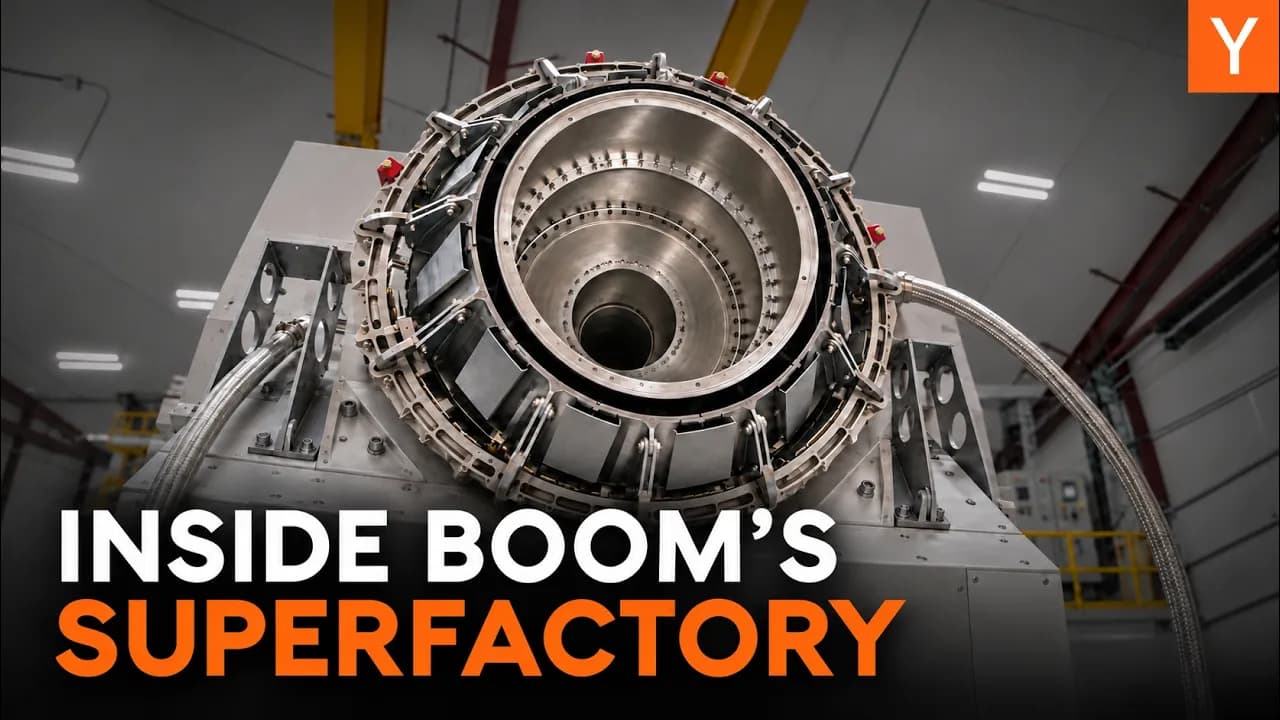
After looking into it more carefully for two more months to be absolutely convinced that the market existed, they invested in it with all their might. Now there is a huge influx of revenue, or at least there will be next year. The same engine, if they remove the front propeller that pushes air backward to propel the aircraft forward, and replace it with an additional small turbine connected to an electric generator, the motor that produces 40,000 pounds of thrust on a supersonic aircraft produces 42 megawatts.
This turns out to be the ideal size for a modular turbine that can be easily installed in a data center. If you want gigawatts, that means 24 units put together. For medium-sized turbines, they can deploy them in n+1 arrays. It turns out they had spent three years developing the optimal artificial intelligence product. They had to contact customers and inform them in advance of the entire production plan, since they were going to convert these engines into airplanes.
They had not solved any of the manufacturing problems at that time. They were still living in a world of high speed, where financing the business was extremely difficult, and they could barely keep up with engine development. This project would have been a great success. They had to act as quickly as possible, and they were able to raise a large amount of money with this strategy, so that they no longer suffered from a lack of capital.
The prevailing view at Boom before its founding was that the founder wanted to be a rider and would never be an investor, because it was too risky. There is a whole wave of advanced technology now. People have realized that high-tech businesses are not necessarily more capital-intensive. Companies like Uber or Airbnb have consumed much more venture capital than high-tech companies like Anduril or SpaceX.
The fundamental difference is the way things operated at Y Combinator before the emergence of advanced technology companies. It is very easy to come up with software ideas, and it is relatively easy to develop software. But it's very difficult to determine how suitable a product is for the market. The only way to determine how suitable a software company's product is for the market is to launch it, grow it, and prove that they have developed something useful.
You cannot prove that you have developed a useful supersonic aircraft. You cannot test whether someone wants to fly faster than the speed of sound by building a supersonic aircraft and putting it on the market. Concorde did that, but they developed the wrong supersonic aircraft, so it didn't work. Therefore, you need to follow a different method to prove product suitability to the market in advanced technology companies, and the amounts invested before achieving the first revenue are higher.
The last entrepreneur to establish a commercial aircraft company before Boom was in 1921 when Douglas Aircraft Company was founded. No one has made any significant profits since then. A hundred years ago, someone might have made money from this aircraft company that everyone has forgotten about. Therefore, this does not apply to venture capital. It is very difficult to maintain the company's continuity.
Ironically, living on a monthly salary made the company less efficient in its use of capital. It was very difficult to convince the team to make any long-term decisions. When they knew they were in a difficult situation, they said "Perhaps we should reconsider the matter." Time is very tight. There are some things in life that are more enjoyable to tell the stories about later than to experience them.
The funding with the turbine company was raised at the end of 2025. Everyone was very excited. Some people thought they might not build a supersonic aircraft, but they will build one anyway. The route is the most important thing. They told talent experts that they're going to hire an engineering team specializing in supersonic aircraft to work on a power turbine. You will never be able to achieve that in terms of talent in any other way. They have a huge talent magnet because of the appeal of the task.
No one wants to say "I'm working on a turbine," but they want to say "I'm working on a jet plane. I'm working on a supersonic engine for an aircraft that you will be flying." This is what attracts talent. Turbines are really interesting when put into their current context, given the different situation being gone through, and the amount of energy needed for computing, it becomes more attractive now than it was two decades ago.
There is a trend line that can be followed, starting from the Industrial Revolution, which is the amount of energy produced per capita. This was an exponentially increasing curve until 1971, then it turned into a slow linear curve, then finally stabilized and stopped in the United States. They are not increasing energy production per capita. They haven't done that for decades. They kept pace with population growth, but not much more than that.
This coincides with the success of the environmental movement, the early environmental movement. It also coincides with the entry into force of several laws and regulations. One organizational theory is that most laws and regulations consist of two parts. They have a moral cover, such as "We should ban supersonic flight because the sonic boom is so bad" or "Nuclear power is scary and will irradiate us all." You have some ethical cover-ups, but if you track the money, you'll find there's a lazy party that doesn't want to work hard.
It wouldn't be surprising if the truth is that the coal industry was behind the opposition to nuclear power. There is fairly reliable information that Boeing was behind the opposition to supersonic flight. Some important laws were passed. There was a law called the National Environmental Policy Act (NEPA), which made building solid infrastructure in the United States extremely difficult.
The electricity grid became fixed with the idea that energy should be conserved rather than abundant. Superintelligence now requires significant energy, requiring restart of an energy-producing machine idle for 55 years. The major turbine companies are the same companies that make major jet engine aircraft. When the market becomes restricted, turbine prices and stock prices rise, with executives receiving lucrative stock options. Existing companies have little incentive to expand, and new entrants face mockery and attempts at undermining from established players.
Boom recently hired people from General Electric. Colleagues from established companies claim Boom can barely build an engine. These competitors are betting on Boom's failure, which works in Boom's favor because they are not taken seriously. The medium-sized turbines are modified jet engines, with General Electric's latest LM 6000 based on a 1971 Boeing 747 engine.
The state of American aerospace and energy industries is extremely poor. Boeing last built a new airplane design in 2004. All Boeing does is take old planes and make modifications, and even that is no longer done efficiently. The lack of new design work means all current undergraduate students at Georgia Institute of Technology were born after Boeing's last new aircraft design.
Designing their own turbines and engines provides control and brings in revenue from products with very high profit margins, allowing self-financing of aircraft while still having money left over. When using Rolls-Royce engines, Boom had no control and couldn't improve the passenger experience. The team was constantly trying to convince themselves that designs were good enough when they were not satisfactory.
A different cabin design was presented that was far better than anything designed for small aircraft before. To make this interior design work, the aircraft body shape needed to change slightly. The hypothesis is that designers should think like engineers and engineers like designers - a collaboration between design and engineering. However, simulation showed this would lose 1,000 miles of range on a 4,000-mile aircraft due to the shape change.
Before the iPhone, Apple had two projects: Purple 1 was an iPod with a phone featuring a small black and white screen and touch wheel as dial pad. Purple 2 was based on shrinking the iPad project to phone size, though initial engineering prototypes had only one hour of battery life. Steve Jobs asked the team which phone they would want in their pockets, everyone chose Purple 2, and they stopped working on Purple 1 to focus all efforts on making Purple 2 work.
Boom stood in front of the company and asked which plane the team wanted to sit on - everyone chose the better cabin design. The team agreed to try to regain the 1,000-mile range. After parting ways with Rolls-Royce, Boom decided to build their own engine to the same specifications but with potential modifications to the front fan size and engine core size. Different configurations create competing factors - larger propellers make the plane quieter but worse at maximum speed, while larger engine cores perform better in the speed of sound range.
Boom designed twelve theoretically manufacturable engines and ran them through a program called "Make Boom" that automatically wraps an aircraft around each engine and simulates takeoff, climb, acceleration, hovering, and landing operations. This program was developed before artificial intelligence but now resembles what can be done with AI, with much more capability possible through AI. One engine was clearly the winner, bringing back most of the thousand-mile range.
The vision is for aircraft designed with attention to detail like Steve Jobs or Jony Ive. Current aircraft have joints, gaps, things that don't fit properly, and dirty elements. There are numerous gaps between the inside of the plane and the outside of windows. The worst element is small black spots above window seats below overhead compartments on non-brand-new aircraft - these are stains from people bumping their heads, which cannot be cleaned and airlines do not clean.
The goal is to design the passenger experience in conjunction with aircraft design to create the first truly enjoyable experience by fixing the things people hate most about flying. New middle seats will be eliminated entirely - there will be no middle seats anywhere on the plane. The target is getting all passengers on board in 5 minutes and off in 5 minutes, with potential to exceed this target. Starlink service will be available immediately.
Since in-flight Wi-Fi was invented after the latest new commercial aircraft was designed, current aircraft have Wi-Fi ports added as afterthoughts installed in the back of planes. Boom's aircraft will be the first commercial aircraft designed after Wi-Fi technology, with the antenna integrated inside so it cannot be seen and causes no additional resistance.
Boeing acquired McDonald Douglas, which brought in accountants who were followers of Jack Welch from General Electric. Welch's return on net assets metric led companies to sell their supply chains and decommission factories to improve performance metrics. The last competent CEO left around 2003, coinciding with the launch of Boeing's last new aircraft. Subsequent leadership focused on beating Wall Street forecasts by five cents each quarter rather than making long-term investments.
Jim McNerney, Boeing's CEO in the late 2000s, declared there would be no more ambitious projects and limited development to improving existing products. Speed was historically the key factor driving aviation innovation from Wright brothers' planes to the Boeing 707. The 1973 ban on supersonic flight in the United States effectively banned innovation in commercial aviation.
In defense, innovation was driven by urgent need to defend the country, continuing until the end of the Cold War. After the Cold War, the enemy disappeared for twenty to thirty years until the invasion of Ukraine, eliminating urgent need for defense innovation. All defense aircraft programs became employment programs or company support programs. Young people passionate about aviation turned to software as a service companies because Boeing seemed miserable with nothing new to do.
A lost generation exists of software engineers and tech entrepreneurs passionate about aviation but running SaaS companies because there was nothing in aerospace when they were young. By definition, the only people who stayed at Boeing were those with no interest in innovation. The nuclear power industry represents the worst version - it ceased producing anything, leaving only people who don't care about doing anything.
In 1969, both the moon landing and Concorde supersonic flight occurred. No one in 1969 would have predicted inability to return to the moon or break the sound barrier by 2026. The Concorde and Apollo programs share a common thread as ambitious government projects during the Cold War, not driven by economic feasibility or commercial markets. The American supersonic project was cancelled, leading to the ban on supersonic aircraft in the United States.
The Apollo program consumed about 4% of the federal budget. After cancellation, aerospace companies needed to maintain operations and received their own projects, resulting in the Space Shuttle program. Five shuttles were built, and two crashed in fatal accidents killing all passengers. The space industry remained dead until Elon Musk revived it.
The theory was to keep the industrial base alive by funding small projects for companies like Lockheed and Boeing. However, putting companies on social assistance makes them fat, stupid, and lazy. Lockheed, which manufactures interceptor missiles needed to protect forces from Iranian missiles, has run out of stock, with manufacturing a single interceptor missile taking more than two years.
Before World War II, there was no defense industrial base, but America had the best commercial industrial base with companies like Ford, General Motors, and Chrysler. When threatened, everyone changed strategy, re-equipped factories, and made fighters, bombers, tanks, and everything needed. Today, commercial industries have moved to Asia, and the defense industrial base has become fossilized and dilapidated. A blade that could be 3D printed in 3 days commercially takes 18 months to obtain from the United States at a cost exceeding the machine itself.
Boom's role in defense is to be an efficient commercial manufacturer capable of adapting rapidly in wartime. Very few components of turbines or aircraft are built on solid hardware that is difficult to reconfigure. The goal is to go from design concept to fully manufactured, high-performance turbocharger component within 24 hours. In worst-case scenarios, Boom could cease manufacturing supersonic passenger jets and power turbines to focus on manufacturing everything the defense industrial base needs, doing it quickly and efficiently.
The best defense is a strong, flexible, and adaptable commercial industrial base. Anduril is attempting to make products and technology manufacturable and commercial. About 25% of companies in the latest Y Combinator cohort are based on advanced technology. Aerospace engineering and mechanical engineering students today are amazing, with competent people choosing this field again, largely due to inspiration from Elon Musk.
Live-streaming the XB-1 supersonic jet flight resulted in pictures from classrooms with children watching the plane take off. A video showed a girl approximately six or seven years old jumping for joy when the supersonic aircraft sound appeared during the live broadcast breaking the sound barrier. One of these children will be a chief engineer in the future, with some becoming pilots and mechanical engineers.
Keep Y Combinator in your library
Save the videos and channels worth coming back to, and find them again in one place.