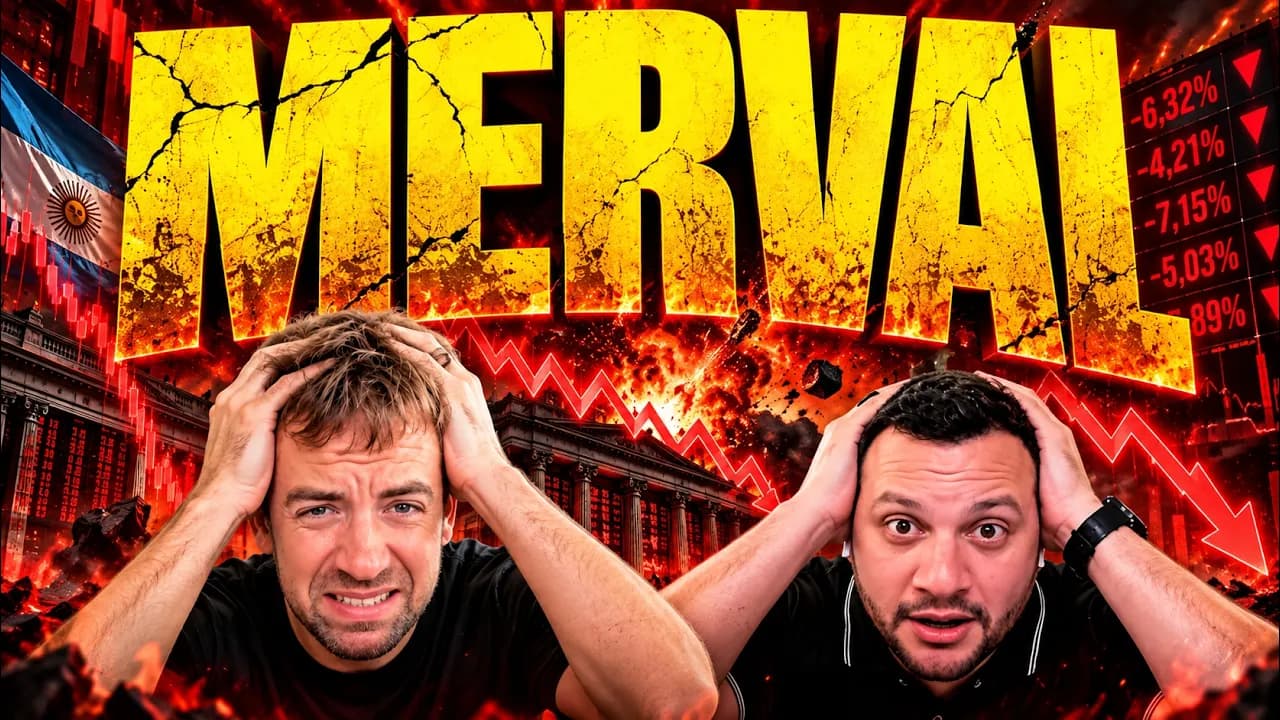
¿Cómo invertir en Argentina antes de las elecciones? | Cazadores de Tendencias
In a Nutshell
El mercado argentino cotiza con miedo y lateralidad porque el riesgo electoral ya está descontado, pero las acciones locales (especialmente bancos) ofrecen mejor riesgo-retorno que los bonos ante un escenario Milei. La recomendación central es no sobreexponerse: si el patrimonio ya está concentrado en Argentina, limitar la liquidez invertida en el país y priorizar posición en acciones antes que en bonos. El carry trade sigue vigente mientras el dólar no supere los 2.000 pesos, nivel que el gobierno defenderá con reservas y líneas de swap.
These notes were generated by AI and may contain inaccuracies.
The hosts begin by addressing the one-year timeline until Argentina's elections, noting significant investor uncertainty about what the market is currently pricing in regarding potential outcomes. The discussion focuses on concrete investment decisions rather than speculation, with emphasis on what assets to consider under different electoral scenarios.
The hosts distinguish between uncertainty and anxiety, noting that investors are experiencing significant anxiety about the electoral outcome. The conversation is framed around practical investment questions rather than abstract analysis.
Viewers are participating from locations including Mar del Plata, Lomas de Zamora, Cava, Ituzangó, Buenos Aires, Puerto Madryn, Rafaela, Bahía Blanca, Chaco, San Isidro, Neuquén, Rosario, Casilda, Santa Fe, Tupan, and Pilar. The hosts announce plans to visit Vaca Muerta during their Neuquén trip.
A poll is conducted asking whether Milei is expected to win the elections. Comments indicate the prevailing view that Milei will win, with some uncertainty expressed. One viewer commented "If it doesn't win, we deserve the worst."
A second poll asks what percentage of liquid patrimony viewers would invest in Argentina given current conditions. Responses ranged from 15% to 80%, with notable comments including "after Brazil, 75% in Argentina" and "80% of liquid patrimony."
The hosts analyze what current market prices are reflecting regarding the electoral outcome. They conclude that prices are between pessimistic and neutral, reflecting fear rather than optimism. The stock market being at similar levels as a year ago indicates this uncertainty, with the lateral movement demonstrating the fear of a potential 2027 fall similar to the 2025 post-election decline.
The analysis suggests that those fearing a significant drop have already exited the market, which explains the current price levels. The lack of significant international participation is also noted, evidenced by low trading volume.
The hosts draw parallels with Brazil's market behavior before its last election, noting it was in a low, directionless lateral market for two to three years before beginning to rise on favorable bets. The Brazilian market rose 12-13% following Bolsonaro's victory but then stagnated.
The stock market is positioned as a thermometer of Milei's electoral success probability. As uncertainties are resolved (particularly regarding opposition candidates), market prices should react accordingly. A delayed opposition candidate emergence would favor the current government and trigger favorable market reactions.
Country risk increases are attributed to Argentina's position as a lower-quality debt issuer. When US interest rates rise, the effect on high-yield bonds like Argentina's is amplified beyond the linear effect seen on investment-grade bonds. Argentina is characterized as the closest to a "garbage bond" or "high yield bond" in the sovereign debt world.
The hosts note that Bolsonaro's position is strengthening with 47% support, and right-wing candidates who fell below Lula would likely transfer their votes to him. The discussion touches on regional political financing patterns, suggesting that Kirchnerism may face reduced financing options following Lula's potential victory.
The hosts strongly favor Argentine stocks over bonds for pre-electoral investment, citing superior risk-return characteristics. This is positioned as a significant observation for investors considering Argentine exposure.
A critical warning is issued against over-concentration in Argentine assets. If an investor has their house, company, and income source all in Argentina, allocating 80% of liquid savings to Argentine investments represents an unbalanced risk position. The hosts emphasize the need to understand this concentration risk.
A potential opposition victory could trigger a significant market decline, though not as severe as the 50% drop following Alberto Fernández's PASO victory. The hosts express reluctance to experience such a decline, emphasizing the importance of avoiding excessive exposure.
The hosts divide the market into two layers: those who have already exited due to fear, and those remaining. Current valuations of Argentine companies, particularly banks, are described as very attractive. A Milei victory would likely drive share price increases, improving the risk-return proposition for Argentine investments.
The hosts evaluate whether carry trade remains viable, questioning what interest rate can be earned over the next year. They note that peso instruments are offering approximately 30% returns, providing defense against dollar appreciation up to 2,000 pesos per dollar.
The government's 2027 budget forecasts the dollar ending below 2,000 pesos at 1,850. The hosts express confidence that the government will defend this level, citing sufficient ammunition including China and US swap lines, futures market operations, and approximately 75 billion dollars in reserves.
Those who bet against the government by purchasing future dollars have lost significantly. The hosts note that much of the peso debt accumulation relates to leveraged operations where investors borrowed in pesos to buy dollars, expecting the dollar to reach 2,500-3,000 pesos.
The hosts dismiss concerns that US midterm elections would affect American support for Milei, stating that Bessent's position remains consistent regardless of electoral outcomes. They also reject the notion that a Bolsonaro victory would diminish Milei's regional importance.
Argentina benefits from US-China strategic competition, with the US financing 7 billion dollars in infrastructure to redirect Argentine minerals through Atlantic ports rather than Chilean routes that could fall under Chinese control via Peruvian ports.
The hosts express preference for stocks over bonds, noting that bonds outside Milei's term have different pricing dynamics than those within his term. They find bank stocks particularly attractive for potential upside in a Milei victory scenario.
Energy is characterized as a more robust, internationally-oriented trade with significant growth potential through Argentina LNG projects, Vaca Muerta Sur, and partnerships with ENI and XRG. Banking is described as a more local trade with greater upside potential under Milei.
The hosts explain that their investor club helps members make better investment decisions by understanding reasoning processes and correcting flawed assumptions, using the patrimony allocation example as illustration.
The hosts mention rising interest rates affecting gold prices and note OpenAI's reduced sales projections from 70 billion to 50 billion dollars, with Anthropic's IPO potentially marking a cycle ceiling.
The $600,000 figure represents the same underlying value proposition. Marketing emphasizes that at the $1,500 price point, participants receive $400 in value, which translates to approximately $32-33 per month. For someone making financial investments, this monthly cost becomes a consideration only when their capital reaches around $1,000 or when total investable assets exceed $25,000-30,000.
The club provides access to market analysis, trade recommendations, and educational content that has covered topics including Sandisk (which experienced significant gains) and gold investments. The value proposition centers on improving investment decisions and potentially avoiding market downturns.
Many people prefer the free content portion, but this calculation approach is incorrect. The free content represents only a portion of the total value available through the paid membership.
Financial Coffee sessions occur every Tuesday, featuring market analysis with live participation and question-answering. A 24-hour live chat provides community access for financial discussions. The consultancy addresses the common problem where individuals lack neutral parties for financial consultation, as financial advisors may have conflicts of interest.
The community aspect, despite reservations about the terminology, provides value through exposure to different perspectives that individuals might not have considered independently.
The membership includes a money-back guarantee. If participants find the service unsatisfactory after trying it, they receive a full refund. This eliminates financial risk for new members who want to test the service.
Roque joined the discussion and shared his experience as a club member. He is currently enrolled in the options course after previously completing the stocks course. He describes himself as primarily focused on equities rather than bonds or fixed income investments.
Roque agrees with the broader market view regarding Argentine investments. He notes that the electoral cycle is already influencing market dynamics for the following year. While external factors like US market conditions could impact Argentine stocks, the decisive factor remains the upcoming elections.
Roque highlighted the value of contact with Blas and the educational team. The courses provided exposure to new analytical platforms, including those offering free access to chart analysis tools. Technical analysis education expanded his knowledge of specific details, while fundamental analysis coverage provided broader market understanding.
The twice-weekly videos and private consultation access represent key value components. The combination of educational content and ongoing support creates a comprehensive learning environment.
Investment success depends less on selecting individual stocks and more on strategic position management. The framework emphasizes:
- Determining appropriate position sizes for each investment idea
- Managing overall portfolio exposure
- Understanding timing and allocation decisions
Poor strategic decisions about position sizing and risk management lead to losses more frequently than poor individual stock selection.
Position sizing refers to the amount of capital allocated to each operation or investment idea. This concept receives limited attention in typical investment education but significantly impacts overall portfolio risk management.
Interest rates represent a long-term structural shift rather than a temporary fluctuation. The movement resembles tectonic plate activity - a large-scale, gradual process that will likely persist for years. Current 10-year rates at 5.30% could reach 6% within a year, while 30-year rates might approach 6.5%. These levels align more closely with 1990s norms.
Higher interest rates impact mortgage lending, construction activity, and equity valuations through increased discount rates applied to free cash flow calculations, reducing present values.
The overall outlook for Argentine investments remains positive but requires caution. This caution translates to:
- Careful position sizing
- Risk assessment relative to existing Argentine exposure
- Avoiding over-concentration that could lead to significant losses
The program concluded with thanks to participants despite technical difficulties during the broadcast.
Keep Club de Inversores in your library
Save the videos and channels worth coming back to, and find them again in one place.