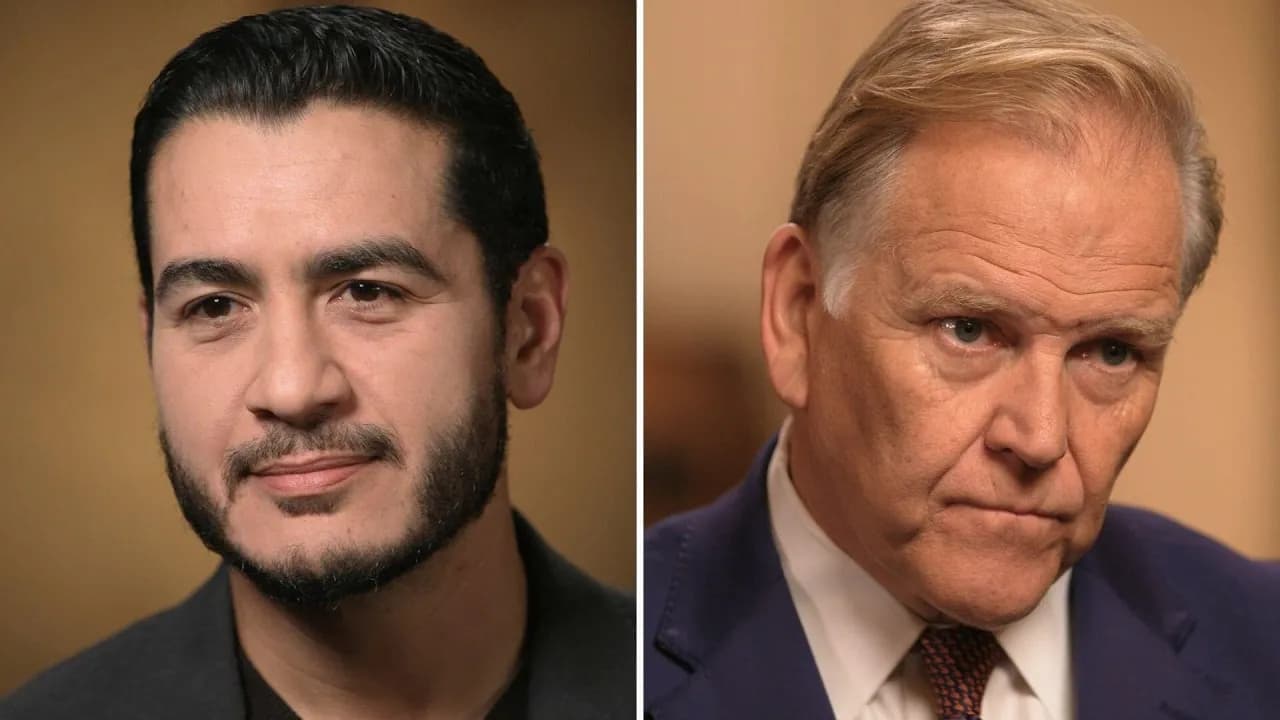
Extended Interview: Republican Michigan Senate candidate Mike Rogers
In a Nutshell
Mike Rogers is running for U.S. Senate in Michigan as a Republican focused on reversing the state's economic decline—lost manufacturing jobs, highest Midwest utility rates, worst auto insurance costs, and 2/3 of fourth-graders reading below grade level. He argues his 14 years in Congress, coalition-building experience, and ability to work across party lines distinguish him from his opponent Abdul El-Sayed, whom Rogers labels a "Democrat socialist" with ties to the Muslim Brotherhood and positions that equate Israel with Iran. Rogers claims his ground game has knocked on 6 million doors and is building an unprecedented bipartisan coalition, including Jewish Democrats and African-American pastors, driven by voter frustration over inflation, energy costs, and eight years of Democratic control in Lansing.
These notes were generated by AI and may contain inaccuracies.
Rogers spent 14 years in Congress, eight years in the private sector as a cybersecurity professional, and returned to politics in 2024 because Michigan faces severe economic and educational challenges. The state has lost 200,000 manufacturing jobs since 2000, holds the highest utility rates in the Midwest, has the highest auto insurance rates in the country, and ranks 46th overall in economic performance. Two-thirds of fourth graders cannot read at grade level, creating a 70 percent chance of future imprisonment or welfare dependence. Rogers argues these trends can be reversed through manufacturing revival, utility rate reduction, housing affordability improvements for younger buyers, and restoring shop classes to connect students with skilled trades.
Rogers emphasizes focusing exclusively on Michigan issues despite running in a national environment. Michigan represents a change election after eight years of Democratic control in Lansing and 25 years without a Republican U.S. senator. The state is purple rather than red, with voters prioritizing practical solutions over national partisan battles. Rogers claims to have built coalitions no recent Republican has achieved, centered on opportunity, hope, and prosperity rather than national political trends.
When asked what would be different with Rogers joining the existing Republican Senate majority, he states he will get things done through coalition-building rather than partisan positioning. He references his experience as House Intelligence Committee chairman where he partnered with the ranking member, a former prosecutor, to prioritize national security over party differences despite their FBI agent and prosecutor backgrounds.
Rogers highlights specific educational failures: in Detroit, 15 percent of eighth graders read at grade level and 12 percent perform math at grade level. Local fabrication and tool-and-die shops have removed measuring tape questions from interviews because high school graduates cannot understand fractions. Rogers' father was a shop teacher who required all five sons to take shop class. He proposes legislation making reading literacy the top bipartisan priority, followed by restoring shop classes in every high school and expanding skilled trades programs for jobs that artificial intelligence cannot replace and China cannot steal.
Rogers comes from a fourth-generation military family including his father, brother, himself, and son. His wife served in Iraq and her father was a retired lieutenant colonel. He notes military recruiting failures during COVID occurred partly because recruits could not pass reading tests, making literacy reform essential for national security.
Voters consistently identify cost as the top issue, particularly fuel costs driving food prices higher. Rogers called for ending the Iran conflict after achieving original objectives of preventing nuclear capability and diminishing Iranian military capacity. He supports a temporary fuel export ban to address diesel costs affecting Michigan agriculture during September and October harvest periods, along with agricultural rebates to protect farmers.
Rogers argues that ending the Iran conflict will provide immediate downward pressure on fuel prices. He contrasts Democratic solutions like the Green New Deal, which he claims would raise utility rates by $2,000 per household and increase gas prices by 20 cents per gallon, with Republican approaches focused on American energy production and deregulation. He notes Democrats in Lansing raised gas taxes by 20 cents to 52 cents per gallon and rejected his proposed gas tax holiday for commuters during the conflict.
Rogers cites positive Michigan developments including General Motors moving Chevy Silverado production from Mexico back to the Orion plant, Detroit Diesel adding a third shift, and small manufacturers gaining additional work through reshoring. He supports Trump tariffs overall for protecting Michigan industries but opposes Canadian tariffs, noting the integrated U.S.-Canada automobile supply chain where Jeep Cherokee components cross the Detroit-Windsor bridge multiple times during manufacturing.
Canada imposes tariffs up to 400 percent that harm Michigan dairy farmers. Rogers argues for fairer trade while acknowledging the integrated North American auto industry makes abrupt tariff changes disruptive. He positions himself as someone willing to have direct conversations with the administration to fix policies harmful to Michigan rather than building separate political movements.
Before becoming a senator, Rogers successfully reopened the Gordie Howe Bridge after it was shut down due to Canadian government-White House conflicts. He also resolved a dispute between Michigan's governor and the White House that had blocked FEMA funding for ice storm damage in northern Michigan, demonstrating practical ability to work across government levels.
Rogers supported the original Iran conflict objectives of eliminating nuclear capability and diminishing army, navy, and air force capacity, noting Iran's sponsorship of Hamas's October 7th attack that killed 1,200 people. He argues Iran is the leading state sponsor of terrorism through support for Hamas, Hezbollah, and Houthis. He advocates ending the conflict now that objectives are achieved, returning to the first Trump administration's containment strategy using sanctions and sufficient military presence to prevent nuclear site reactivation.
The containment approach includes crippling sanctions and enough military capability to deter nuclear site development. Rogers argues this can be accomplished with fewer than three carrier groups currently deployed. He believes reduced presence would allow internal Iranian opposition to the regime to strengthen without requiring direct U.S. intervention for regime change.
Rogers supports using Senate tools to override presidential tariffs harmful to Michigan if direct negotiation fails, arguing each state has unique economic interests that one-size-fits-all policies may not serve. On Iran policy, he refuses to speculate on hypothetical congressional actions to end conflicts but commits to thorough fact-gathering on military and intelligence assessments before offering specific recommendations once in office.
The relationship between the US and Israel represents a key point of contrast with opponent Abdul El-Sayed. The candidate passionately defends Israel's right to defend itself and to exist as a Jewish state, noting this immediately sets him at odds with his opponent who refuses to acknowledge Israel's right to exist and equates Iran with Israel.
The candidate argues this position is disqualifying for Senate service, stating: "If you don't know who your friends and enemies are around the world, that's trouble." He criticizes the use of terms like "genocide" and "from the river to the sea" chants, noting these create fear and division.
Jewish students at the University of Michigan have reported needing to hide their Star of David to walk across campus due to harassment. The candidate describes meeting with students who receive predominantly anti-Israel information, noting that when leaders use inflammatory language like "genocide" and "blood lust," it amplifies dangerous rhetoric.
He highlights that Jewish Democrats for Rogers is a fast-growing coalition due to concerns about their children's safety and what kind of America they will grow up in. The candidate notes this is becoming part of the "Democrat socialist agenda" that requires being anti-Israel, citing a recent 7,000-delegate Democratic meeting where attendees had to acknowledge "genocide" to enter.
The candidate proposes starting with universities, requiring real anti-semitic programs with enforcement mechanisms. He has already spoken with University of Michigan regents about beginning conversations before being sworn in if elected. The University of Michigan recently issued eight indictments against students involved in pro-Palestinian protests, including one who worked for Abdul El-Sayed.
The candidate notes incidents including a chemical device thrown through a Jewish regent's window, slashed tires, and graffiti targeting university regents. He also argues Qataris should not send money to universities, citing concerns about influence against anti-Semitism.
The candidate references a terrorist attempt to kill 130 children in Michigan by placing explosives in a vehicle and driving through a door. He criticizes the opponent's response that condemned the attack but stated "hurt people hurt people," arguing this provides contextual justification for violence based on disagreement with policies 5,000 miles away.
The candidate rejects the notion that the terrorist had the right to attempt killing children due to policy disagreements, emphasizing this interpretation is shared by Jewish Democrats who are supporting his campaign.
The candidate describes the October 7th attack where Iranian-funded terrorists raped, murdered, killed families, put babies in ovens, and cut off women's breasts. He draws an analogy to what would happen if Mexicans crossed the border and killed 40,000 Americans, arguing America would need to respond similarly to Israel's actions.
He emphasizes the importance of language, criticizing both media and the opponent for giving passes to inflammatory rhetoric that continues to spiral out of control.
The candidate argues no solution is possible while Hamas remains in charge, noting they demonstrated their capabilities on October 7th. While acknowledging potential different approaches might have been possible, he emphasizes America has seemingly forgotten the 1,200 people killed and the next generation of children is being influenced to think being against Jews is "cool."
He states this sounds like 1933 rather than today, arguing it's not the America he wore the uniform to defend.
The candidate argues criticism of Israel must be separated from criticism of being Jewish, noting that information reaching young people is "out-and-out anti-Jewish" with outside influences pouring into inboxes. He distinguishes between legitimate policy discussions with people like Jewish voters who don't like Netanyahu versus campaigns that essentially argue "Israel is our problem" and "if you're Jewish, you're our problem."
The coalition includes several prominent Democrats who have publicly stated they cannot support Abdul El-Sayed because he is "too extreme," including the Democrat state party chairman, one of Alyssa Slotkin's finance chairs, Senator Cory Booker who called him a "fringe candidate," and CNN commentator Van Jones who described his policies as "insane."
This has enabled productive conversations in Detroit's African-American community focusing on housing issues, education, affordable housing, and food deserts. The candidate proposes community-run grocery stores rather than government-run solutions, teaching commercial enterprise skills.
The candidate contrasts his approach with El-Sayed's dismissive attitude toward pastors, noting El-Sayed told a group he didn't need their votes. The candidate has held pastor meetings across diverse congregations, spoken with law enforcement and city council members about skilled trades and education improvement.
He notes one pastor's church hadn't had a Republican in 76 years, yet the candidate was welcomed for conversations. A pastor called after a meeting to say "You don't have a hole in your heart" and offered to help in the city.
Democrats for Rogers yard signs are the fastest-selling campaign materials, with the coalition growing particularly in Detroit. One elected Democrat helping the campaign cited a pamphlet promoting making Detroit a "Democrat socialist of America city" as motivation to support the candidate instead.
The candidate addresses voters who want to support him but worry about empowering the Trump administration, citing his congressional record including voting against TARP bailout despite presidential pressure, arguing it wouldn't help Michigan, while supporting the auto bailout.
He emphasizes willingness to push back when needed regardless of who is president, focusing on concrete issues like children's reading, homeownership accessibility for people in their 20s, and bringing advanced manufacturing jobs including ship building, submarine components, drones, and aerospace industry support.
The campaign has knocked on over six million doors, building what the candidate claims is the largest ground game in Michigan history with tech-enabled organization. The campaign is hearing that voters are concerned about utility rates, gas prices, and costs from Green New Deal policies and higher taxes.
The candidate notes polling challenges in capturing support from Jewish Democrats (projecting 35,000 of 70,000 votes) and African-American voters in Detroit who don't typically answer polls, emphasizing these voters aren't reflected in traditional polling data.
Rogers reports no evidence of Trump voters defecting to Democrats in this election. Michigan is identified as a purple state where Democrats have controlled Lansing for eight years and held both US Senate seats for 26 years. Economic indicators have declined under Democratic leadership, with utility rates, gas prices (raised 20 cents per gallon), and the Green New Deal legislation cited as sources of voter frustration. The speaker notes that Democrats have raised utility rates nine times since 2023, with the most recent increase occurring the week prior.
Rogers criticizes poll accuracy, citing Abdul's primary where polls showed a 15-point lead but resulted in a victory margin of nine-tenths of one percent. He reports that polls undercounted Republicans by approximately four points in recent races. The campaign focuses on door-to-door engagement in Detroit, targeting traditional Republicans and hesitant Democratic voters.
Rogers positions himself as an independent voice in Washington, emphasizing his past work on intelligence budgets as part of the most bipartisan House group and his handling of the TARP legislation. He states that his track record demonstrates independence and that he previously did what was right for Michigan despite presidential pressure.
Rogers highlights his FBI training in organized crime and public corruption as preparation for serving Michigan's interests in the Senate. He commits to evaluating facts on a case-by-case basis rather than engaging in speculation about alleged Trump administration corruption.
Regarding the president's acceptance of a jet from a Middle Eastern nation, Rogers states he would not have accepted it and would have ensured congressional review to avoid questions of impropriety, though he believes it was not illegal.
Rogers supports Senate examination of family members of high officials conducting business deals connected to US foreign policy when those activities work against American interests. He acknowledges having received presidential calls in the past and claims his record shows he prioritizes Michigan's interests.
Rogers expresses opposition to sanctions relief for Putin and the diesel deal. He emphasizes his willingness to work directly with the White House on these issues rather than seeking media attention. He worked under the Biden administration as committee chair, addressing disagreements through direct engagement rather than press releases.
Rogers argues that Michigan politics will change with a senator focused on state-specific issues like increasing defense industrial base work, improving education, and strengthening the economic picture. He states Michigan has lacked US senators prioritizing these state needs for a quarter century.
The first economic priority identified is maintaining low energy costs through expanded American energy production. Rogers warns that additional bureaucratic requirements and Green New Deal mandates would be disastrous for Michigan, potentially dropping the state to 50th in economic rankings.
Rogers proposes a national security framework with guardrails to prevent AI from advancing beyond regulatory control. He advocates for narrowly crafted antitrust legislation allowing AI companies to cooperate on safety issues, enabling sharing of safety discoveries between companies to prevent mistakes.
Rogers expresses concern about AI-driven job losses and the rapid pace of AI development, noting the technology now doubles in capability every nine months compared to previous 18-month cycles. He emphasizes the need to avoid falling behind China or Russia in AI capabilities while protecting domestic workers.
Rogers references former Russian Defense Minister Shoygu's statement that whoever wins the AI race wins the next war. He contrasts American productivity-focused AI development with Russian weaponized automated systems, stressing the need to prevent adversarial AI-driven weapon systems from creating strategic disadvantages.
Rogers describes his opponent as a "Democrat socialist of America" with strong speaking abilities but problematic policy outcomes. He criticizes the opponent's support for defunding police, releasing prisoners, government takeover of private healthcare, and 100% renewable energy mandates within ten years.
Rogers raises concerns about his opponent's relationship with the Muslim Brotherhood, citing the opponent's op-ed supporting the organization during Egypt's 2012-2013 transition, financial connections to former Muslim Brotherhood spokesmen, and front-page congratulations from the Muslim Brotherhood upon his candidacy announcement. He also mentions the opponent's failure to condemn a Hezbollah-sponsored terrorist who attempted to kill 130 Michigan school children.
Rogers gives the Trump administration an A++ for job creation in Michigan, citing the third shift at Detroit Diesel, multi-billion dollar Chevy Silverado investment, and General Motors' plan to build 500,000 more cars domestically. He notes Michigan was the only state to lose 27,000 manufacturing jobs in the previous eight years while the rest of the country gained 100,000.
Rogers acknowledges criticisms of the Canadian trade war and Iran policy as factors lowering the overall grade. He emphasizes his approach of direct engagement to resolve issues rather than public confrontation, citing successful past interventions on the Gordie Howe Bridge and northern Michigan FEMA funding.
Rogers reports speaking with the president approximately one month prior and maintaining regular contact with Commerce Secretary's office regarding Canada trade issues. He notes the administration is aware of his pending return to Washington and appears receptive to Michigan-specific concerns.
Keep 60 Minutes in your library
Save the videos and channels worth coming back to, and find them again in one place.