How Did Ancient Humans Survive the Savannah Heat?
In a Nutshell
Ancient humans survived the savanna’s extreme heat by evolving exceptional heat tolerance—dense full-body sweating, near-naked skin, and upright posture—allowing them to remain active when all other large animals were immobilized. They weaponized this advantage through persistence hunting at midday, forcing prey to overheat while hunters kept cool. Water storage and midday rest further extended these physiological edges, turning the hottest hours into the safest and most productive time for survival.
These notes were generated by AI and may contain inaccuracies.
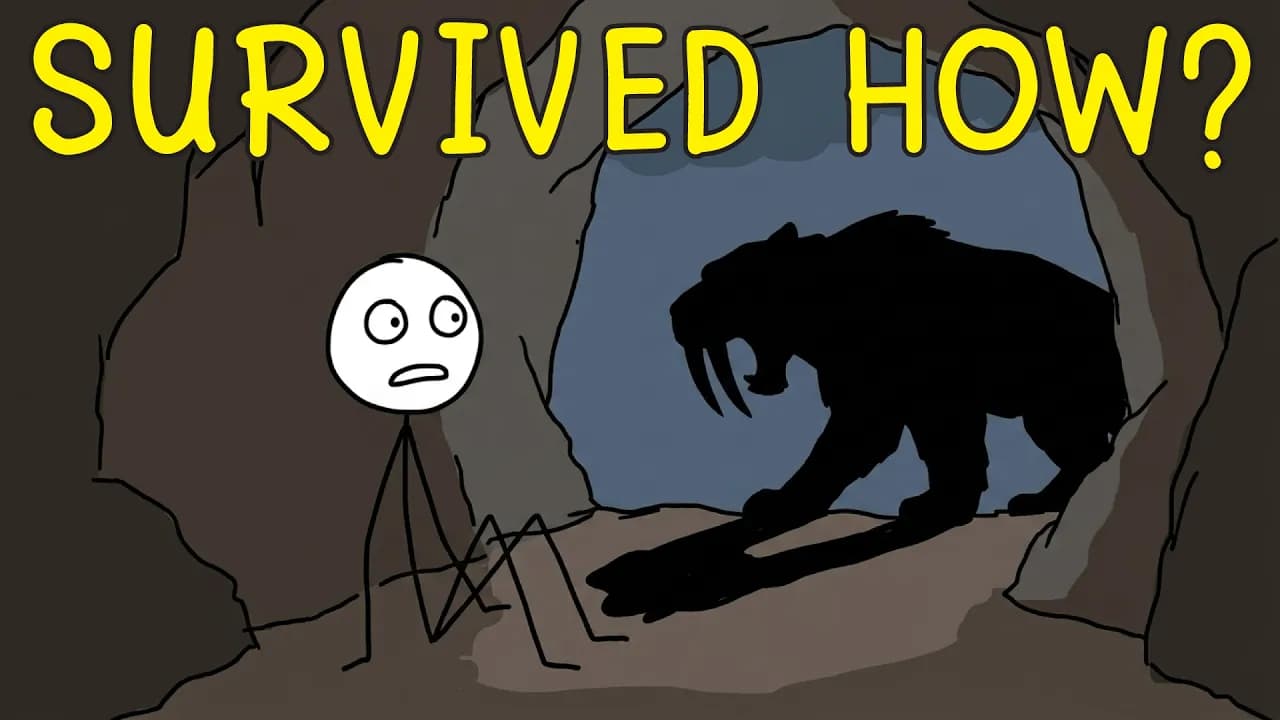
It is a hot afternoon in the African savanna. The temperature is approximately 45 degrees Celsius. The sun is directly overhead, and there are no clouds covering the place. The grass is dry, and the ground radiates heat upwards. All the large predators, lions, tigers, and hyenas, lie motionless in any shade they can find, conserving their energy, waiting for the temperature to drop. All the large herbivores stopped moving, stood with their backs to the sun, and breathed slowly. A group of humans are running across the open plain, chasing a kudu.
This is not a story of surviving the heat, but a story of surviving because of it, and understanding this difference changes your view of your body. Two million years ago, when your ancestors moved from the forest to the open savanna, they entered one of the most thermally harsh environments on the planet. Flat, exposed land, without permanent shade, under the scorching tropical sun for 12 hours a day. The problem was not the danger of the heat itself, but that all the other large animals were adapted to it, and many of them were eager to devour your ancestors, and there was nowhere to hide.
The solution your ancestors came up with was not to avoid the heat, but to become more tolerant of it than any other living being. In doing so, they inadvertently turned the hottest hours of the day into the safest time of their lives.
Every mammal in the savanna produces heat when moving. Running generates enormous amounts of internal body heat, and this heat must escape somewhere, otherwise the animal will die from overheating. Large mammals solve this problem primarily by panting. Dogs pant, lions pant, wild animals pant. The evaporation of moisture from the respiratory system draws heat from the blood, thus cooling the animal from the inside. This method is highly effective, but panting has a fundamental flaw. To do this effectively, the animal needs to slow down or stop completely, because it is not possible to maintain maximum speed and pant efficiently at the same time. The respiratory system and the locomotor system compete for control of the breathing cycle, and when a certain speed is exceeded, the locomotor system prevails, cooling stops, and the animal's temperature rises.
Humans do not suffer from this problem; they sweat. The human body contains between 2 and 4 million sweat glands distributed across the entire surface of the skin. No other primate has this density of sweat glands. A person running at maximum effort can produce more than a liter of sweat per hour. As this sweat evaporates from the skin's surface, it draws heat directly from the blood flowing through the capillaries just beneath the skin. Cooling occurs across the entire body surface simultaneously, regardless of breathing, and continues to operate at full capacity regardless of the person's speed. The regulation of human body temperature does not compete with movement, but rather runs parallel to it.
The second adaptation that makes all this possible is nudity. With the exception of a thin layer of fine hair, humans are the only hairless great apes. In the savanna, fur becomes a hindrance, trapping heat generated by movement on the body instead of allowing it to dissipate. When the human race developed bare skin about 1.6 million years ago, the efficiency of cooling through sweating increased dramatically. The skin surface became completely exposed to the airflow, and every movement in the dry savannah air accelerated evaporation. The human body has, in effect, become a mobile cooling system whose efficiency increases the more it moves.
The third element is the upright body posture. A person who walks on two feet at noon exposes only the top of their head and shoulders to direct sunlight, a small portion of their total body surface area. While the four-legged animal exposes its entire back and sides. A study published in the Proceedings of the National Academy of Sciences showed that a bipedal human absorbs about 60% less solar radiation at noon than four-legged animals of the same size. Reduced absorption of solar heat means less effort required from the cooling system. The standing posture that made humans slower and more visible than other animals also made them remarkably more efficient at dealing with heat when it was intense.
By combining these three adaptations—acute sweating, bare skin, and bipedalism—we get something unprecedented in the animal kingdom: a large mammal capable of maintaining continuous, moderate-intensity movement during the hottest hours of the day without its body temperature rising. Under the same conditions in which heat paralyzes all other large animals, the San Bushmen of South Africa and the Tarahumara of northern Mexico still practice stalk hunting, the technique for which these biological adaptations were designed. The hunter does not run at top speed, but rather trots after the animal at a pace that the animal can easily outrun. But the hunter never stops. Each time the animal slows down to rest or pant, the hunter reappears on the horizon, forcing it to resume movement. This is repeated for two, three or four hours during the midday heat.
The animal, restrained by panting, cannot cool itself adequately while moving. As for the hunter, he keeps his body temperature constant at all times, sweating profusely. Eventually, the kudu or oryx stops running not because of exhaustion in the traditional sense, but because its body temperature has risen above the threshold of safe activity. His muscles begin to spasm, and he falls to the ground. The hunter approaches him and kills him.
Anthropologist Louis Lipenberg, who documented stalking among the San Bushmen tribes and published his research in the Journal of Contemporary Anthropology, describes observing hunters tracking and chasing animals for distances of up to 35 kilometers in ambient temperatures exceeding 40 degrees Celsius. The hunters finished these chases drenched in sweat, but still able to move. In some cases, the animals they hunted were suffering from a very high fever to the point of muscle failure. Not only did humans survive the heat of the savanna, but they also used it as a weapon at the right time of day and in the right circumstances.
Hunting by hard work was not the only trick, for even the most heat-adapted bodies have limits, and exceeding these limits means death. The most important resource in the open savanna is not food, but water. A person who sweats profusely during their midday activity may lose more than one liter per hour. Dehydration weakens the body's temperature regulation. With a decrease in blood volume, the body reduces blood flow to the skin, which reduces the rate of sweating, and thus cools the body less, leading to an increase in internal body temperature.
The old solution was not to reduce sweating, but to carry water. It is almost certain that the first vessels used by humans were animal bladders or stomach pouches. Flexible, waterproof, and available anywhere an animal is slaughtered. Later, ostrich eggshells appeared, which the San Bushmen people still use today. Hollow, sealed with a plug of grass, and buried in the ground at strategic locations across the region so that water is available at known points along the usual travel routes.
Anthropologist Polly Wisner of the University of Utah documented these water storage networks among the Ju/Huansi people, and described how knowing the locations of water reservoirs was among the most important pieces of information a family possessed, and was kept very carefully. People did not simply drink water once they found it; rather, they planned their movements based on where it was stored, as the stored water enabled them to perform actions that might otherwise have been fatal.
The timing of the move was also crucial. Ancient humans organized their activity according to the thermal environment, just as any advanced living organisms do. Dawn and dusk, the coldest periods with reasonable light, were peak times of activity for travel, foraging, and socializing. As for the intense midday heat, when temperatures reach their peak and the sun is directly overhead, it was reserved either for resting in any available shade, or specifically for continuous hunting when the heat was in a person's favor. Activity resumes in the late afternoon as temperatures drop.
Evidence of this pattern is preserved among the Hadza people of Tanzania, one of the last true hunter-gatherer groups studied by researchers today. Anthropologist Frank Marlow of Cambridge University documented their daily activity patterns and found consistent evidence of a midday rest period. A few hours of relative inactivity at the height of the daytime heat, during which social customs, storytelling, and crafts replaced strenuous physical activity. This was not laziness, but rather sophisticated thermal management. Napping is not just a cultural custom, but a biological strategy that humans have practiced for hundreds of thousands of years, and have only recently abandoned.
Another adaptation worth knowing is that the human brain is very sensitive to heat. It only takes a rise of just two degrees above the normal core body temperature for cognitive functions to begin to deteriorate. Reaction time slows down, decision-making declines, and concentration becomes difficult. For an animal whose survival depends on its intelligence, a rise in brain temperature is incomparably more catastrophic than a rise in muscle temperature. The naked, sweaty, erect body not only moves efficiently in the heat, but also protects its most precious possession from the one thing that could render the entire survival strategy useless.
Your ancestors came out of the forests into a land that was supposed to kill them. Bright sun, few shadows, and scattered water sources. But every predator adapted to these conditions, and every prey became faster over short distances. The heat, which was supposed to be the final obstacle, turned into the solution. Not because they found ways to circumvent it, but because two million years of natural selection transformed their bodies into machines specifically designed to run, fight, hunt, and survive in it, while nothing else is capable of doing so. Every time you sweat, you are using a system that has been developed over two million years on a burnt plain for this very purpose. It works so efficiently that you don't notice it until it makes you feel uncomfortable in your shirt.
Keep Axen in your library
Save the videos and channels worth coming back to, and find them again in one place.