How I Use Vitamin D3 & K2 to Heal Arteries
In a Nutshell
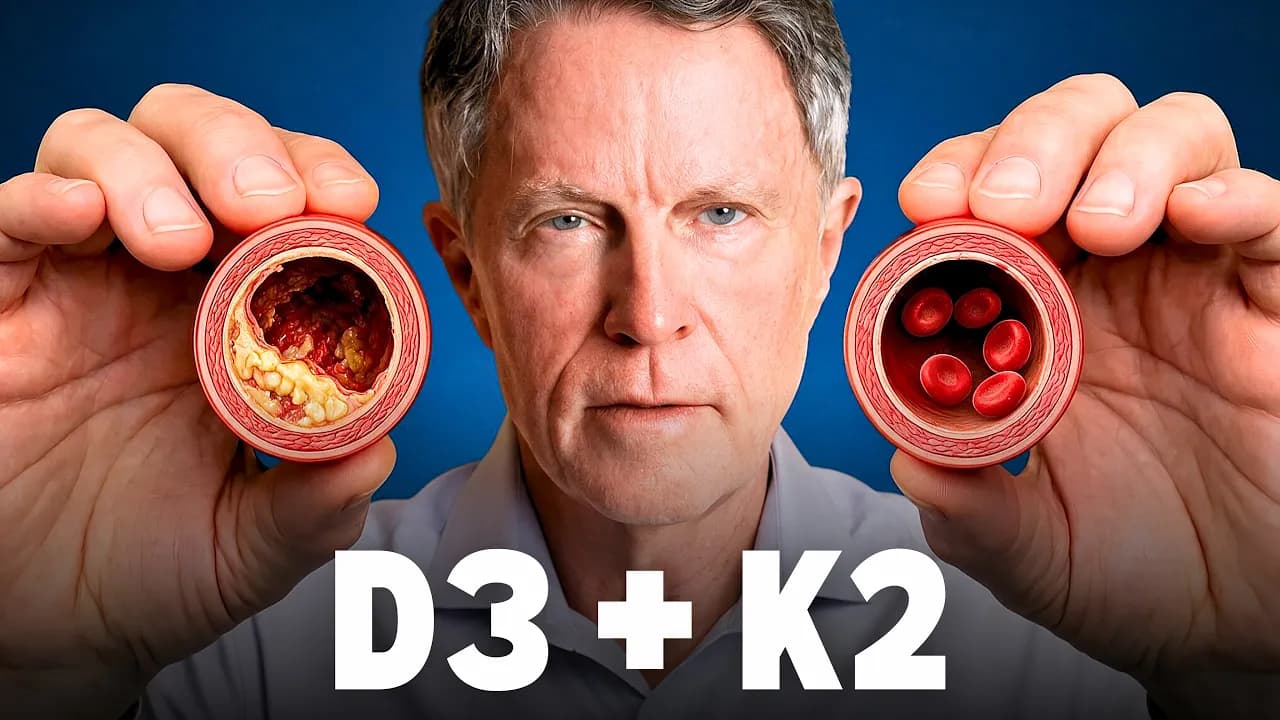
Vitamin D3 (target 50-90 ng/mL via 4,000-8,000 IU/day, test and adjust) supports artery health by regulating blood pressure, boosting nitric oxide, reducing inflammation, and improving insulin sensitivity. Vitamin K2 (≥400 mcg MK4 or equivalent MK7 daily, avoid low-dose combos) activates matrix GLA protein to prevent arterial calcium buildup, stabilizes plaque, and enhances insulin resistance without "pulling calcium out." Together they promote stable, rupture-resistant plaque but require lifestyle changes (low-carb diet, exercise, sleep) for full effect; test levels, take separately to avoid overdosing D3.
These notes were generated by AI and may contain inaccuracies.
Most people take D3 and K2 completely wrong. Dr. Ford Brewer and Dr. Vega may have contributed to confusion with a popular short video that left important details unsaid. Today, they explain how D3 and K2 work, interact, why most underdose one due to combination setups, why combo pills cause trouble, and how to use them to protect arteries.
Dr. Ford Brewer has a long history in preventive medicine, started at Johns Hopkins, ran the program teaching other docs. Dr. Jesus Vega is well trained in preventive medicine.
Everybody hates clickbait, but everybody clicks on it. They aim to provide information nobody else gives. Start with why D3 helps artery health beyond bones.
D3 acts more like a hormone than a vitamin, with receptors throughout vascular system, arteries, heart muscle, artery walls, and immune cells involved in cardiovascular inflammation.
- Calms blood pressure via built-in regulation system like a thermostat; low D3 keeps vessels tighter, pressure higher.
- Helps inner lining (endothelium, one cell thick with glyocalyx) make more nitric oxide to relax and open artery walls, reducing stiffness and stickiness to cholesterol and white blood cells.
- Cools inflammation, shifts immune system from chronic low-grade fire driving plaque growth and instability.
- Improves insulin response; better blood sugar control reduces plaque growth damage and stabilizes plaque.
Low D3 causes higher pressure, stiffer/stickier walls, more inflammation, worse blood sugar—all simultaneous.
D3 neglected for decades, now trending; people take high doses. Beyond osteoporosis/bone health, D3 deficiency is major issue.
Bone story real but fraction of D3 effects. Low D levels linked to higher heart attack, stroke, heart failure rates, metabolic disease, mental health issues. Mechanisms debated but biological links exist.
Science started 100 years ago with rickets prevention; stayed there until ~20 years ago when deeper research began, still debated. Lab normals say 25-40 ng/mL fine, but during COVID, low levels problematic for immunity, debunking rickets-only view.
Optimal levels debated: 20-40 vs. 40-90 ng/mL (Brewer proponent of latter). Problems like kidney damage/death at 105-110+ ng/mL.
Patients think K2 pulls calcium from arteries to bones—not accurate. Focus on plaque: high calcium score not always risk; uncalcified/soft plaque is dangerous (early, unorganized, unstable). Body organizes, strengthens, stabilizes plaque then adds calcium.
Chasing calcium out misses benefit. Matrix GLA protein (MGP) is calcium guard in artery walls; grabs calcium, prevents wrong deposition, steers to bones. Without K2, MGP inactive. K2 activates it, slows new calcium deposit in arteries.
Calcium in plaque not bad—stabilizes, hardens, less rupture-prone (e.g., Honda study: stable plaque risk near normal). High calcium score often marks unstable plaque presence or past bad metabolism now calcified via lifestyle change.
Standard American diet (Doritos, McDonald's, refined carbs) causes inflammation, soft plaque patched ineffectively with calcium islands.
Low-carb diet, blood sugar <140, exercise, stress/sleep management creates healthy calcification: uniform calcium layer, fibrous muscle fibers, thicker cap, less rupture-prone.
High calcium good if lifestyle improved (cleans soft plaque); bad if not (building unstable plaque).
K2 improves insulin sensitivity → less inflammation → more stable plaque. Not calcium in/out.
Internet mixed. Calcium in arteries stabilizes (hardens, less crack/rupture); target less soft/unstable plaque.
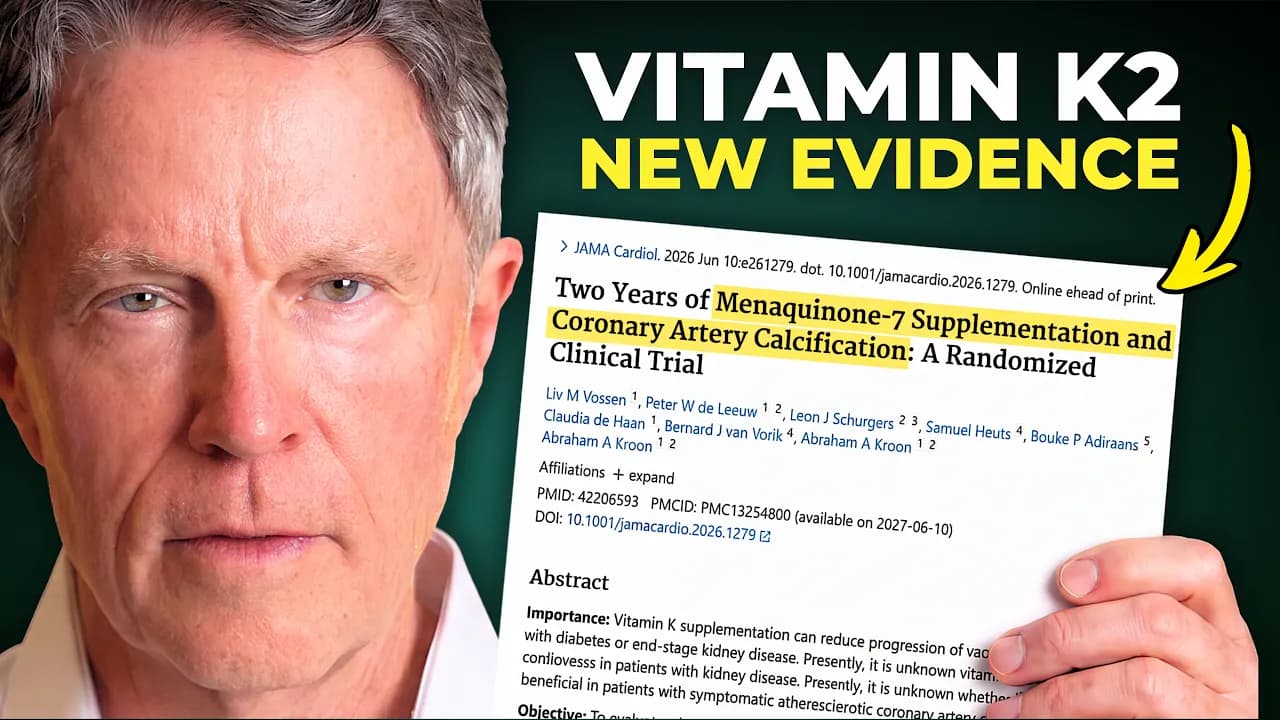
EVADECK trial: high-dose K2 + D (2 years, high-risk): K2 group numerical reduction in non-calcified plaque volume (-6 mm³ vs. +46 placebo), not statistically significant (small n, imaging issues)—research signal.
Stronger evidence: slower calcium progression, high-calcium subgroup fewer heart attacks, revascularizations (stents, bypasses), lower all-cause mortality (biggest signal).
1% plaque reduction = 25% average risk reduction, but stability > size reduction; stable/calcified plaque reduces risk even if grows.
K2 activates MGP (low K2 → brittle calcification, plaque hemorrhage); improves insulin resistance → less inflammation → stable plaque. May mature plaque to stable calcified form; no strong proof shrinks soft plaque.
Goal: stable non-rupturing plaque reduces heart attack/stroke risk.
Test D3, don't guess: target 50-90 ng/mL (25-hydroxy vitamin D) for CV risk (vs. 20+ for bones). Many need 4,000-8,000 IU/day; start 5,000 IU, test serum, adjust (body size, absorption, fat mode, genetics affect). <1/2 of hundreds/thousands hit target on 1,000-2,000 IU. Aim, test, adjust. Deaths from excess D3; don't guess forever.
K2: shelf supplements 45-90 mcg (too low). Trials use 180-360 mcg MK7 (longer blood levels, better protein activation). Brewer uses mostly MK4 (sourcing/practicality). Protocol for soft plaque/CV risk/diabetes/inflammation: ≥400 mcg (vs. 90 in combos).
Combo pills backwards: high D3, low K2 due to cost. Lower calcium score not always better; D3/K2 influence plaque biology to stable form.
D3: test to 50-90 ng/mL, start 4,000-8,000 IU/day. K2: 400 mcg (MK4). Combos have ~90 mcg K2—issue. MK7 lasts longer but availability/comparisons ongoing.
Evidence suggests MK7 lasts longer, but availability issues exist, and comparisons are ongoing. Some use both MK4 and MK7; higher MK4 doses around 45 milligrams, mostly for osteoporosis prevention, combined with D3.
MK4 works just as well as MK7 with adequate higher dosages taken regularly, despite MK7's longer half-life advantage at equivalent doses. Sourcing issues favor MK4, especially at desired prices. Practical approach prioritizes results over theory: appropriate MK4 doses achieve the same outcomes as MK7.
D3 and K2 work as a team: D3 aids blood pressure signaling, inflammation, insulin sensitivity; K2 activates proteins directing calcium from artery walls to bones. They complement each other but cannot out-supplement a poor lifestyle. Supplements and medications rank last for prevention—lifestyle is first-line.
Supplements are like expensive urine if lifestyle is ignored.
Doctors often dismiss supplements and lifestyle due to patient non-compliance after repeated advice on weight loss, diet, and supplementation fails. Burnout leads to drug focus. Self-motivated patients who implement lifestyle changes benefit most from supplementation discussions.
Question from JMK: If calcium in artery linings stabilizes coronary plaque, why pull it out with K2?
Not all calcium is bad; plaque stability matters. K2 addresses misplaced calcium.
Question from V Talumni: Doesn't K2 cause blood clotting and increase heart attack risk?
"K" comes from German for coagulation, but K1 relates more to clotting than K2.
Question from Henry: Takes 25,000 micrograms (25 milligrams) concentrated K2 plus 500 micrograms MK7, with 10,000 IU D3 daily for arterial health and immunity—rarely gets sick.
25 milligrams MK4 or 500 micrograms MK7 aligns with recommendations; test D3 levels first. Sometimes recommend 10,000 IU D3, but test first. D3 acts like a hormone, stored in body fat; weight loss mobilizes it into bloodstream. Obesity sequesters D3 in fat cells. Sun exposure (e.g., 20,000 IU equivalent) does not reliably raise blood D3 levels like ingestion.
Wife indoors supplementing 1-2,000 IU has higher D3 than golfing husband with 20+ hours Florida sun weekly—sun does not guarantee D3 production. Aging impairs sunlight-to-D3 conversion; darker skin reduces efficiency. Sunlight sounds natural but often fails.
High-dose D3 (10,000-50,000 IU daily, meant for weekly use) can cause toxicity despite claims otherwise. Seen levels of 115-130 ng/mL with kidney damage in several patients (less than half a dozen); all reversed after stopping D3, but not always guaranteed. No strong evidence for extra benefits above 100 ng/mL; aim for safe 50-90 ng/mL. Avoid 20,000+ IU daily.
K2 has no recorded bad side effects—safe like B12. Mega-doses (40-50 milligrams) standard for osteoporosis management.
High blood calcium from D3 is rare overall but riskier at 20,000-50,000 IU daily. Toxicity understudied since most have deficiency. Kidney damage occurs via stones, but also artery tightening to kidneys reducing blood flow/fluid—gradual, not acute. Impacts kidney cells without stones.
Typical pills: 5,000 IU D3 + 90 micrograms K2. To reach 400 micrograms K2 requires 4-5 capsules (20-25,000 IU D3)—danger zone. Single pill gives insufficient K2. K2 expensive, hard to source; D3 cheap—companies skimp on K2 for cost.
Solution: Take D3 and standalone K2 separately to hit 400 micrograms K2 without excess D3. Do not discard combined pills; add separate K2.
Inflammation (not plumbing) drives issues; American College of Cardiology acknowledges shift, but practice lags—more stents/bypasses despite warnings. CRP elevated in non-vascular inflammation (e.g., two patients yesterday); better markers: LP-PLA2, MPO, microalbumin/creatinine ratio.
Undiagnosed metabolic disease primary driver.
Growing old is not for sissies, but easier with healthier arteries. Diagnose undiagnosed metabolic disease, fix lifestyle.
Upcoming video: Test predicting 98% of heart attacks.
Haters gonna hate.
Keep Thomas Fordham Brewer MD MPH in your library
Save the videos and channels worth coming back to, and find them again in one place.