The Vitamin D Level that Actually Stops Heart Attacks (Most People Never reach it)
In a Nutshell
The Utah study showed that targeting vitamin D levels between 40-80 ng/mL cut heart attack risk in half (7.9% to 3.8%) among recent heart attack patients, unlike prior trials that failed because they used fixed doses without measuring blood levels. The key is reaching this optimal range—below 40 is harmful, above 100 provides no extra benefit, and 50-70 may be ideal—rather than focusing on any specific dose amount. This requires testing and adjusting, not just taking a standard 2,000 IU supplement and assuming it's sufficient.
These notes were generated by AI and may contain inaccuracies.
There's a vitamin that has been shown to help heal arteries, yet many people don't connect the dots on its importance for the heart. Some people think they can take humongous amounts and still be fine, but this vitamin has a danger component. A new study indicates this vitamin reduces heart attack risk, but it must be taken the right way—keeping levels in the right range.
Vitamin D works on the lining of arteries, the smooth inner layer of the pipe. Those cells have receptors for vitamin D, and so do the muscle cells in the wall behind them. When the lining is healthy, it makes nitric oxide, the signal that tells the pipe to relax and keeps inflammation in the wall quiet. When vitamin D runs low, the lining makes less nitric oxide, the wall gets stiffer, and inflammation runs hotter. Low vitamin D travels with insulin resistance, the engine behind most plaque. Inflamed soft plaque cracks, a clot forms on the crack, and that clot is a heart attack or stroke. Vitamin D works on the inflammation side of that chain.
Previous big trials found nothing because they gave everybody the same fixed dose and never measured. They never knew who got to a healthy level. They just knew they gave everybody 2,000 international units.
A group at a major heart institute in Utah conducted a randomized trial published last month in one of the top cardiology journals in Europe. The study included 630 people, all just out of the hospital after a heart attack. Half got usual care, the other half got vitamin D3 dosed to their blood levels. They measured, adjusted, measured again, and targeted a level above 40 but less than 80 nanograms per milliliter. The average starting level was 25, and 87% were at or below 40 when they started.
After four years, the combined score of death, heart attack, heart failure, and stroke came down from 18.4% to 15.7%, but that wasn't statistically significant. Heart attacks went from 7.9% down to 3.8%, better than half, and that reached significance. Death was a wash, and heart failure and stroke were a handful of events each.
Traditional thresholds of 20 and 30 grew out of skeletal health enough to prevent rickets. Good scientists started saying about 20 years ago that there's more to vitamin D than bones and rickets. The range of 50 to 90 is considered the right level for years. Below 40 gets attention, and 100 and significantly above like 150 and above requires reassessment. Severe toxicity shows up above 150 with high calcium, kidney damage, and in rare cases enough to cause death.
A pooled analysis of three randomized trials in pre-diabetes found that about 15% less progression to diabetes happened with better levels. The benefit runs well past the skeleton into metabolic health and even mental health.
Get the level checked. If it's low, treat it with a lab behind the dose. If approaching 100, reassess. The question isn't so much how much to take, but what the resulting level is. Don't just take 2,000 international units and say you're done.
Most of what people hear about vitamin D skips the settled, unsettled, and actionable parts and goes straight to the fight—55 or 75, pick one, or maybe even 155. People walk away thinking nobody knows anything, so they never get their level checked. Or they hear only enthusiasm and decide more has got to be better, taking more and more. The pressure to pretend the whole subject comes down to picking a team rewards certainty whether earned or not.
This tendency to demand certainty when it doesn't exist kills people. It happens with LDL, the B argument, statins arguments—every debate has a settled part and an unsettled part. The shouting makes it hard to tell which is which. The demand for allegiance to a team creates greater danger than arguments about vitamin D, LDL, APOB, and statins put together. Political hatred gets people killed every day.
Scientific knowledge comes in degrees of certainty. Some things we're nearly sure of, some not sure of at all, and none of it is absolute. Ask four questions: What happened? What supports that account? What would make me reconsider? Would I accept this same explanation if it came from the people I oppose?
The optimal level is between 40 and 80 nanograms per milliliter. This range can cut heart attack risk by 50%. Below 30 is detrimental, and over 100 doesn't provide additional benefits. The range of 50 to 90 is generally considered safe and effective, with 50 to 70 possibly being a better target.
Stable plaque and calcified plaque is not much more risk than having no plaque at all. For soft plaque, first test don't guess. Glycemic carbs are a big issue for 90% of adults. Cut carbs that raise blood sugar. Exercise with intensity, particularly leg muscles. Add intensity to both resistance training and aerobic training. Remove roadblocks like sleep, stress, or lack of purpose. Then consider supplements, then medications, then reassess.
Don had a heart attack in November 2023. His vitamin D level was 79.2 while taking 10,000 international units. His doctor reduced him to 5,000 units, and he's also taking vitamin K2 MK7 at 400 mcg. The recommendation is that 5,000 international units is usually a safe bet to start with, but testing is essential. The target range is 50 to 90, with 50 to 70 possibly being optimal. Levels shouldn't get below 40 or above 150.
Some people suggest within a week for a good indicator, but a month is usually advised before retesting blood levels. The key question is what level is reached, not the dose amount. If levels drop too low on 5,000 units, going back to 10,000 may be appropriate, but the focus should be on staying within the 50 to 90 range.
This is not medical advice. For personalized medical advice, call 859-721-1414 to become a patient. Dr. Brewer is licensed in all 50 states. The practice includes trained nurse practitioners and health coaches who are overtrained beyond standard certification and specifically trained by Dr. Brewer to deliver his lifestyle advice. Lifestyle represents 90% of what is needed, followed by supplements, then medications in some cases.
The hosts acknowledge receiving many questions about vitamin K.
CCTA with AI analysis has become the standard but is very difficult to obtain due to payment-related issues. Medicare decides to pay, then decides not to pay, creating uncertainty. Groups providing the service including Qangio, Clearly, and Heartflow get whipsawed by these policy changes. Providers cannot accept personal payment for AI analysis because Medicare's changing coverage creates fraud and kickback law concerns. The issue is not clinical quality differences between groups but access problems that are very real.
People with calcium scores over 1000 often had big problems in the past, made major lifestyle improvements, and have calcified soft plaque they didn't know they had. Scores of 2000, 3000, or even 4000 exist among patients. The key is soft plaque content, not total calcium score. When soft plaque is minimal, risk is reduced.
Ruth takes 5,000 IU of Metafood vitamin D3 with K2. Her levels were previously 4, now 40. She asks whether to stay at 5,000 IU or go higher. Dr. Brewer references Dr. Sasha Gman (possibly seen on Diary of the CEO regarding sleep studies) and notes sleep importance.
How much vitamin D you take is secondary to blood levels. The original standard of 30 was focused on bone health and preventing rickets. Medical standards move slowly. Some still say 30 is okay, but most in the preventive space say 40 is needed. If a patient has a blood level of 45 on 5,000 IU, Dr. Brewer keeps them there. If a patient has a level of 50 on 5,000 IU, he keeps them there. Dr. Brewer personally maintains a level of approximately 50 on 5,000 IU daily.
Dr. Jesus Vega has a Spanish-language show approaching 1 million views with approximately 3,600 subscribers. Consultant Daryl Ees encouraged starting the show because many Spanish speakers need this information.
Joanne references Dr. Moy Robbins' hypothesis that excess vitamin D relates to copper issues. Dr. Brewer has seen this discussed minimally, would not rule it out, is not skeptical, but is working at a more basic level of managing fundamentals before going deeper into the theory.
The AI took two years to develop subtlety, detail, and nuance. Bootleg versions created from just a couple of video bites lack this level. Smaller AIs lack this level of nuance and detail. The team continues working on nuance and debated whether to include bunny holes or give straight answers versus 30-minute answers with 100 bunny holes.
A new book is being written summarizing Dr. Brewer's system. The system emphasizes taking all information you can trust, then making your own health decisions. The goal is empowering patients, removing confusion, and eliminating concerns about making the right decisions. The book will likely be offered with a free month of AI access. The book itself will be free, with the AI subscription being the paid component.
Steve takes 5 milligrams every other day along with 10 milligrams of Aami plus glucose manager (containing berberine, alpha lipoic acid, chromium, vanadium, and carnitine) with a well-balanced diet. Results: total cholesterol of 98. The focus is not just lowering cholesterol but also lowering metabolic disease and inflammation.
The approach supports a new era where patients make their own choices. Previously, patients had to listen to one expert. Insurance programs and the prevalence of illness in the boomer population reduced time for expert-patient conversations. The goal is supporting knowledge needed to talk to one's doctor.
Sherry has a calcium score of 1156. Started protocol including 1,000 units of nattokinase daily and two 1,000-unit eltrilines. Previously short of breath walking across parking lots; this resolved after 2-3 weeks on the protocol. Sherry is in her late 70s. She had a carotid ultrasound through Lifeline Screening showing moderate on one side, normal on the other. She asked her cardiologist about CIMT (carotid intima-media thickness) ultrasound but was discouraged from testing until problems develop.
Nattokinase does not lower cholesterol. It functions like aspirin as a blood thinner, preventing clot formation by cutting up fibrinogen/fibrin rather than decreasing cholesterol or plaque. Do not mix nattokinase with other blood thinners including low-dose aspirin or prescription blood thinners. Side effects have been observed even at low doses of nattokinase added to aspirin or prescription blood thinners. Nattokinase is appropriate for those not taking other blood thinners who want additional clot prevention support.
Sherry's bone density test from June 2025 showed osteoporosis. In her 40s, she took calcium supplements extensively without K2. She has stopped all calcium supplementation but drinks milk and takes 2,000 IU (50 micrograms) of vitamin D daily. She continues taking K2. Her nattokinase is the type made from K2. She questions whether past calcium supplementation without K2 caused her high calcium score.
Calcium in the diet or from supplementation is not the major cause of calcium in arteries. The major cause is preceding inflammation. The body tries to heal and manage inflammation and soft plaque, which then calcifies as a normal part of the healing process. Stopping calcium supplementation or dietary calcium will not stop arterial calcification if vascular inflammation healing is the underlying mechanism.
Stopping calcium supplementation or calcium in the diet will not decrease calcium in the arteries. The stopping of inflammation will decrease calcium in the arteries. The focus needs to be on what causes the inflammation in the first place, which has to do with undiagnosed metabolic disease, pre-diabetes, diabetes, and insulin resistance that went unnoticed.
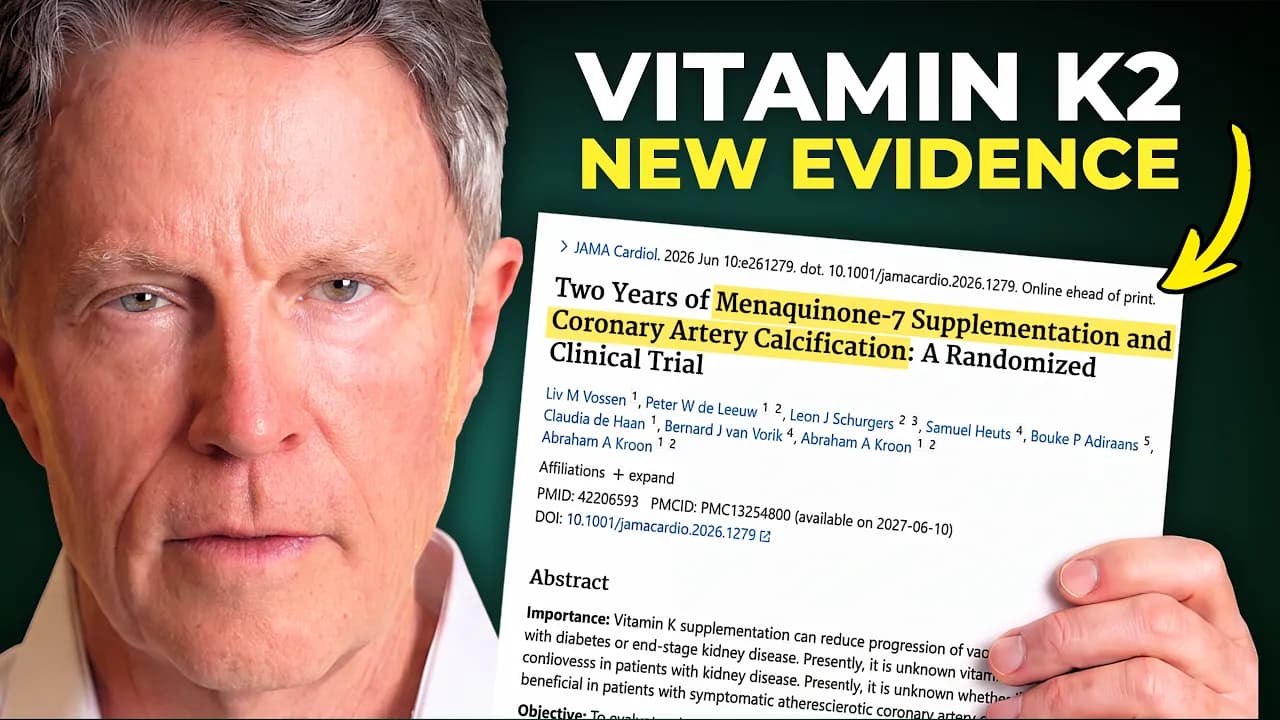
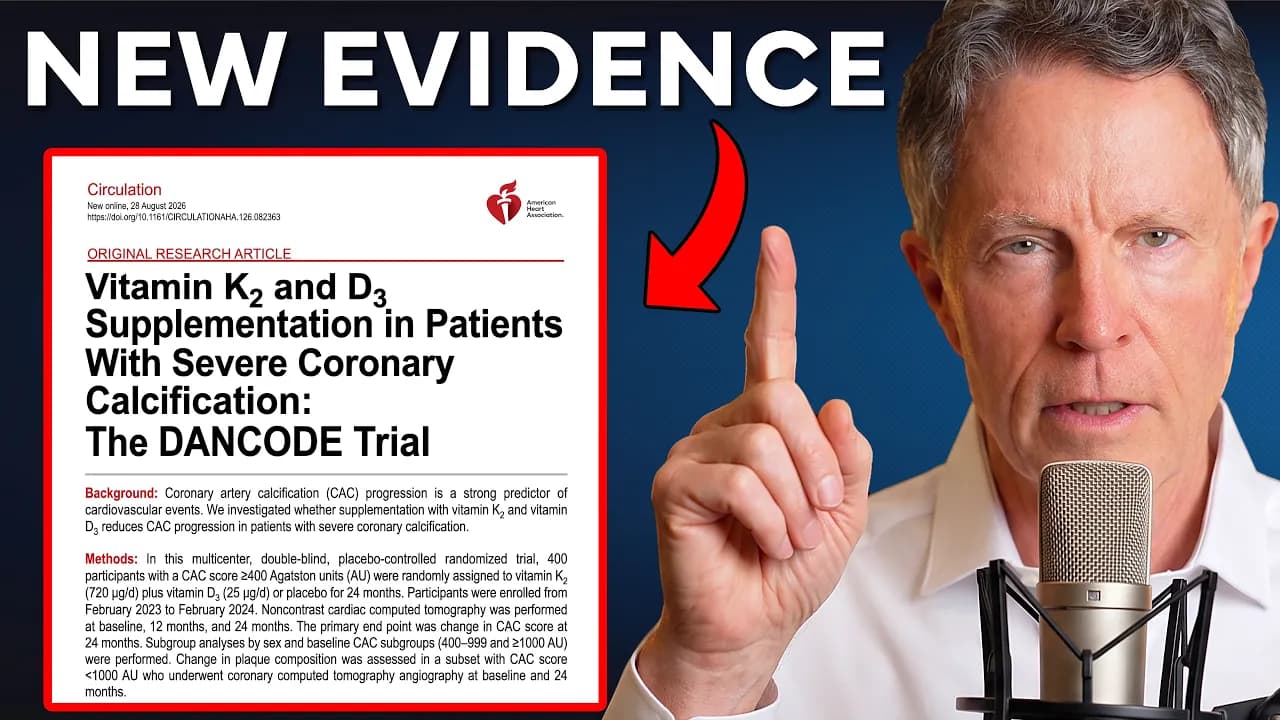
Vitamin K2 in mega doses helps with osteoporosis based on well-established evidence. If you have a problem with calcification in your arteries, look for undiagnosed metabolic disease, pre-diabetes, diabetes, and insulin resistance rather than calcium in your diet. If you have osteoporosis, vitamin K2 is a much bigger consideration than just arterial health.
A mega dose of vitamin K2 is considered to be around 45 milligrams, which is approximately 150 times more than the typical 200 micrograms dosage.
Growing old's not for sissies.
Having healthy arteries makes growing older significantly better, as noted by both a caller in her late 70s and the speaker in his late 60s.
Keep Dr. Ford Brewer MD MPH in your library
Save the videos and channels worth coming back to, and find them again in one place.