How to Heal Your Gut After Antibiotics (Most People Never Do)
In a Nutshell
Antibiotics permanently alter your gut microbiome by replacing beneficial strains with resistant ones, even if total microbe counts recover. Fermented foods like sauerkraut, kefir, and kimchi outperform fiber for rebuilding microbiome diversity and lowering inflammation, while probiotics alone lack the necessary strain variety. Support surviving dormant microbes in your appendix by consistently consuming raw fermented foods, polyphenols, and fulvic acid to restore the gut environment.
These notes were generated by AI and may contain inaccuracies.
Unfortunately, many people never fully recover after even one round of antibiotics. The worst thing you could do for your health is have the idea that every time you get sick, you have to run to the doctor and get a prescription for an antibiotic. Antibiotics do not work for viral infections, only for bacterial infections. Antibiotics come with a package of side effects.
Many doctors will tell you that your gut will fully recover and all those microbes that were killed will come back to normal. That is absolutely not true. The numbers of microbes might come back, but you have a different forest in your gut microbiome. You're going to have a lot of new different strains that you didn't have before. Plus, you're going to have added resistance genes—genes that now resist antibiotics. Every time you take them, you become more resistant to the point where they don't work anymore.
A really important purpose of eating is to support your microbes because they can give you so many health benefits. If they're not there in the right ratios, they can make your life a living hell. Even though they're not really an organ, they act like another organ. We can't even live without the microbiome. We have trillions of microbes that we have a relationship with. We allow them to live in our body.
They help us break down fiber. They make vitamins. They support our immune system. They make neurotransmitters. There's a whole gut-brain axis, meaning our mood is greatly affected or influenced by the gut microbes. When you start killing them off, the relationship changes. They start fighting you and becoming antagonistic. All the microbes that they were keeping in check and keeping suppressed—like candida, yeast, fungus, mold—now can come out and create secondary infections.
There are two main types of antibiotics: broad-spectrum antibiotics and narrow-spectrum antibiotics. Penicillin is a narrow-spectrum antibiotic and was the first one discovered. When at the doctor, you might want to bring up asking if there's a chance you can take a narrow-spectrum antibiotic for your infection. This contrasts with a broad-spectrum antibiotic like Cipro, which wipes everything out. There's major damage that can occur years later because the entire ecosystem, everything connected, is influenced.
This is why there's a lot of mood disorders after antibiotics, like depression, anxiety, panic attacks. Microbes make the majority of serotonin in your body—90% of all the serotonin. Serotonin supports the peristalsis or the pumping action of the colon to allow you to eliminate. If you don't have enough of that, you can get constipation. There are even microbes that make bile. If you wipe those out, you don't have bile, leading to additional problems with fat digestion and increased risk of SIBO.
If you take an antibiotic and then afterwards take a probiotic thinking it will replace all the strains that were missing, a typical probiotic might have three to 10 to maybe 20 different strains of bacteria. Your gut microbiome has hundreds of different microbes. Who knows if the ones in the probiotic are the ones you really need. Probiotics are not against, but realize a lot of times it's not reseeding the microbes. You take the probiotic, it might get killed at the stomach acid level, and it never ends up reseeding or adding new bacteria to your gut.
However, there are certain probiotics that do survive the stomach acid, so always make sure you get one of those. You want to take probiotics during the process of taking an antibiotic. Do that at the same time. As the antibiotic is killing the good and the bad, at least you're putting some of the good back in.
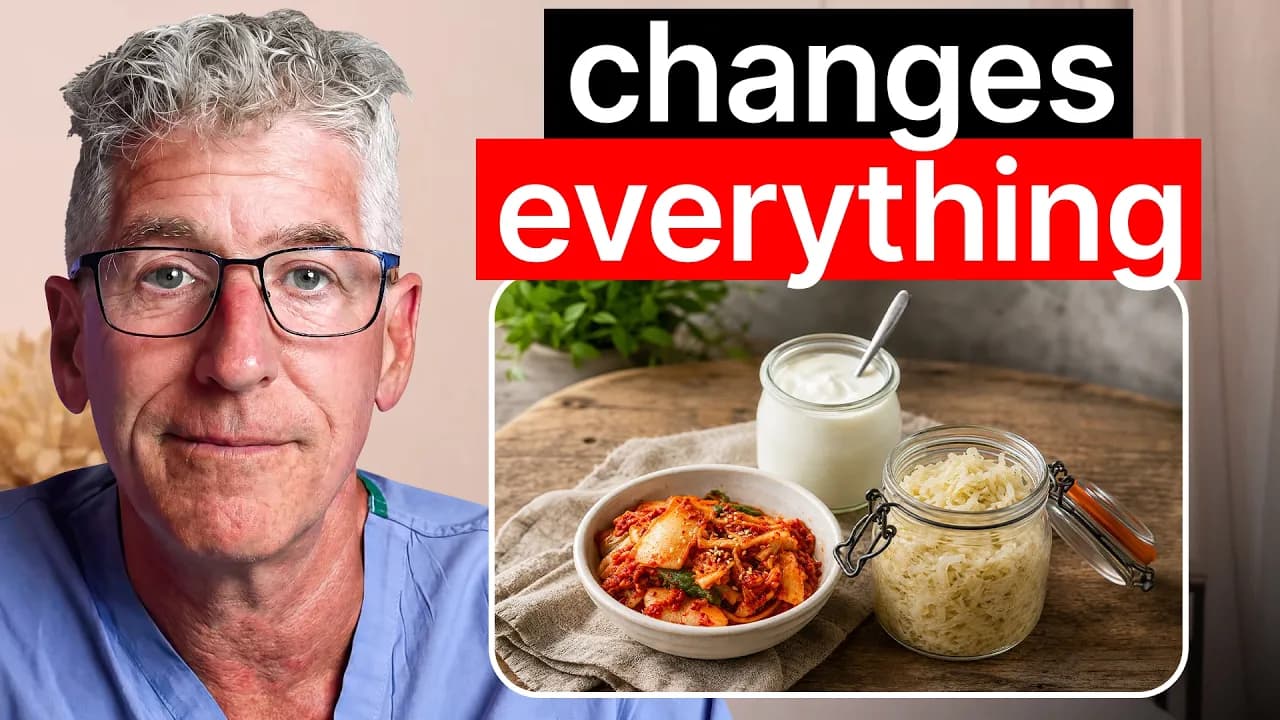
A probiotic is good, but there's something way more important: sauerkraut. Sauerkraut not only gives a lot of different microbes that are conditioned to survive the harsh elements of the stomach acid as well as the harsh bile salts—they survive all of that. When you make sauerkraut, you have to go through different stages of acid levels. It trains your immune system. You have the fiber in there in a state that your body can easily assimilate, so you have the prebiotic to feed the microbes to make short-chain fatty acids. Short-chain fatty acids are what your colon cells actually use as fuel. When you're taking sauerkraut, you're making your colon cells very, very happy.
Out of all of the vegetables, cabbage—which makes sauerkraut—has something called vitamin U. It's a chemical proven to actually heal ulcers. Raw sauerkraut is recommended. Get it in the refrigerated section in the grocery store. Even though the pasteurized sauerkraut can give you some good benefits, the raw stuff is recommended.
Stanford University did a research study with two different groups head-to-head for 10 weeks. One group consumed a high fiber diet: legumes, seeds, whole grains, vegetables, nuts. The other group consumed high fermented foods: yogurt, kefir, kimchi, sauerkraut, and fermented vegetables.
In the fiber group, the diversity of microbiome was completely unchanged. Also in the fiber group, those inflammatory proteins did not drop down—they did not decrease, none of them. Fiber does not reduce inflammation, especially in your colon. In fact, it might increase it, which is why a lot of people have gone to carnivore and been very successful.
In the fermented group, there was a massive microbiome diversity—increased in every single participant. 19 inflammatory proteins were decreased. Fermented foods decrease your inflammation. You don't just have to do sauerkraut. You can do a high quality yogurt without all the other crap or emulsifiers. Bulgarian yogurt or other sour yogurts are recommended, and kefir is even better because kefir has a lot more microbes.
Microbes also eat polyphenols. Cacao can be put in coffee, or a little dark chocolate like at least 85 to 90%. Fulvic acid is a type of compound that acts as an antioxidant that can be used in our bodies. It's a lot of times in supplements and things you can add it to the diet. It's really good to help the environment of your microbiome, and there's been a lot of great success with fulvic acid and humic acid.
Don't waste the sauerkraut juice. If there's some extra juice in there, drink a little bit of that down each day—it'll really help. There's a lot of stuff in there.
The appendix is really a reservoir of microbes. When we have diarrhea and we lose all of our microbes, these microbes can go out there and reseed the gut microbiome. When you get an antibiotic, you don't always wipe out every single thing. Some of those microbes go into a dormant state and they just wait there until the environment's better. This is why it's so important to consume these foods and eat for your microbiome to support the environment so the spores can come back to life. It's already been in there the whole time—it's just waiting for the right time to come out and thrive and grow.
The viewpoint is not to sell on a certain diet. Try different diets, see which one works for you. Be a vegan for a while, be a carnivore for a while, or do half carnivore, half vegan—some plants, a lot of meat.
Keep Dr. Eric Berg DC in your library
Save the videos and channels worth coming back to, and find them again in one place.