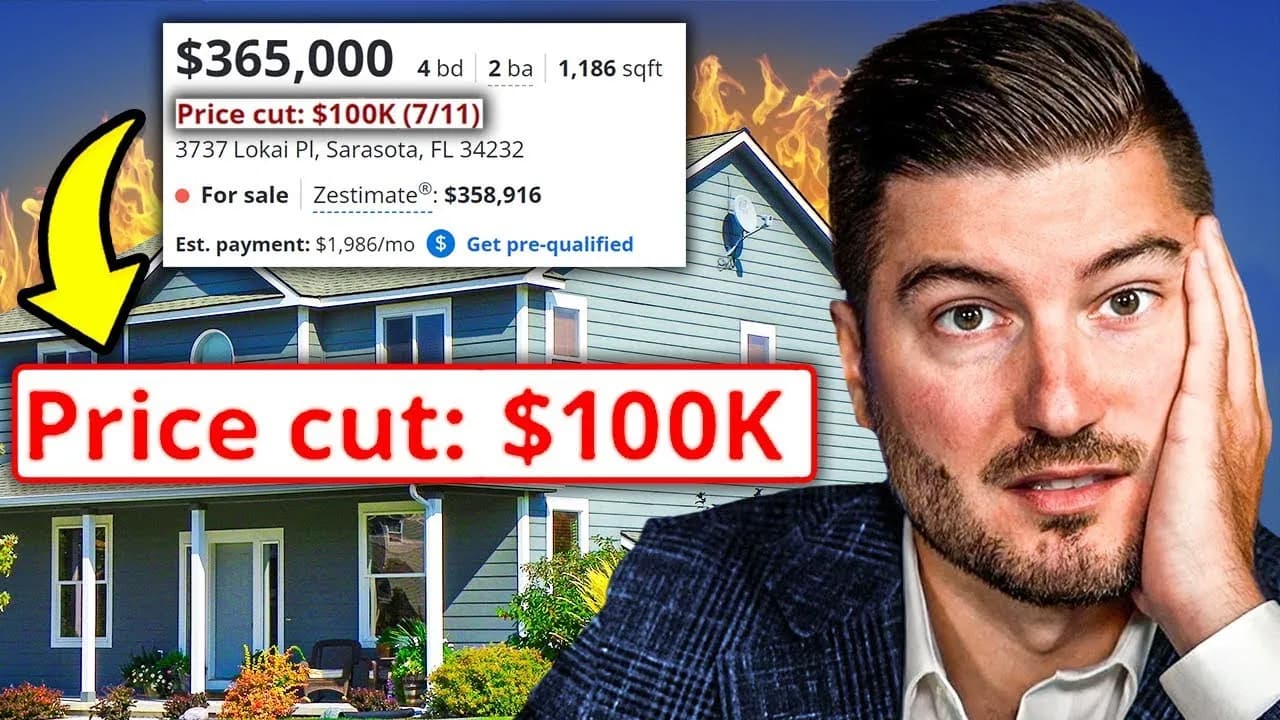
It Started: Homebuyer Demand Just Collapsed - Buyers Getting 20-40% Discounts!
In a Nutshell
Home prices remain near record highs with 30-year mortgage rates at 7.5%, but sellers now outnumber buyers by 63%—the widest gap since 2013—with 41 of the 50 largest metro areas now official buyer’s markets. Price cuts hit a record 22% of listings, pending sales are down 13%, and homes are taking 49 days to sell, with major markets like Austin, Seattle, and Miami seeing steep discounts. Qualified buyers with 20% down can safely submit 10–20% below-asking offers, as sellers increasingly pay closing costs and concessions, while renting remains the cheaper option for most.
These notes were generated by AI and may contain inaccuracies.
The speaker states that sellers have outnumbered buyers at the highest level since 2013. Pending home sales have fallen by 40%. This is the first time in over a decade that sellers have outnumbered buyers at this level. The median home in the United States sold for $417,000 in September, marking the 39th consecutive month that prices have been higher than they were a year ago. Mortgage rates for a 30-year mortgage recently reached 7.5%, which is 1% higher than earlier in the year. For a $400,000 home with a 20% down payment, this means an additional payment of approximately $300 per month on the mortgage. Redfin found that the average monthly mortgage payment rose 8.8% from last year, the highest level in Redfin's records.
The housing market consists of hundreds of individual cities moving in different directions simultaneously. Home prices in Austin are now essentially stable compared to what they were 5 years ago, after prices doubled during the pandemic. The same situation applies to Oakland, California, and Washington, D.C., where home prices today are cheaper than they were five years ago. Redfin found that the largest annual price drops are currently in Seattle, down 6.5%, San Jose, down nearly 5%, and Orlando, down more than 3%. During the same period, home prices in Miami have risen by 57% since 2020. Prices in Camden, New Jersey have risen by 53%, while in both Hartford and Rochester they have risen by 51%. Hartford is now 29% higher than it was at its peak in 2022, while Austin, Texas is down nearly 29%.
The first force is that some areas have built too many houses. Markets experiencing the biggest declines, such as Austin, Florida and much of Texas, were flooded with new buildings. These sellers are willing to lower prices as quickly as possible to keep sales going. The second force is that prices have risen faster than domestic income. During the pandemic, many people moved to cities with high salaries and drove up housing prices to levels that local residents could no longer afford. When prices eventually rose again, they had to rely on domestic income, meaning housing prices had to fall to levels most people could afford. The third force is the high cost of owning property. In Florida, homeowners insurance costs have tripled since 2019. When insurance goes up from $3,000 to $9,000 a year, that money is deducted from what buyers are willing to pay for homes. The Northeast and Midwest face the opposite problem, with fewer homes for sale compared to 2019 and very little new construction.
Redfin found that there were 63% more home sellers than buyers, the biggest gap in their records since 2013. This means about 1.5 million sellers competing for 900,000 buyers. 41 of the 50 largest metropolitan areas are now officially buyer's markets. The Miami market, which has risen 58% since 2020, is now one of the largest buyer's markets in the country, with 160% more sellers than buyers. For every buyer in Miami, there are two and a half sellers trying to get attention. 22% of homes for sale saw price reductions, a record high for Redfin. The average home now takes 49 days to sell, and pending sales are down 12.7% from last year, the lowest level ever recorded by Redfin.
Many homes are currently selling for much less than they were at the peak of the market. In Austin, a real estate brokerage firm analyzed recently sold homes and found that 75% of those who bought in 2022 are now listing their homes for less than they paid. In Beverly Hills, Lizzo bought her home in 2022 for $15 million and sold it this year for $11 million, representing a $4 million loss not including closing costs. Buyers who close their deals in December pay the lowest premium compared to any other month, because sellers at this time need to sell the most.
Submitting an offer 10% lower than the asking price for a $400,000 home saves $40,000. This means paying $8,000 less as a down payment and saving about $300 a month in mortgage payments over the loan term. There is also the possibility of submitting bids 20% lower. Sellers are already beginning to pay for closing costs, repairs, or even interest rate cuts, according to Redfin.
The speaker describes buying real estate in 2011 when everyone said it was a bad time to buy. Prices were down 50 to 60% at that time. A survey of economists found that nearly half predicted prices would fall again, and none predicted prices would fully recover within the next five years. When Gallup asked Americans what would be the best investment that year, real estate came in second, far behind gold. The speaker wrote dozens of low-price offers regularly, sometimes every day, and within approximately one year, three deals were accepted and completed that later quadrupled in value.
The speaker states this is not 2011 after prices have fallen by 60%. Prices are at their highest levels in a long time, and interest rates are at their highest levels in a long time. However, the speaker observes similar patterns where everyone has decided it is a bad time to buy a house. Some people are getting deals that would have been unthinkable two years ago. Redfin described this as a buyer's market born of caution, not strength.
Real estate is highly dependent on location, with every market being different. The speaker believes prices will continue to gradually decline and that interest rates will remain higher than many people expect. This is viewed as a turning point where low offers are starting to be accepted. In the best case, buyers can purchase at a discount large enough to offset higher mortgage rates, and if rates decrease, they can refinance. In the worst case, prices continue to fall but this was factored into the original offer. For buyers with a 20% down payment who are qualified and ready to buy, they represent a rare commodity in this market and can make bold offers due to lack of competition. Writing low offers carries virtually no risk - if they are not accepted, there is nothing to lose. Objectively, renting remains the cheapest option based on the numbers.
Keep Graham Stephan in your library
Save the videos and channels worth coming back to, and find them again in one place.