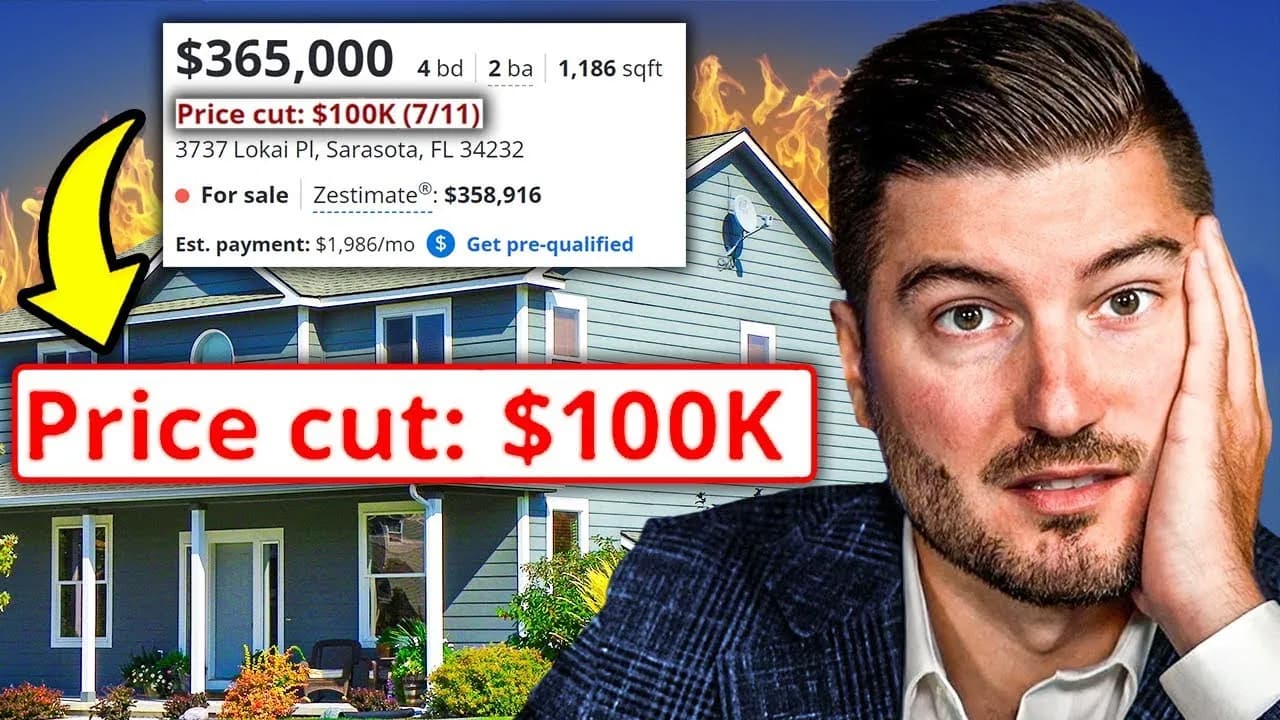
WTF Just Happened To The Housing Market?!
In a Nutshell
The US housing market is weakening dramatically, with 47 of the top 50 cities declining, listings down from 2024 levels, sellers outnumbering buyers by 600,000+, homes taking the longest to sell in over a decade, and mortgage rates spiking amid high oil prices that inflate construction costs and crush affordability (e.g., median $398K home now requires $106K income at 6.25% rates). Pandemic boomtowns like Florida (-2.73%), Austin (-5.9%), and Colorado (-1.5%) are crashing hardest due to excess supply and slowing migration, while affordable spots like Milwaukee (+10%) gain; condos are flooding the market with 83% more listings than buyers. Forecasts predict flat-to-negative prices for 2026 (0-1% nominal growth, all real losses after inflation), no crash due to locked-in low-rate owners, but great deals via builder incentives (up to 14%)—Trump proposals like mortgage buyouts offer minimal relief; focus on locations, total costs, and long-term math over hype.
These notes were generated by AI and may contain inaccuracies.
For the first time in almost 20 years, the housing market has started to fall. 47 out of the top 50 cities are getting weaker. Listing prices are now lower than they were in 2024. Over the last few weeks, searches for "can't sell a house" and "help with mortgage" hit an all-time record high. Home sellers outnumber home buyers by more than 600,000. Mortgage rates are quickly going back up and the average home is now taking the longest time to sell in over a decade.
Discuss what's happening throughout the entire housing market, how higher interest rates are completely destroying demand across the country, where prices are headed throughout the rest of the year, and personal thoughts. This is the type of market where some of the best deals could be made if you know what to look for. Sources cited in pinned comment.
Mortgage rates are back to their highest level in 3 months. 37% of home builders are dropping their price by an average of 6%. Homes are taking the longest to sell in over a decade. Headlines often based on deals agreed weeks or months ago under different conditions. Data like home prices up 0.3% from a year ago pulled in December, doesn't account for rising mortgage rates, price cuts, and inventory piling up.
Not all markets equal. Sellers panicking in Miami (197% more sellers than buyers), Austin (124%). Opposite in Milwaukee and New York (more buyers than sellers, pushing prices higher). Home prices growing fastest where most affordable compared to incomes. Upper east coast houses around $400,000 attract more people.
Largest increase to home prices in 2026 tied to oil. Oil above $100/barrel and gas over $5/gallon pushes investors to demand higher returns on long-term bonds, raising 10-year Treasury yield and mortgage rates. Market pricing in rate hike as soon as April.
1% increase in mortgage rates reduces buyer's purchasing power by 10%. $500,000 home at 6% same affordability as $450,000 at 7%. Higher rates mean home prices need to fall to balance.
Higher oil prices raise construction costs: aluminum up 39% over last year, steel up 20%. Costs passed to buyers. Outcomes: buyers pay more due to higher rates when affordability already impacted, or prices come down.
At 6.25% mortgage rate, median-priced home of $398,000 with 20% down: monthly payment $1,954 before property taxes, insurance, maintenance, repairs (another $500-$800/month). Requires $106,000/year income; average American family $23,000 short. 25 basis point increase prices out additional 1.4 million buyers.
- 4.22%: $67,000/year
- 5.22%: $75,000/year
- 6.22%: $84,000/year
- 7.22%: $93,000/year
Home prices don't instantly fall; sellers don't sell, volume drops, market freezes.
Headline median prices up 0.3% last year, but with 2.4% inflation, lost 2.1% purchasing power. Wages growing 3-4% in 2026 outpacing home price growth; gap narrowing. Called a real terms correction: healthiest normalization. Prices trade sideways while incomes improve. Redfin calls it the Great Housing Reset; first time since Great Recession incomes rise faster than prices for prolonged period.
Largest gains: Milwaukee up 10% year-over-year, North Dakota 6.4%, Delaware 6.3%, Illinois 6.1%.
Biggest losers: Florida down 2.73%, Colorado down 1.5%, Oakland down 9.1%, Dallas down 3.8%, Austin down 5.9% (after 20% from peak).
Pandemic hot markets: builders ramped supply as prices surged; now migration slowed, affordability worse, insurance rising, more sellers than buyers.
83% more condos listed than buyers. HOA fees and insurance skyrocketing (Florida average $3,200/year). Condos underperform single-family homes in appreciation; hit first in downturns.
Standard & Poor's: national home prices grew 1.3% in largest 20 cities, weakest full-year gain since 2011 (when fell 3.9%). 2025: first half up 2.6%, second half down 1.3%; trend continues in 2026. Realtor.com: median list price fell 2.4% year-over-year, 18th straight week flat/negative, 5th consecutive week 2%+ below last year.
Predictions for rest of year:
- Redfin: 1% increase
- National Association of Realtors: 4% gain
- Zillow: 0.7% jump
- JP Morgan: 0% appreciation
Accounting for inflation, all negative for 2026.
-
$200 billion mortgage buyout: Fannie Mae/Freddie Mac buy own mortgage-backed securities to lower rates. Dipped 0.2% short-term, effect gone. Only 1.4% of mortgage market; one-time, not ongoing. Doesn't fix affordability, lets buyers pay more.
-
Banning institutional investors: Wall Street <1% of single-family market; no impact.
-
Portable mortgages: Take existing low-rate mortgage to new home. Banks oppose due to underwater loans; unlikely but could unlock inventory.
-
Building on federal land: Government owns 28% of US land. Task force for parcels near cities for affordable housing. 7.3% overlaps cities (WSJ); 5-10 years minimum.
No housing crash: too many sellers with equity. Era of easy money over; must research location, price, total costs, hold period.
Good deals possible if seller compensates for falling market. Builders offering up to 14% incentives. Long-term buyers: put out feelers.
If not buying, rent, save difference, invest in index fund while market normalizes.
Headlines scarier than reality: normal market after years of excess. Focus on fundamentals, think long-term, run numbers.
Keep Graham Stephan in your library
Save the videos and channels worth coming back to, and find them again in one place.