SpaceX Going Public Soon? Here's What You Need to Know
In a Nutshell
SpaceX has filed to go public on June 12, 2026, targeting a ~$1.25 trillion valuation despite generating $8.7B in revenue and $4.9B in losses. The IPO is backed by major banks and could see a short-term hype-driven rally, but the valuation at 90x sales is extreme compared to profitable peers like AMD. Long-term sustainability is questionable given ongoing losses and reliance on speculative future growth.
These notes were generated by AI and may contain inaccuracies.
SpaceX has officially filed for its long-awaited IPO. The company plans to list under the Nasdaq ticker SPCX with a potential debut expected around June 12, 2026, just a few weeks from the time of the video. The filing follows a massive valuation milestone where earlier in 2026, SpaceX reached an estimated $1.25 trillion valuation after merging with XAI.
Tesla currently trades at $1.6 trillion market cap. The merger of SpaceX and XAI is estimated at $1.25 trillion. If the IPO proceeds as expected, Elon Musk could simultaneously lead two trillion-dollar public companies alongside Tesla. The offering is backed by major Wall Street firms including Goldman Sachs, Morgan Stanley, JP Morgan, Bank of America, and Citigroup, indicating strong institutional demand ahead of pricing.
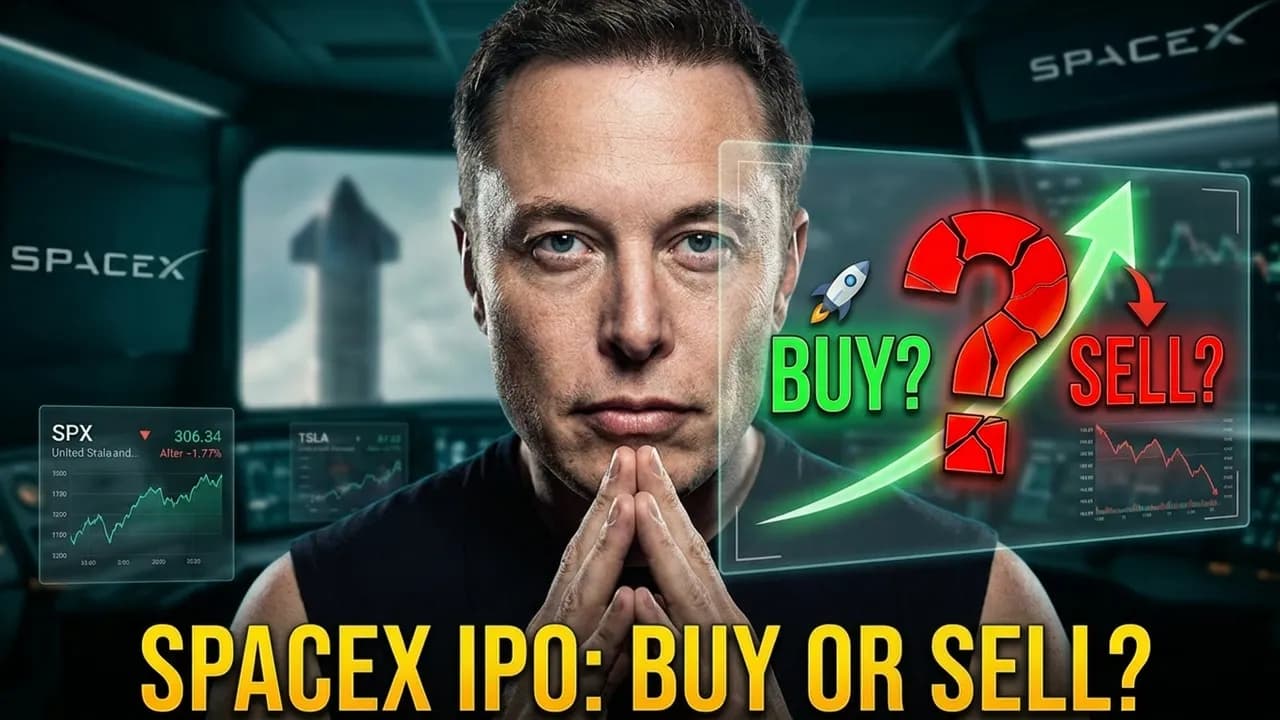
The first day and first few weeks of an IPO could see significant excitement making it potentially sensible to trade SpaceX. However, the question of whether it is a good investment depends on the price at opening and the resulting valuation. Markets are trading at an incredibly irrational rate. The most speculative stocks and valuations are likely to correct if markets begin to correct.
A common statistic shows that on IPO day, the average IPO is up 6-12%, but on average 90 days later, the stock is down from its IPO price. Big swings in prices are to be expected.
The primary catalyst is the official SEC filing confirming SpaceX's transition to public markets with the IPO set to go live on June 12, 2026. The bull case rests on SpaceX's unique positioning across interconnected ecosystems benefiting from long-term secular growth. Reusable rocket technology, large-scale satellites, and integration with AI and XAI give exposure to a combined $28.5 trillion addressable market. Management emphasizes that identifying trillion-dollar company opportunities is a repeatable part of the business model.
SpaceX remains heavily loss-making in several core areas. The AI division is consuming billions of dollars in infrastructure and research spending while the space segment continues with high capital intensity and ongoing losses. Investors entering the IPO are effectively pricing in years of future execution at an already historic valuation.
SpaceX is valued at nearly $2 trillion and is not profitable. It produces $8.7 billion in revenue and $4.9 billion in losses. Part of the loss is due to the XAI acquisition. For Q1 2026, the company reported a $4.2 billion loss. In 2025, the company reported $18.7 billion in revenue and a $4.9 billion net loss.
AMD is worth $800 billion with $34 billion in revenue and $4.3 billion in profit. Even during the AI revolution hype, AMD producing profit is valued at $800 billion. SpaceX's reported IPO valuation is roughly 90 times sales. For context, the previous record IPO, Saudi Aramco, listed at 6 times sales. SpaceX is now 15 times that multiple with a net loss attached.
There is always positive optimism behind Elon Musk running any of his companies. Tesla's revenue over the past 2-3 years has been plateauing and has almost lost revenue after losing government subsidies, yet the stock trades near all-time highs at a $1.6 trillion market cap. Investors do not care because of optimism around the Optimus robot and robo-taxi despite years of discussion without visible results. Irrational valuations always tend to follow Elon because of hope in what he can do.
It could make sense to trade SpaceX due to momentum and hype, with a potential pump in the first week to 2 weeks of its IPO. However, sustaining that valuation is questionable if market conditions become less favorable. SpaceX is a non-necessary company already yielding losses. If markets begin to correct, it is unlikely to grow during uncertain times. If irrational markets continue pushing higher, irrational valuations are supported.
SpaceX is expected to have the largest IPO in history while still losing billions of dollars every year. The outcome could be either a huge hit with the IPO price continuing to skyrocket or the traditional pump, sharp correction, and later catch-up.
Keep Ricky Gutierrez in your library
Save the videos and channels worth coming back to, and find them again in one place.