The Formula Behind Your WHOOP Age!
In a Nutshell
WHOOP Age estimates an “effective age” by converting six months of sleep, activity, and fitness metrics into all-cause mortality risk equivalents, then expresses the result as the chronological age that would produce the same risk profile. Pace of aging tracks the most recent 30 days and predicts whether the six-month WHOOP Age will rise, stall, or fall if those patterns continue. The score is not a direct measure of cellular aging; it is only a statistical translation of selected behaviors and a few physiological readings, so its accuracy is limited by the accuracy of the underlying sensors and the completeness of the inputs.
These notes were generated by AI and may contain inaccuracies.
WHOOP can now tell you your biological age and claims that recent behavior is slowing, accelerating, or reversing the pace of aging. The video examines what WHOOP is actually measuring, whether it reflects biological aging inside cells, or if it converts sleep, fitness, and activity data into a more understandable but meaningless score. The question is whether a WHOOP age of 35 should be interpreted as evidence that the body is really 35 years old.
The video takes WHOOP's system apart and examines the data and assumptions behind it, separating what is useful from what could be over-interpreted. The creator is Rob, a post-doctoral scientist specializing in biological data analysis. The focus is on the algorithm behind the WHOOP age.
Disclosure: The creator has an affiliate link for WHOOP and would appreciate using it for discounts, but the purpose is not to convince anyone to buy a WHOOP. Alternatives mentioned include Fitbit Air, Amazfit Helio strap, Polar Loop, and Garmin Circa, which may provide what people need from a cheaper device without requiring a subscription.
Each band has its own limitations. The Garmin Circa has not been received yet, so testing will be later than other reviewers. The overall opinion is that if price is not considered, WHOOP is still a good product for people wanting a polished interface, generally good data quality, serious exercise and recovery features, and strong gamification. However, it is no longer an automatic recommendation for everyone looking for a screenless wearable given cheaper competition.
The video comes from interest in understanding what WHOOP age represents, what science supports it, and what the limitations are. WHOOP's full white paper will be linked, but the video summarizes it in more understandable language.
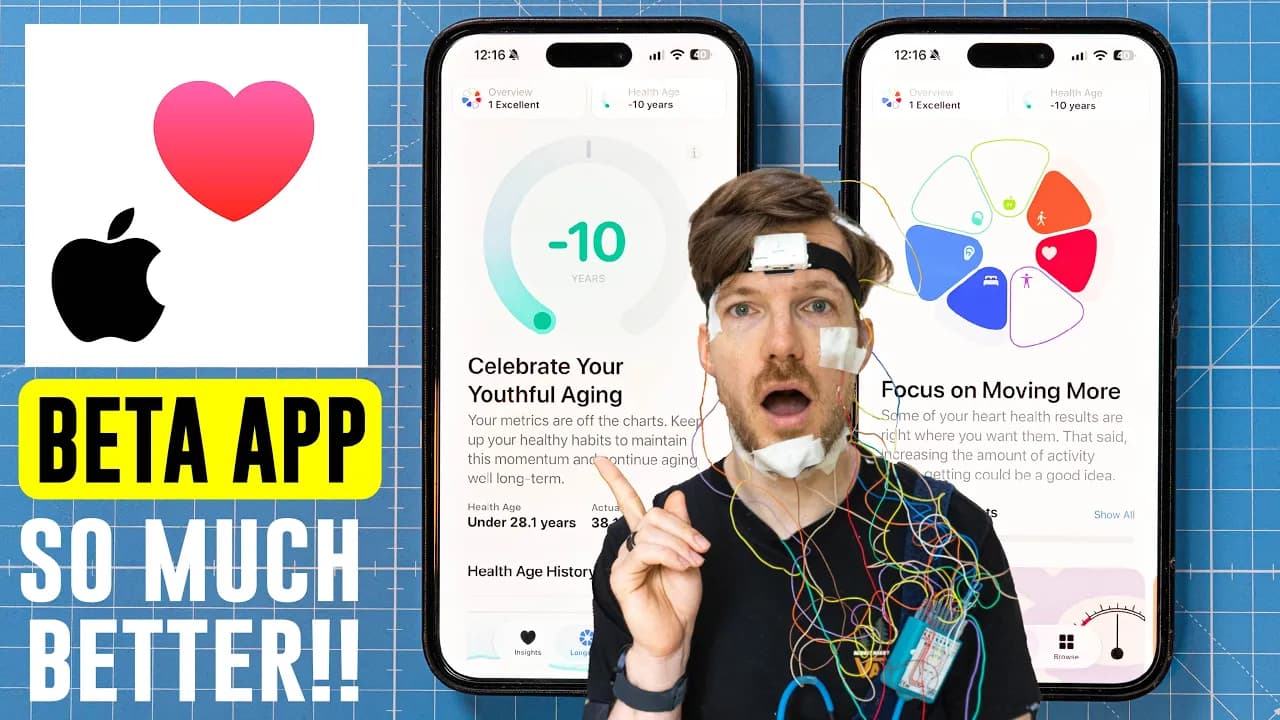
In the WHOOP app, WHOOP age has two parts: WHOOP age as a number and pace of aging. WHOOP age is the more slow-moving summary, using approximately 6 months of sleep, activity, fitness, resting heart rate, and body composition data to estimate an effective age. Pace of aging is a faster-moving number that looks at the most recent 30 days and estimates what would happen to WHOOP age if those recent patterns continued.
WHOOP age tells where someone is within their model, while pace of aging tells the direction of current movement if the last 30 days would continue. Neither number is a literal measurement of the age of cells, and neither predicts exactly how long someone will live.
WHOOP age tries to estimate what scientists call an effective age based on estimated all-cause mortality risks. As adults get older, their statistical risk of dying in any given year increases approximately exponentially, with mortality risk roughly doubling every 8 to 10 years. Figure two in WHOOP's white paper illustrates this relationship on a logarithmic vertical axis.
WHOOP uses this relationship as a conversion scale. It looks at a behavior or physiological measurement, estimates how that factor associates with mortality risks, and asks how many years of aging would produce a similar change in risks.
In a hypothetical example, age is along the horizontal axis and mortality risks along the vertical axis. The line shows expected distribution with a risk score marked. Even though chronological age may be low, if risk score is high, effective age is much higher. Following guidelines, taking steps, and sleeping well can reduce risks, making effective age lower than chronological age.
If someone is chronologically 40 but receives a WHOOP age of 35, WHOOP is not claiming cells look exactly like those of a 35-year-old. It means that based on measurements included in the model, scientific literature used, and WHOOP's statistical assumptions, the risk profile of dying resembles the healthy reference profile at age 35.
If WHOOP age is smaller than actual age, someone is exceeding expert recommendations for good long-term health. If WHOOP age equals biological age, someone is meeting exact recommendations for good long-term health. If WHOOP age is older, someone is failing some recommendations for long-term health.
This differs from normal science, which takes the general population and compares someone to that. The normal population includes many 35-year-olds who already have chronic conditions, pulling down the average. WHOOP compares someone with a hypothetical health-optimized person of their age who meets WHOOP's targets for sleep, activity, cardiovascular fitness, resting heart rate, and body composition.
Some targets come from estimated public health guidelines. Others, such as age-specific and sex-specific VO2 max targets, are based on WHOOP's interpretation of scientific research and expert recommendations. This is a mixed bag and not 100% scientific, with some gut feeling involved.
This choice affects how results should be interpreted. If WHOOP age equals chronological age, it does not mean someone resembles the average person of their age. It means they are roughly meeting WHOOP's selected health recommendations. Since many people in the general population do not meet these recommendations, an on-track result may indicate a healthier than average lifestyle and fitness profile.
A table shows a 30-year-old male and 30-year-old female as examples. An average US person of 30 years old does not get 7 hours of sleep, whereas the average WHOOP user does get 7 hours of sleep. The average WHOOP user gets more physical activity, more time in higher heart rate zones, has a higher VO2 max, and a higher resting heart rate. The average WHOOP user is already much better than the average US population because people who buy a WHOOP have interest in improving or tracking fitness.
WHOOP cannot measure everything including cholesterol, diet, smoking, and glucose control. Some of these can be input manually, but most people will not do that.
WHOOP age is based on approximately 6 months of data and changes relatively slowly. Pace of aging focuses on the most recent 30 days. WHOOP asks what would happen to WHOOP age if recent sleep, activity, and fitness values were maintained for the next 6 months.
A pace of aging of 1 means WHOOP age is projected to increase at the exact same speed as chronological age, so the difference between chronological age and WHOOP age stays the same. Both would increase by 6 months in the next 6 months.
If pace of aging is above 1, recent 30 days look less healthy than the longer-term baseline, and if patterns continued, WHOOP age would increase faster than calendar time.
If pace of aging is between 0 and 1, WHOOP age is still increasing over time but more slowly than calendar time. If pace of aging is below 0, recent inputs are sufficiently better than the long-term baseline, meaning WHOOP age decreases over time even as chronological age increases.
A pace of aging of minus 0.5 does not mean WHOOP has observed cells becoming younger. It means recent behaviors would push the WHOOP effective age calculation downward if they continued. This cannot continue indefinitely, and WHOOP age is cut off at 18 or 20 or so.
Pace of aging should be seen as a short-term trend indicator telling whether the last 30 days look better or worse than the longer period behind WHOOP age. A very fit person can receive an accelerated pace of aging after a bad month, while someone with a much higher WHOOP age can receive reverse pace of aging after making substantial improvements. The second person is moving in a better direction but is not necessarily healthier than the first person.
WHOOP organizes inputs into three categories: sleep, activity, and fitness. Across those categories, there are nine main contributors. WHOOP does not use simple weighing such as 30% sleep, 30% activity, and 40% fitness. Each contributor has an age impact based on its estimated association with mortality risk, and that impact depends on the value, how far someone is from the target, chronological age, and sometimes sex.
WHOOP takes into account that many values are interrelated and correlated, and tries to regress out the effect to not double count effects between related measurements.
Sleep is made up of two parts: sleep consistency and hours of sleep. Hours of sleep is basically sleep duration. WHOOP's target is between 7 and 9 hours per night. Averaging fewer than 7 hours can add to WHOOP age. Averaging between 7 and 9 can subtract a small amount. More than 9 hours of sleep is treated as neutral. Long sleep has been associated with poor health in some studies, but underlying illness might be the cause for longer sleep, and longer sleep might not be the cause of illness.
Sleep consistency measures how regular the schedule is of going to sleep and waking up. WHOOP uses 70% consistency as a main threshold. Values below this can add years, while values above this can subtract years. One bad night of sleep will not suddenly make someone biologically older according to WHOOP.
Activity or strain contains four contributors: daily steps, time in heart rate zones one to three, time in heart rate zones four to five, and strength activity time.
Daily steps capture general movement. For younger adults, WHOOP's target is approximately 8,000 steps per day, and the target becomes lower at older ages because the same number of steps is associated with a larger relative benefit in older adults. The benefit levels off around 8,000 to 10,000 daily steps. Walking far beyond it does not keep subtracting WHOOP years indefinitely.
Heart rate zones are split into two contributors. Zones one to three represent lighter and moderate activity, and zones four to five represent more vigorous exercise. For younger adults, WHOOP recommends at least 100 minutes in zones one to three and at least 10 minutes in zones four to five. These targets decrease slightly with age.
Strength activity time measures going to the gym or doing strength training at home. More than approximately 40 minutes per week can reduce WHOOP age, and this increases until about two hours, then the reward stops. Doing more than two hours of weightlifting does not add much additional longevity credit. It does not mean more strength training is harmful, it means WHOOP does not assign additional longevity credit beyond that point.
Fitness is made up of three parts: VO2 max, resting heart rate, and lean body mass percentage.
VO2 max measures cardiorespiratory fitness and is likely one of the more influential contributors because cardiorespiratory fitness has a particularly strong association with all-cause mortality.
WHOOP compares estimated VO2 max with a target that depends on age and sex. The target for a 30-year-old female is above 38 ml. For a 38-year-old male, the target would be 40. Being below this target will add to WHOOP years, while being above it subtracts WHOOP years.
WHOOP uses approximately 60 beats per minute as the neutral point for males and 64 for females. Higher values add years, while lower values subtract them.
Lean body mass is something WHOOP cannot measure and must be entered manually or imported from a compatible scale. If not provided, WHOOP leaves that component out. This means not every user's WHOOP age is based on exactly the same set of inputs, and errors from consumer body composition scales can affect WHOOP age since hydration is a major factor affecting those.
Many things are confounded with each other because exercise directly contributes through heart rate zones, but regular exercise will also improve VO2 max, lower resting heart rate, and change body composition. A single behavior can influence several inputs. WHOOP uses structural equation modeling to reduce double counting, but it will never be perfect.
The main strength is that WHOOP takes complicated epidemiological relationships and makes them more understandable. Most people do not know what a hazard ratio is, and expressing results in years makes the information easy to interpret and somewhat gamified. It is also more actionable because WHOOP shows which behaviors and measurements are increasing or decreasing results. Because it uses months of data, it may represent usual behavior better than a questionnaire or single clinic visit.
WHOOP age is not a direct measurement of cellular aging. It is a model that converts selected behaviors and some physiological measurements into mortality risk equivalents. The feature is called health span, but the mathematical foundation is more based on all-cause mortality. Mortality and health span are related but not identical. Health span refers to the period of life without substantial disease or disability, while life span is just how long someone is alive.
WHOOP is not directly calculating remaining years of healthy life, and the underlying research is largely observational. People who sleep consistently, exercise regularly, and have high VO2 max may differ from other people in many ways, so the exact causal relationships are not fully known.
The initial validation in WHOOP users is encouraging, though validation is used with quotation marks. WHOOP age moves in the expected direction when compared with self-reported health and certain chronic conditions, but a score built from sleep, activity, fitness, resting heart rate, and body composition would be expected to correlate with health. The more important test would be prospective validation asking whether WHOOP age predicts future disease or mortality. These questions have not been answered and will likely never be answered because things move too quickly in the health space.
A model can only be as good as the data going in. If WHOOP misrepresents or misestimates sleep, steps, heart rate zone time, resting heart rate, or VO2 max, those errors can affect the final age. This does not make the feature useless, but users should watch reviews to see how accurate the WHOOP strap actually was.
Compared to competition, WHOOP is good but not great. WHOOP is better at sleep than the Amazfit Helio strap on biceps. The Amazfit Helio strap is better at measuring heart rate during exercise. The Fitbit Ace is basically better at both on the biceps. However, the app of the Fitbit Ace is not close to what WHOOP does. The WHOOP app is a lot better, but WHOOP is also a lot more expensive.
Based on testing, WHOOP is a good wearable in many categories and probably performs better than roughly 70% of devices on the market, sometimes 80%. It combines generally good data with one of the better user experiences, especially for people who train seriously and value recovery guidance, long-term trends, and gamification. However, if looking at only raw sensor accuracy, WHOOP is not the best performing device in any category. It is close to the top for sleep stage tracking and pretty okay for heart rate tracking, but better devices can be found for raw data.
What users pay for is not simply sensor accuracy. They also pay for the interface, analytics, ecosystem, and features that make the data more engaging. Whether this is worth the subscription depends on what someone values and how much the money is worth to them. For many people, WHOOP cannot be recommended if they do not value that a lot and just want a device with good measurements. In that case, a Fitbit Ace will definitely do. But if someone wants a polished system that encourages training, recovering, and sleeping consistently and paying attention to long-term habits, WHOOP remains a strong option, though it is not cheap.
If someone mainly wants accurate raw measurements and basic sleep or activity trends, a cheaper device will likely already do most of what is needed and may even do it better. The creator has affiliate links for other devices including Fitbit Air, Amazfit Helios strap, and other items on Amazon. The aim is not to convince anyone that WHOOP is the only sensible choice, but to help understand what devices measure, how accurate they are, and which one best fits individual needs.
The creator personally still uses WHOOP age as one of the main motivational dashboards, not as a definitive statement about the age of the body, but knowing it helps motivate keeping up with each of the individual contributors and focusing on sustainable trends. It works for the creator, but checking other reviews is recommended to see what device works best for individual needs.
The creator is curious to hear in comments what people think of WHOOP age, if it is reflective of healthy behavior, how pace of aging is going, and how it has affected behaviors in good or bad senses. Some of these numbers can become obsessive for some people, which might not actually be a good thing.
If you are considering purchasing a ring, an Oura ring, a Fitbit Air, an Amazfit Helios strap, another device, or anything at all on Amazon for that matter, even something as small as toilet paper or coffee beans, you want to support the channel and get the best discount possible, use one of the affiliate links I have down below. Now given that you watched this video on the Whoop strap, also check out my full review and my video on the HTC Bolt.
Keep The Quantified Scientist in your library
Save the videos and channels worth coming back to, and find them again in one place.