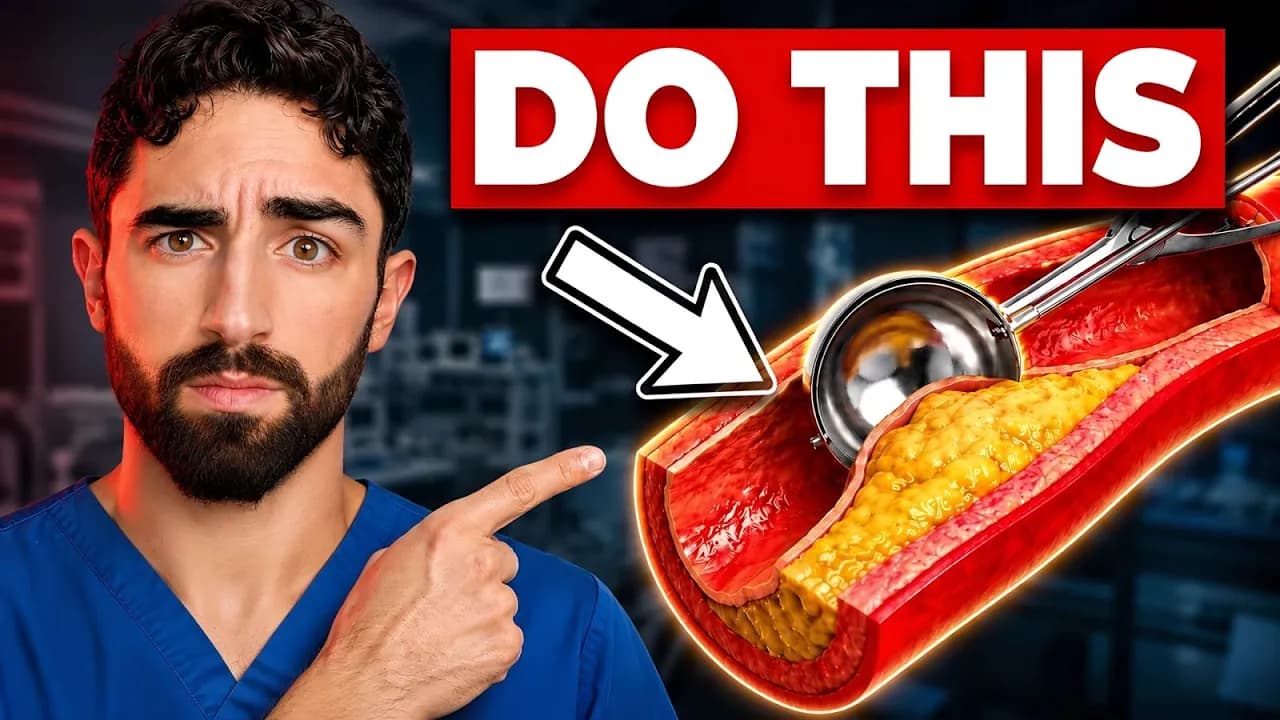
You Can't Out-Prescribe a Bad Diet (Here's What Actually Works)
In a Nutshell
You can't out-prescribe a bad diet—statins only lower a lab number while diet and exercise fix the underlying metabolic inflammation that drives soft plaque formation. Mediterranean-style eating (olive oil, nuts, vegetables, fish) plus cutting refined carbs reduces heart attacks and strokes by 30%, and nuts alone cut cardiovascular death risk by 21%. Statins have a role when plaque is present, but the goal is stabilizing plaque through metabolic health, not chasing LDL numbers alone.
These notes were generated by AI and may contain inaccuracies.
Picture this. It's morning. You line up your pills next to your coffee. The statin, maybe the blood pressure pill. You take them like clockwork every day. And you figure, well, that's handled. Here's the belief that most people carry. If the numbers are managed by a medication, then you're going to be protected. Your arteries are okay. But there's a problem with that. You just can't outprescribe a bad diet. Now, the statin pulls the number on the paper down, but the damage inside the artery just keeps right on going.
Today I'm going to show you two things. What that statin's really doing for you and what it isn't touching at all. And the one lever that works upstream of every pill on the counter. The thing that doesn't just manage a number, it changes the disease. I'll show you the research, too, because I'm not going to ask you to just take my word for something. I'm going to bring the evidence.
I'm Dr. Ford Brewer. I've spent my career in preventive medicine. I ran the preventive medicine program at Johns Hopkins, and now I help people avoid heart attacks, strokes, early death, and disability. Now, I'm not your doctor. Nothing on this show is medical advice, but it's better. What I teach you is how to be a smarter patient, how to not have to see your doctor, and if you do, how to change the conversation entirely because I teach you how I think about this stuff. And that's worth more than any prescription.
Here's your diet and your exercise. Here's what they do that the pill cannot do. They don't work on one number. They work on all of it at once. Your core metabolism. Cut the refined carbs that drive the sugar spikes and the insulin flood begins to settle down. When the insulin flood settles, the inflammation cools down too. And when the inflammation cools, that inner lining of the artery starts to heal. And that lining is exactly where the dangerous plaque gets its start. I'm talking about the soft non-calcified plaque. The young kind. The kind that squirts open, throws a clot, and starts the heart. Stops it entirely. And even worse, stops the brain. A statin doesn't really reach that process the way real food and real movement reach it. That doesn't really impact the metabolism.
There's a major randomized trial, the gold standard, the kind of study that you should trust the most. Older adults at high risk ate a Mediterranean style diet built around olive oil, nuts, vegetables, and fish. This one was a lowcarb Mediterranean style diet. Especially refined carbs, they were cut. The ones that spike your blood sugar, these people ate well and they ate plenty. They held their weight right where it was. The rate of heart attacks, strokes, cardiovascular death, it dropped by 30%. Compared to the group just told to eat low fat. So they were the other group was told eat low fat. In other words, decrease fat calories and make it up with carb and protein calories. 30% decrease in heart attacks and strokes from food.
Take nuts, just nuts by themselves. When researchers pulled the studies together, about 1 ounce of nuts a day lined up with roughly 29% less heart attacks, heart disease, around 21% fewer cardiovascular deaths, and about 22% lower odds of dying from any cause at all. In one big study of nurses followed for years, swapping the calories from that handful of nuts, swapping those in for refined carbohydrates was tied to about a 30% lower risk of heart disease. So, you're replacing refined carbs with a handful of nuts. 30% lower risk of heart disease. So, keep this in mind. It's not just adding the nuts. It's what the nuts replaced, those refined carbs.
Then there's exercise. Regular movement lowers your blood pressure, sharpens your insulin sensitivity, and keeps those vessels flexible and doing their job. And it does all of that without lowering your LDL one point. And that's the whole point. These things work on the disease, the metabolism. The pill works on a number.
Let me be clear because this is the part that people miss here because they're emotionally attached sometimes. Statins do have a place whether we like to admit it or not. For some people, especially at high risk, they do earn their spot. And I'm not telling you to throw them out. You cannot outprescribe a bad diet. That is the biggest problem that's hurting people in our world today. They're relying on a pill. The pill manages a number. The food and the movement change what's actually happening inside the artery.
Think about the man who did everything right for 30 years. Took every pill exactly as it was prescribed. At least he thought he was doing everything right because his diet and his exercises weren't there, but he never missed a dose on that pill. He still wasn't protected. And here's the piece that if anybody explained it to him, he didn't hear it. A prescription is built to manage a number, but the diet is what changes the course of the metabolism and the disease. That's the part that should stick with you because it sticks with me. That man's got a wife counting on him. He's got grandkids who want him at the games and not waving from the porch from a wheelchair, a church, a shop, a community that still needs him standing and useful. Staying capable isn't vanity. It's what you owe the people who depend on you.
A lot of people are thinking about two major goals. They either want to lower their cholesterol because they think automatically that that's going to solve their problem and it's going to stop the heart attack or they want to reverse their plaque which I would argue there is more evidence on plaque reversal. 1% of plaque reversal can reduce up to 25% of risk of heart attacks and strokes. But yet we have talked over and over again neither lowering cholesterol should be the goal or reversing plaque should be the goal.
I haven't met somebody who could not improve their risk, who could not improve their lifestyle. All of us can do that and most of us can stabilize plaque. I mean, we can all stabilize our plaque. That's a practical goal. We've heard people come in saying, "Well, I've seen your videos. I've seen videos where people actually measurably reverse plaque." That's pretty rare. And it's not quite so much because you're not stabilizing your plaque. It's because the measurement devices are not that simple or easy.
The other thing is when you're reversing quote reversing plaque, you're probably not taking the LDL that has gotten into the plaque. You're not taking that out. But what you are doing is taking the inflammation out. You're taking the fluid. You're taking the cells like monocytes, neutrophils, all of the inflammatory components. It's like when you scrape your arm, you fall on the pavement, you fall on the ground, you scrape your arm, you got some cuts, you got stuff going on, and the arm swells up. As you heal, that swelling goes away. And that's what we want to see with the plaque itself.
So many doctors are so emotionally committed to LDL as a number and there's reason for that. The literature's full of places where they see LDL going up as cardiovascular risk goes up. That is a correlation. But the problem is unfortunately too often it's pegged as causation and you hear that all the time when you start listening to folks on the internet. Correlation is not the same as causation and you can see that when this relationship breaks down and it breaks down in a couple of places. It breaks down with lean mass hyperresponders for example. These people are improving their lifestyle. They're losing weight. They're getting the carbs out of their diet. Their triglyceride over HDL is improving dramatically. Their triglycerides are dropping. Their HDL's going up. But in that group, LDL shoots way up. You're getting more and more very clear evidence that that's not causing an increase in plaque or cardiovascular risk.
Coming in and just automatically saying, "I want to reverse my plaque. I want to get rid of it entirely." That's great, but it's really more of a pipe dream in terms of what most people can expect. Saying, "I just want to get rid of my cholesterol. I want to blow my cholesterol down to 20, 30, 40." That may or may not be safe. We can argue some about that. A lot of people would say it's not even safe. I used to think that. Now I question a little bit more. But again, just lowering the LDL, it's not going to change the metabolic health. And metabolic health is driving much more of this problem than we understand as a culture. Why is that? Because doctors don't know how to diagnose it. The vast majority of metabolic disease fits in that less than diabetes range. It's more of a pre-diabetes range. And 90% of pre-diabetes is just missed because 75% of doctors that we rely on to pick it up miss it.
Steve had a question about berberine. Steve was taking rosuvastatin 5 milligrams with ezetimibe 10 milligrams but the rosuvastatin after 6 weeks was causing itchy skin. So he's looking to go a different route maybe go berberine 250 milligrams with 10 milligrams of ezetimibe.
The indication for Steve's statin was LDL was 244. His triglycerides were 177, came down to 82, and his HDL is 59. Steve is 63 years old. He dropped over 75 pounds. He was on carnivore for 18 months, now he's more carnivore keto. His LDL went up when he went on carnivore.
Most doctors write statins for LDL levels. That's not really the standards of medicine. Most people don't understand the standards that well. After all, we were not recommending statins unless people had plaque. Maybe 10 years ago about four or five years ago the American Heart Association the Standards Committee said you know what and they still say that if you don't have plaque you really don't need a statin.
Berberine is very helpful. It's not nearly as powerful as a statin in terms of people that do have plaque. There's a genetic variation of people. If you lower your carbs and go keto, add a lot of saturated fat, zero carbs, or 10 or 20 or less, LDL will go from its normal level, normal for me of 70 to 90. It'll go up to like went up to 180 the last time we did that on a demonstration purpose. A lot more people have that metabolic characteristic than we knew prior to this diet, this low carb diet becoming so popular.
Christina was calling to get thoughts on rosuvastatin three days a week. Her cholesterol and LDL were elevated and her triglycerides and HDL are excellent. She's seen a cardiologist and primary care doctor over a number of years. They've been really encouraging her to start a statin and she's resisted. She's cleaned up her diet, exercised almost every day. She finally gave in, but she's leery though.
Christina lost about 25 pounds. Her diet cleanup was cutting out the sugars, limiting dairy, processed foods, white foods, pretty much trying to follow a Mediterranean diet. She feels much better. She has arthritis. She's 69. She had her knees replaced and she clearly felt the difference. Her last check was cholesterol 275 and LDL 175. Both her parents have had significant cardiac history. She had a cardiac calcium score of 11.
A calcium score of 11 is a great score. Even though it's 11 though, it's not zero. You've got very little calcium, at least very little calcified plaque, but you have some plaque. And what that means is your metabolism has gone there in terms of forming plaque. So you no longer meet that standards exception that criteria to say if you don't have plaque you don't need a statin.
A calcium score of 11 indicates plaque is present, which means the patient no longer meets the exception criteria that would eliminate the need for a statin. When plaque is detected, the focus shifts to managing inflammation rather than solely targeting LDL levels.
Beyond statins, options include PCSK9 inhibitors, bempedoic acid, and ezetimibe. Both PCSK9 inhibitors and bempedoic acid decrease inflammation, which is often the primary concern over LDL numbers.
Many patients report inability to tolerate statins. This perception was amplified 10-15 years ago when the Lancet and British Medical Journal engaged in a public debate over statin benefits versus risks, leading tens of thousands of patients to discontinue their medication.
Clinical trials specifically designed to distinguish real side effects from nocebo effects have shown that most reported statin side effects are not caused by the medication itself but stem from fear-based expectations. Despite this evidence, when patients report side effects, these concerns should not be dismissed.
Rosuvastatin is typically the first statin choice due to its low cost, generic availability, and lack of drug interactions involving CYP3A4 metabolism. A personal regimen of 5 milligrams taken two to three times weekly is effective given its 17-hour half-life, which maintains therapeutic levels across dosing days.
Lower doses are specifically chosen when inflammation management is the goal, whereas mid-to-high doses are typically prescribed when LDL reduction is the primary target. The lower dosing approach addresses both plaque presence and inflammatory processes.
C-reactive protein (CRP) serves as an inflammation marker, though it has limitations as a standalone test due to biological false positives from conditions like sore throat. The Heart Reveal Lab Panel expands beyond basic lipid panels and CRP to assess metabolic disease and vascular inflammation through additional markers including microalbumin-creatinine ratio, Lp-PLA2, and MPO.
Low HDL typically results from either metabolic disease or genetic factors. Raising HDL involves eliminating processed carbohydrates, incorporating intense exercise, and potentially adding niacin supplementation. However, HDL elevation alone has not been proven to prevent heart attacks and strokes—treating underlying metabolic disease remains the priority.
High-intensity interval training combined with carbohydrate restriction effectively addresses metabolic disease, reduces visceral fat, and improves HDL levels. These interventions target the root metabolic dysfunction rather than isolated lab values.
A patient with cardiac duplex ratios of 1.6 (right) and 1.3 (left), elevated Lp(a) at 188, ApoB of 85, and soft plaque received a recommendation for 10 milligrams daily rosuvastatin. Weight loss of 25 pounds over six months reduced CRP from 2.6 to 1.2, demonstrating significant improvement through dietary changes including Mediterranean and anti-inflammatory approaches.
Statin prescribing patterns have shifted over the past decade from typical doses of 10, 20, or 40 milligrams toward lower doses of 5 or 10 milligrams. Lower doses effectively manage inflammation while higher doses provide additional LDL reduction. Patients managing metabolic disease through diet and exercise often achieve substantial LDL reductions even with minimal statin doses.
A 70-year-old with calcium scores ranging from 150 to 400, currently on 10 milligrams rosuvastatin, follows a low-carbohydrate diet (60-100 grams daily) with controlled saturated fat intake (20-25 grams) while consuming healthy fats including olive oil, avocado, and salmon, plus 2,000 milligrams combined omega-3s. Previous LDL was 160.
Nattokinase reduces fibrin components of clots but lacks the potency of prescription anticoagulants. Combining nattokinase with baby aspirin creates dual anti-clotting mechanisms and increases bleeding risk. Low-dose nattokinase (2,000-4,000 fibrinolytic units) combined with aspirin has still resulted in bleeding complications in some patients.
For soft plaque, the evidence supports low-dose rosuvastatin combined with baby aspirin over relying on nattokinase. Nattokinase provides supportive benefits but does not replace prescription blood thinners or baby aspirin when indicated for plaque management. Physical activity including 10,000 daily steps and moderate high-intensity interval training requires careful consideration of bleeding versus clotting risks.
While popular claims suggest nattokinase surpasses statins, the comparative evidence is insufficient. Medical decisions require individualized assessment of bleeding risk, clotting factors, and overall cardiovascular profile rather than relying on supplement alternatives alone.
The clinic offers a team of licensed nurses for medical care and highly trained coaches to guide patients through personalized lifestyle changes. Lifestyle is emphasized as the primary intervention, with changes tailored to individual risk profiles rather than following a one-size-fits-all approach. A link in the video description allows interested viewers to become patients for advanced metabolic testing and private telemedicine consultations.
The practice operates on a cash-pay basis because Medicare and insurance systems create barriers to delivering the intended value. Free educational content through videos has helped many viewers improve their health, while those needing more personalized guidance can access direct consultations.
Nick Norwitz, a frequent guest on the show, is identified as a lean mass hyperresponder whose LDL levels rise significantly when he reduces carbohydrates. Through self-experimentation, he demonstrated that eating a sleeve of Oreo cookies daily lowered his LDL more effectively than statin medication. This experiment helped validate the concept that some individuals experience LDL increases specifically when following low-carb diets.
Genotype refers to genetic makeup, while phenotype describes actual metabolic behavior. The lean mass hyperresponder phenotype appears more common than previously recognized, and identifying it requires following a low-carb diet, as the pattern does not appear in individuals consuming standard or high-refined-carb diets.
Craig from Nevada shared his experience with an aortic aneurysm discovered eight years ago during an echocardiogram. His measurements progressed from 3.9 cm to 4.3 cm, then decreased to 4.0 cm after starting metoprolol. He also survived throat cancer with radiation treatment and regained his voice after six months of being unable to speak.
Two specific conditions require avoiding high-intensity exercise: aortic aneurysm and pontine stroke. Both conditions carry risks from sudden blood pressure spikes, such as those occurring during Valsalva maneuvers in heavy weightlifting or intense hill sprints. For aortic aneurysm patients, zone 2 cardio becomes possible under medical supervision, though jogging and higher intensities generally concern surgeons.
Long-term exercise helps lower blood pressure, but intense exercise can cause dangerous spikes in individuals with aneurysms. An aortic aneurysm rupture is typically fatal, making surgical consultation essential for determining appropriate exercise levels. Monitoring occurs every six months, with decisions about exercise intensity made collaboratively with the treating surgeon.
Samantha, a 39-year-old, presented with total cholesterol of 276, HDL of 62, triglycerides of 54, and LDL of 199. Her first blood work in March 2026 showed these values, and her doctor diagnosed possible familial hypercholesterolemia (FH). She has family members with LDL levels above 180, which strongly suggests genetic FH rather than a lean mass hyperresponder pattern.
Genetic testing for FH has not been performed, though ApoB and Lp(a) testing occurred. The patient currently consumes under 100 grams of carbohydrates daily and has six months to attempt lifestyle management before considering statin therapy.
Lifestyle recommendations for FH remain consistent with general cardiovascular prevention: maintain low carbohydrate intake, incorporate movement and exercise intensity, and address inflammation. The key insight is that high LDL becomes problematic primarily when arterial wall inflammation exists, which correlates strongly with prediabetes and insulin resistance.
Many FH patients show minimal plaque until developing insulin resistance in their 50s. This suggests that maintaining metabolic health through carbohydrate reduction and exercise intensity can significantly modify cardiovascular risk even with genetic hypercholesterolemia.
For plaque detection, options include:
- Carotid intima-media thickness (CIMT) scan for soft plaque in neck arteries
- Coronary artery calcium score as an accessible first step
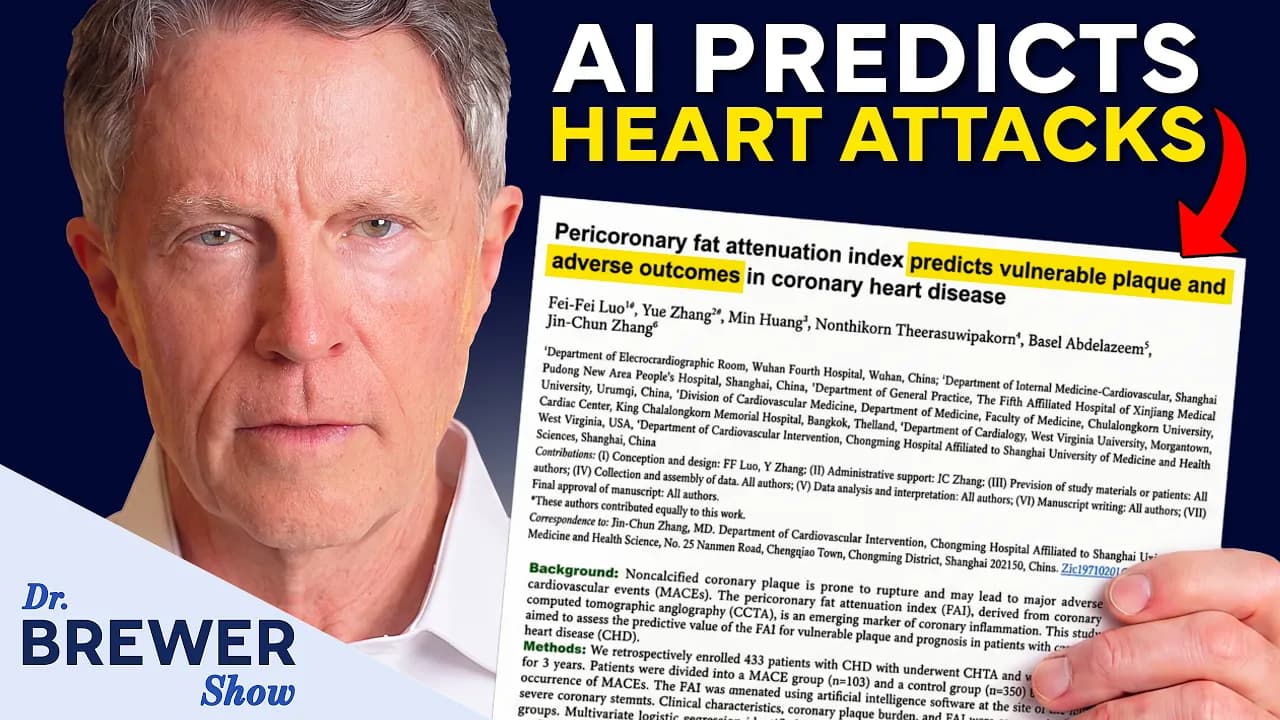
- CT angiogram with AI analysis for detailed coronary plaque visualization, though more expensive and requiring intravenous contrast
A new AI tool trained specifically on Dr. Brewer's teachings and approach to preventive medicine and cardiovascular health is nearing launch. Unlike general AI systems that pull random internet information, this application provides answers based on specific medical interpretations and teachings. A waitlist link appears in the video description for those interested in accessing this resource for personalized questions.
Patient stories provide real-world validation of the discussed approaches. Growing older presents challenges, but maintaining healthy arteries significantly improves quality of life at any age.
Keep Thomas Fordham Brewer MD MPH in your library
Save the videos and channels worth coming back to, and find them again in one place.