Michael Burry Called It: AI Bubble About to Explode?
In a Nutshell
Michael Burry warns that AI stocks mirror the housing bubble's irrational exuberance, with "AI will never fall" rhetoric replacing "homes never fall." He argues the real challenge is implementing agentic AI at scale, while companies overinvest and pass costs to consumers through higher prices. The takeaway is to hold cash at current overbought levels to buy quality names during an expected 10-20% correction rather than chase momentum.
These notes were generated by AI and may contain inaccuracies.
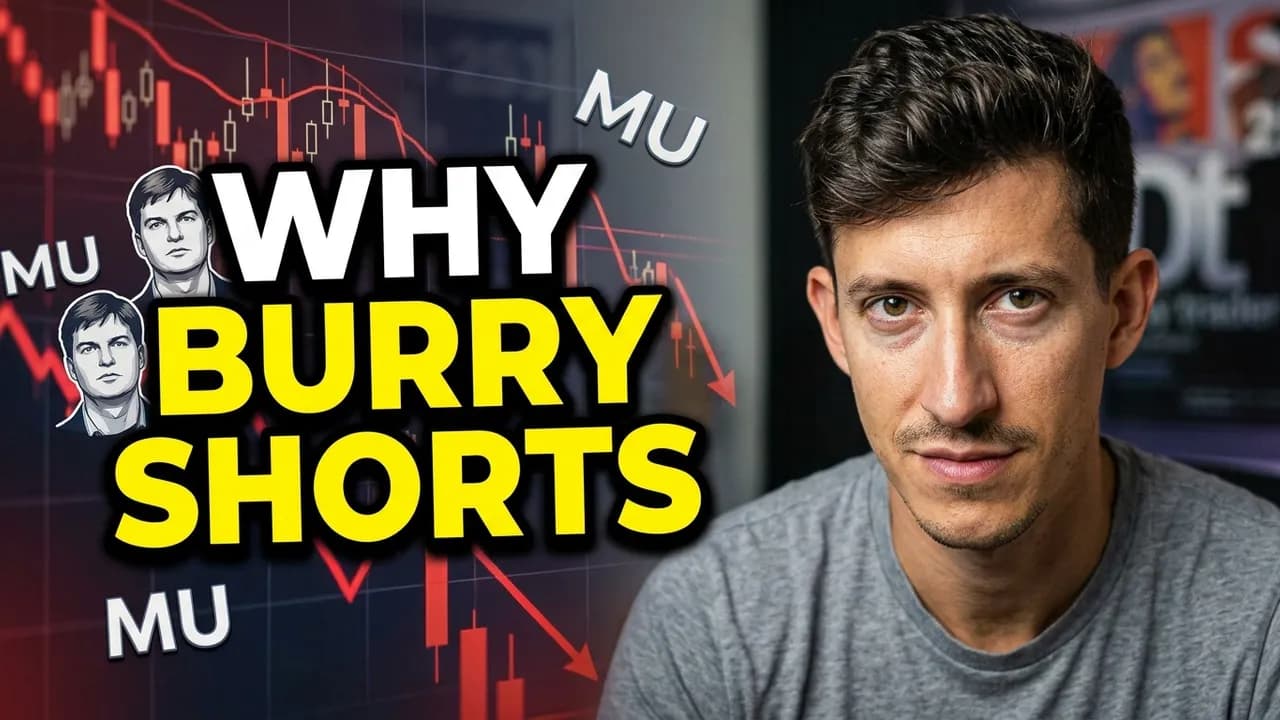
Michael Burry is comparing the current AI boom to the housing bubble that preceded the 2008 crash. He highlighted the rhetoric from 1999 before the housing crash that claimed "home prices never fall," and contrasted it with similar statements being made about AI stocks today. Burry shared phrases like "Buy five houses. Are you both dumb and blind?" and mocked current AI stock mantras such as "AI stocks the moon," "Paper hands," "BTFD," and "Buy the F and dip. Never sell stocks."
Michael Burry made his name and hundreds of millions for investors by betting against the housing market before the 2008 crash. As of last year, he no longer runs his Scion investment fund and no longer needs to report to the SEC. His current views are known through his Substack where he shares his investment thesis. His recent focus has been on AI stocks that have become very overbought in a short period of time.
Burry stated that agentic AI is difficult to implement at scale and in production because new systems need to be built that have never existed before. He emphasized this implementation challenge is the actual hard part and explains why huge success stories have not yet emerged. Every company is trying to figure this out. Burry noted that the demand layer is not the problem, but what is happening at the finance layer is interesting and could be problematic.
The host presents Burry's comments as a red flag but not necessarily a signal to short AI stocks. Direction remains important in trading and investing. Markets can stay rational longer than investors can stay solvent. The host references fusion companies from last year that were among the best performing stocks but have since declined sharply.
Oaklo went from $17 per share to highs of $193 last year, making it one of the best performing stocks. It is now trading at 52-week lows of $48, representing a decline of over 75% from its peak. The host notes this is not a direct comparison to AI stocks since AI has real demand and usefulness, but questions whether AI is as useful as the expensive companies are overinvesting.
AI is being described as inflationary. Apple and Microsoft have announced price increases for popular products due to AI and memory chip price increases. This means AI investments are more expensive for companies while also making products more expensive for consumers, despite claims of greater efficiency.
Burry shared the statement: "I will never buy cyclicals at low PE ratios and record earnings." The host notes that every crash in history is different and never exactly repeats the past. Michael Burry's warnings should be viewed as red flags warranting caution at overbought levels rather than definitive predictions.
Micron went from $1300 to lows of $8.90, representing significant volatility. The host notes that AI remains one of the best performing asset classes of 2025 and 2026, and two things can be true simultaneously: there is real demand, yet overleveraging at overbought levels carries risk. A 33% pullback occurred in some cases.
A correction does not mean a full-blown crash. The NASDAQ could drop 10-20%, with the most overvalued stocks like Micron, SanDisk, and Intel correcting harder. Long-term investors should not be offended by pullbacks. Only those who overleveraged at overbought levels and face margin calls or lack cash to buy the dip get hurt. Crypto investors who bought Bitcoin at $126,000 and urged others to buy have been liquidated and cannot buy at oversold levels.
Every market in history has large runs followed by corrections. The goal is to prepare at overbought levels by holding cash to buy quality companies at cheaper prices during pullbacks. Michael Burry is not always correct. His top pick Adobe has lost 63% over the past 5 years, showing he has made investments that underperformed.
SK Hynix conducted the second largest share sale in history behind only SpaceX. This memory chip stock went public in the US market recently. The timing raises questions about whether companies are raising maximum capital during elevated valuations because they know the good timing may not last.
Conor McGregor has not fought since the S&P 500 was at 4,300. Today it sits at 7,500. Netflix is trading near 52-week lows ahead of its earnings report this week. The host recommends investing money rather than sitting on the sidelines, and suggests that for those uncomfortable with individual stock volatility, investing in non-leveraged ETFs like the NASDAQ or S&P 500 provides diversification. These indexes may be boring but offer lower volatility than single stocks like Micron that can drop 20-30%.
Keep Ricky Gutierrez in your library
Save the videos and channels worth coming back to, and find them again in one place.